Oko Immanuel
Petroleum / Subsea Engineer
Founder, Offshore Pipeline Insight
Texas A&M Alumnus.
March 08, 2026
The land drilling rig fleet in North America (primarily US shale plays) is undergoing its most significant modernization wave since the 2014–2015 downturn. In 2026, operators and drilling contractors are prioritizing walking/multi-well pad rigs, super-spec AC rigs (1,500+ hp, advanced automation), and electrification (diesel → grid → hybrid systems) to reduce emissions, lower fuel costs, improve pad efficiency, and meet ESG pressures while maintaining or increasing drilling performance.
This technical blog examines the key modernization trends, their engineering implications, and real-world deployment signals in 2026.
1. Walking Rigs & Multi-Well Pad LayoutsWalking rigs (also called walking systems or skidding systems) allow the rig to move between wellheads on a single pad without rig-down/rig-up, enabling simultaneous or sequential drilling/fracking on 8–24+ wells per pad.
Key engineering features (2026 standard super-spec walking rig)
- Walking mechanism: Hydraulic or electric cylinders + steel pads/rollers; longitudinal & lateral movement up to 50–80 ft.
- Pad layout optimization: Centralized power house, mud system, and control room; wells spaced 10–20 ft apart; helipad/service access lanes.
- Benefits: 30–50% reduction in rig move time; lower HSE exposure; higher pad density (up to 24 wells/pad in Permian).
- 2026 trends: ~70–80% of new/delivered rigs in Permian/Delaware are walking-capable; older cantilever rigs being retrofitted.
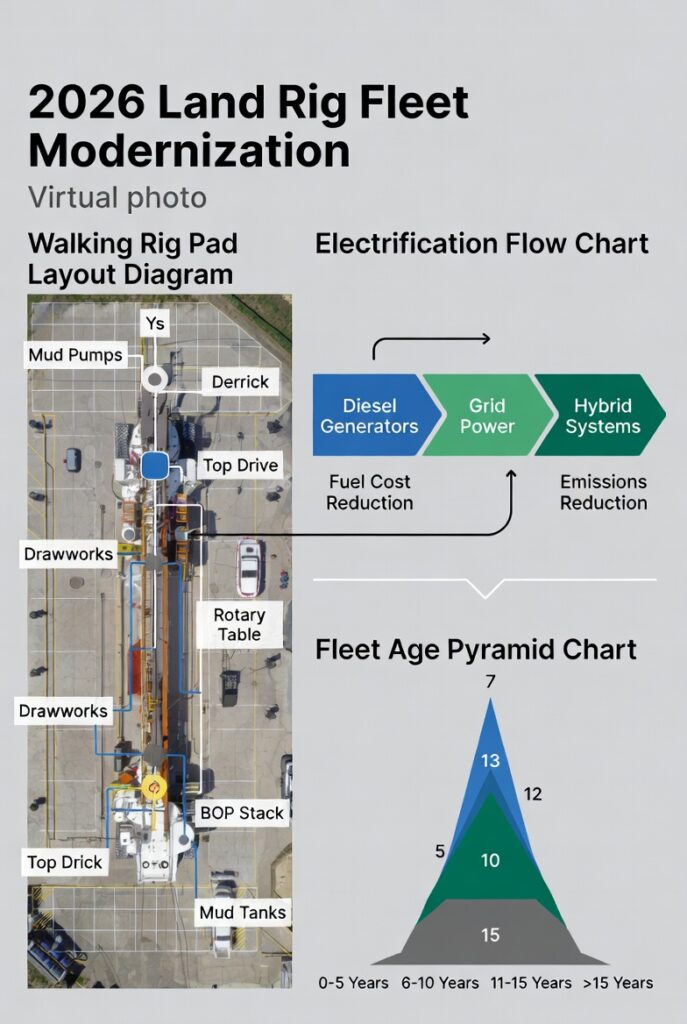
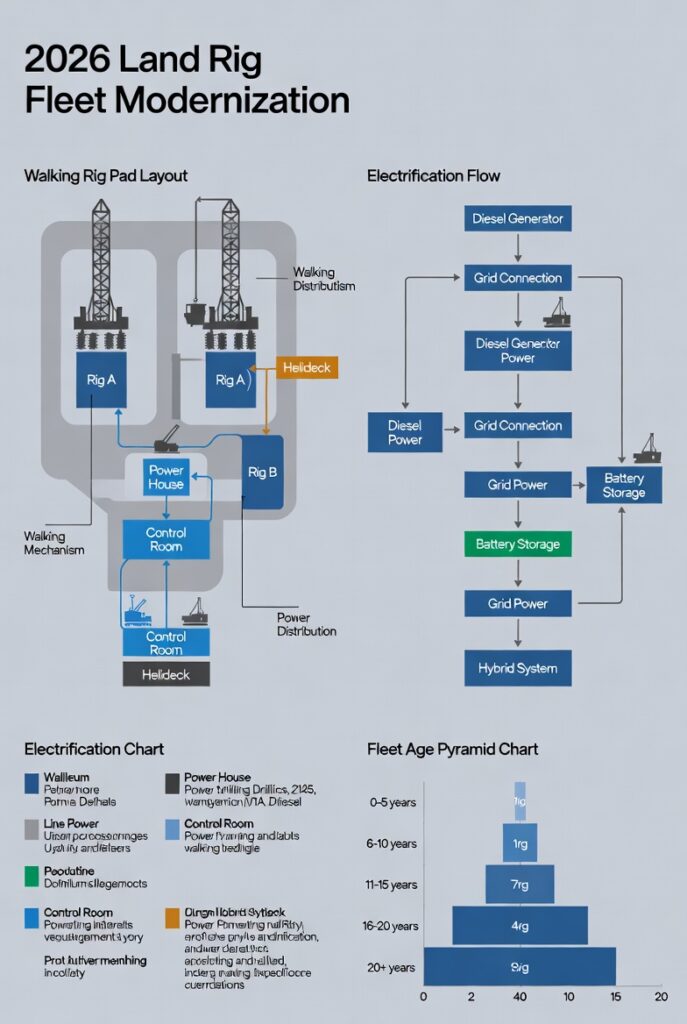
This diagram shows a typical 2026 walking rig pad layout (Permian-style, 12–16 well pad):
2. Super-Spec AC RigsModern super-spec rigs (AC drive, 1,500–2,000 hp draw works, 7,500 psi mud pumps, top drive, automated pipe handling) are now the standard for Tier 1 acreage.
2026 characteristics:
- Drawworks & top drive: 1,500–2,000 hp AC; 37,500–50,000 ft-lb torque top drives.
- Automation: Iron roughneck, auto-traction, pipe racking, real-time torque/drag monitoring.
- Fleet share: ~60–70% of active US land rigs are now super-spec (up from ~40% in 2020).
- Benefits: Faster ROP (rate of penetration), longer laterals, better well control, reduced NPT (non-productive time).
3. Electrification Trends: Diesel → Grid → HybridEmissions reduction and fuel cost savings are driving rig power modernization.Electrification pathway (2026 adoption stage
- Stage 1 – Diesel-only (legacy baseline): High fuel use, emissions ~200–300 tCO₂/rig-year
- Stage 2 – Grid connection: Direct tie-in to local grid (where available); 30–50% emissions cut; requires substation/transmission upgrades.
- Stage 3 – Hybrid (diesel + battery + grid): Battery storage (1–2 MWh) + diesel gensets + grid tie; peak shaving, spinning reserve; 50–70% emissions reduction.
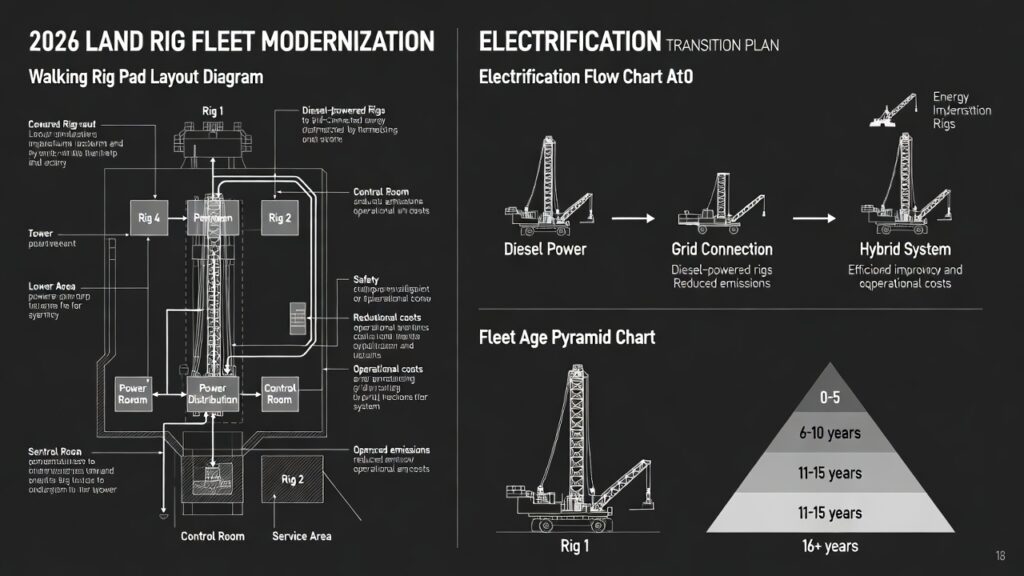
This flowchart illustrates the 2026 land rig electrification transition
Fleet age pyramid (US land rig fleet, approximate 2026 distribution)
- 0–5 years: ~15–20% (mostly newbuild super-spec walking/hybrid rigs)
- 6–10 years: ~25–30% (retrofits common)
- 11–15 years: ~30–35% (still active but lower utilization)
- 15 years: ~20–25% (legacy diesel-only, being phased out)
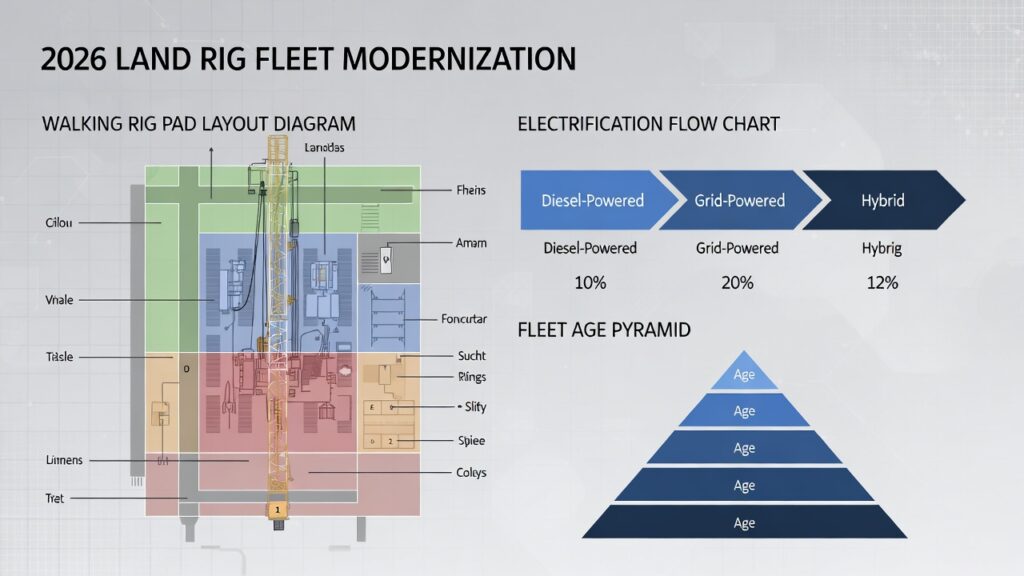
This pyramid chart visualizes the age distribution and modernization pressure:
Integrity & Engineering Implications in 2026
- Walking systems: Increased cyclic loading on substructure, mast, and foundation; fatigue monitoring essential.
- Electrification: Power quality issues (harmonics), cable management on walking rigs, battery safety (thermal runaway risk).
- Super-spec rigs: Higher torque/top drive loads → accelerated drill pipe fatigue; real-time fatigue tracking now standard.
- Overall: Digital twins and AI anomaly detection expanding from offshore to onshore rigs for predictive maintenance.
Closing Thoughts
The 2026 land rig fleet is modernizing rapidly: walking systems for pad efficiency, super-spec rigs for performance, and electrification for ESG and cost. These upgrades bring new integrity challenges (fatigue, power quality) but also opportunities for digitalization and cross-domain learning from offshore practices.For drilling engineers, 2026 is about optimizing high-spec assets while preparing for full electrification.
What land rig modernization trends are you seeing in your basin?
Share in the comments!
Oko Immanuel
Petroleum / Subsea Engineer
Founder, Offshore Pipeline Insight
Texas A&M Alumnus.
March 08, 2026
Author’s Contact: oko@offshorepipelineinsight.com