By Oko
Founder, Offshore Pipeline Insight
March 15, 2026
In the high-stakes world of offshore oil and gas, asset health & monitoring has evolved from periodic inspections to continuous, predictive, data-driven intelligence. In 2026, with aging infrastructure, rising operational costs, and ESG pressures, operators are deploying integrated systems to monitor production in real time, assess asset condition, optimize performance, reduce inefficiencies, avoid unplanned downtime, and maintain flexibility for dynamic reservoir and market conditions.
This technical blog outlines the core pillars of modern asset health & monitoring, key technologies, and their impact on offshore operations, with visuals to illustrate implementation.
1. Core Objectives of Asset Health & Monitoring
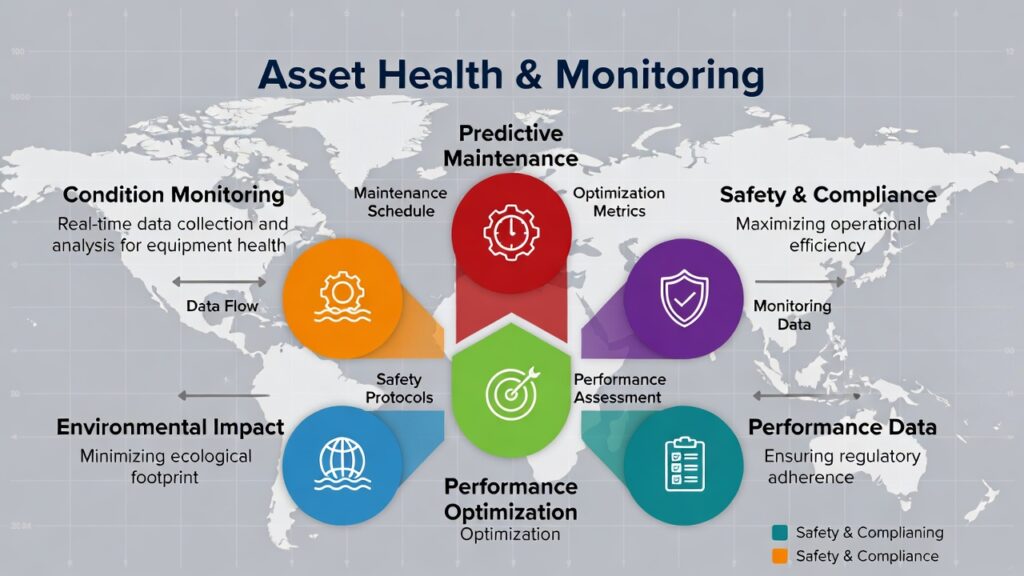
Effective systems target five interconnected goals:
- Monitor Production : Track flow rates, pressures, temperatures, and composition continuously.
- Monitor Assets : Assess integrity of wells, pipelines, subsea equipment, risers, and topsides (corrosion, fatigue, vibration, leaks).
- Optimize Assets : Adjust choke settings, lift gas rates, ESP speeds, or injection profiles for maximum recovery and efficiency.
- Reduce Inefficiencies : Identify bottlenecks, energy waste, and suboptimal operations (e.g., slugging, hydrate formation).
- Avoid Unplanned Downtime : Predict failures before they occur, shifting from reactive to predictive/proactive maintenance.
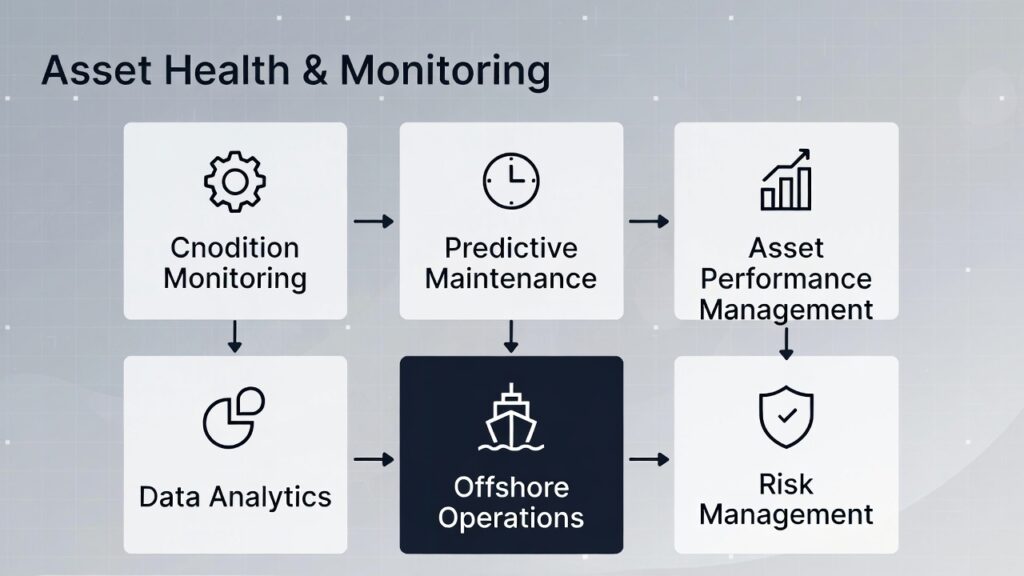
These objectives are achieved through a layered approach: sensors → edge processing → cloud analytics → decision support.
Visual: Infographic showing the five pillars of asset health & monitoring and their interconnections in offshore operations.
2. Key Technologies Powering Asset Health & Monitoring
- Permanent Downhole Gauges (PDGs) & Fiber-Optic Sensing
Real-time pressure, temperature, and distributed acoustic/temperature sensing (DAS/DTS) along the wellbore and flowlines for production and integrity insights. - Subsea & Topsides Sensors + IoT
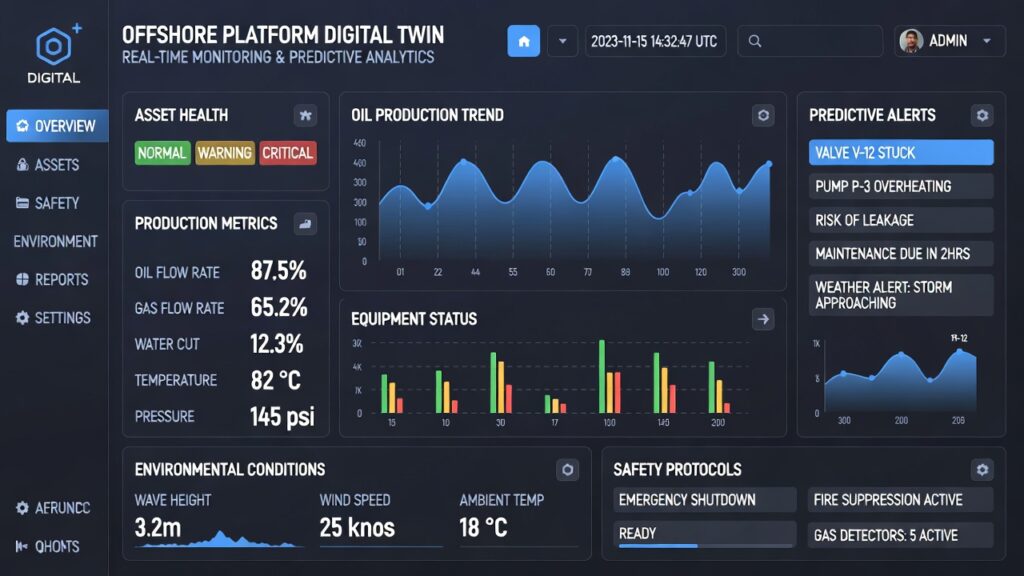
Vibration, corrosion, acoustic emission, and pressure sensors on trees, manifolds, risers, and pumps. IoT connectivity enables remote monitoring. - Digital Twins & Predictive Analytics
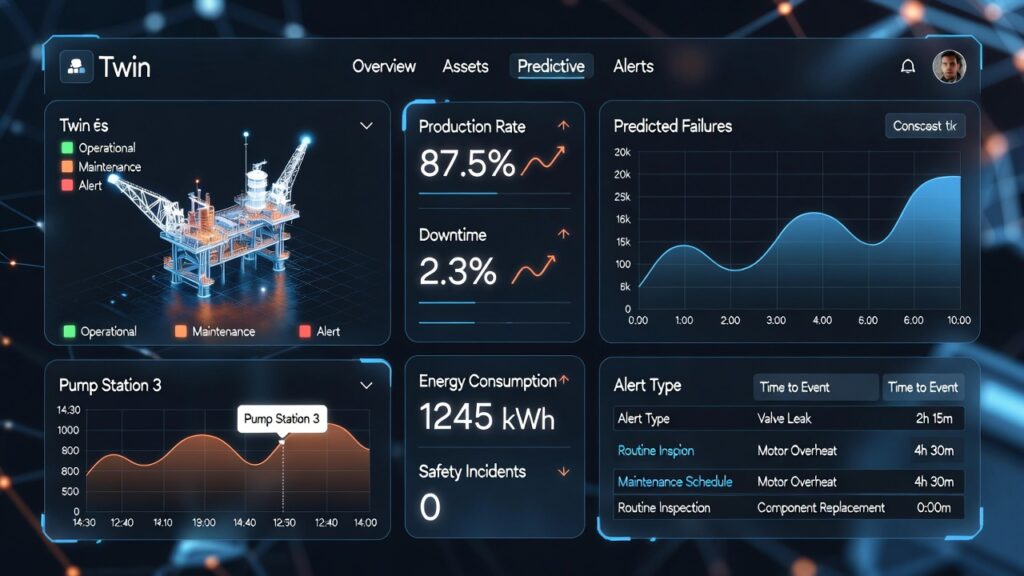
Virtual replicas of assets integrate live data with physics-based models and AI to simulate scenarios, predict failures, and recommend optimizations. - Edge Computing & AI/ML
On-platform processing reduces latency; machine learning detects anomalies (e.g., unusual vibration patterns) and flags potential issues. - Condition-Based & Predictive Maintenance
Combines historical failure data, real-time metrics, and external factors (weather, currents) to schedule interventions only when needed.
Visual: Digital twin dashboard displaying real-time asset monitoring, production metrics, and predictive alerts for an offshore platform.
3. Reducing Inefficiencies & Avoiding Unplanned DowntimeUnplanned downtime in offshore operations can cost $1–10 million per day. Modern monitoring delivers:
- Early Anomaly Detection — AI identifies deviations (e.g., pressure drops indicating hydrate risk) hours or days before failure.
- Root-Cause Analysis — Correlates multiple data streams (vibration + temperature + flow) to pinpoint issues (e.g., pump cavitation, valve sticking).
- Optimization Loops — Closed-loop control adjusts parameters automatically (e.g., gas lift rates) to maintain peak efficiency.
- Flexibility & Resilience — Systems adapt to changing reservoir conditions, weather, or market prices (e.g., ramping production or switching wells).
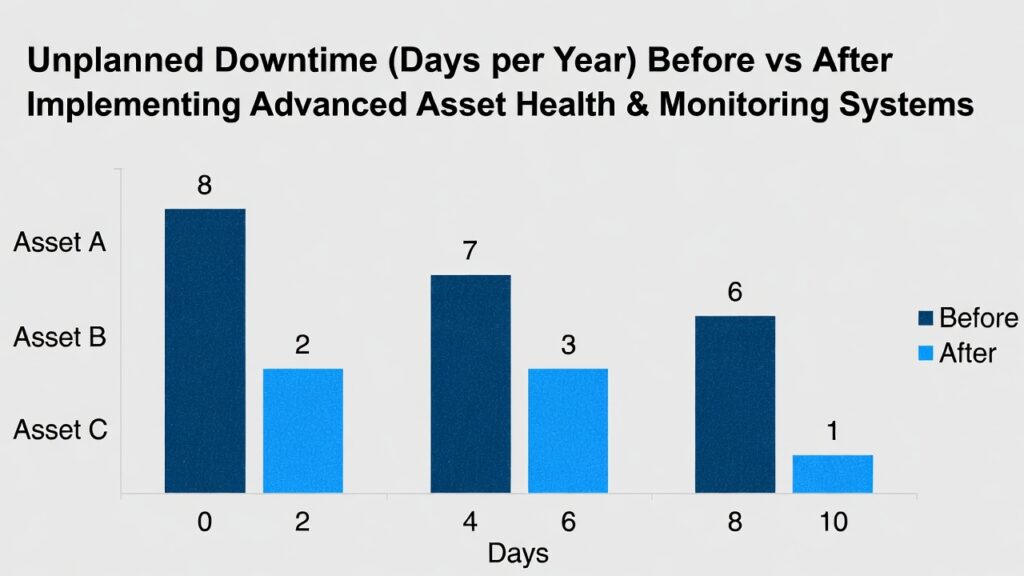
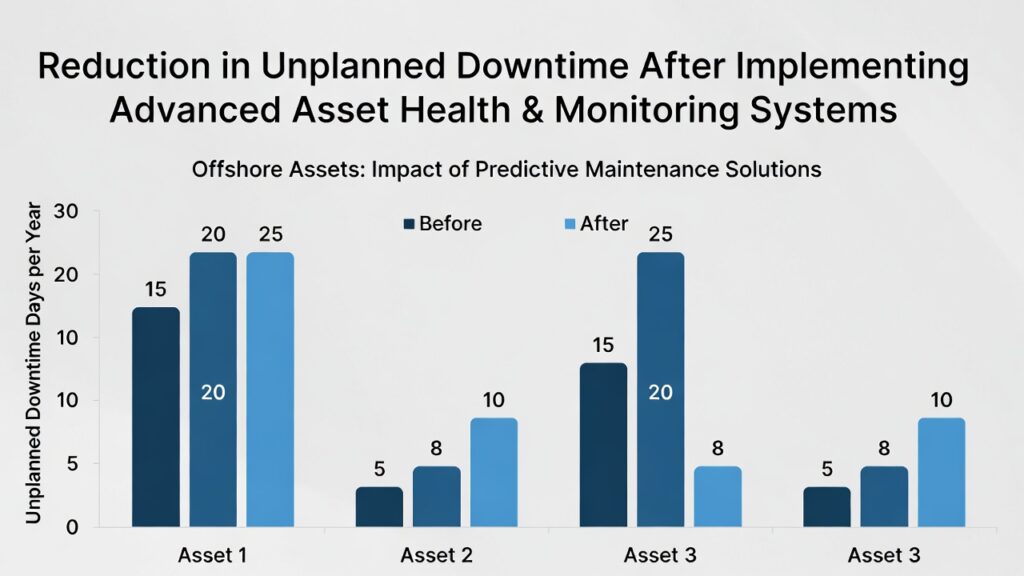
Industry benchmarks show 20–50% reductions in unplanned downtime and 5–15% production gains from optimized asset health programs.
Visual: Bar chart comparing unplanned downtime days per year before and after implementing advanced asset health & monitoring systems on offshore assets.
4. Real-World Impact: North Sea & Gulf of Mexico Examples
- North Sea (Equinor & Partners): Digital twin + fiber-optic monitoring on mature fields reduced unplanned interventions by ~35% and increased recovery by 2–4% through optimized well performance.
- Gulf of Mexico Deepwater: Permanent gauges + predictive analytics prevented multiple ESP failures, saving millions in workover costs and avoiding production losses.
Conclusion: The Future Is Predictive & AutonomousI
n 2026, asset health & monitoring is no longer a support function it’s a core driver of value. By continuously monitoring production and assets, optimizing performance in real time, reducing inefficiencies, avoiding costly downtime, and enabling flexibility, operators achieve higher recovery, lower costs, and stronger ESG performance.For offshore professionals:
Which monitoring technology has delivered the biggest uptime or production gain on your assets?
Share your experience in the comments!