By Oko Immanuel, M.Eng – Founder, Offshore Pipeline Insight
March 18, 2026
High-Pressure High-Temperature (HPHT) reservoirs continue to push the boundaries of offshore engineering in 2026. With pressures exceeding 15,000–20,000 psi and bottomhole temperatures often >300–350°F, these environments demand specialized subsea equipment, advanced materials, and rigorous integrity management. Two standout examples illustrate the progress: Chevron’s Anchor project in the Gulf of Mexico (GoM) the industry’s first operational 20K deepwater HPHT development and ongoing HPHT advancements in the North Sea, where operators like Equinor, Wellesley, and others are accelerating exploration and development in extreme conditions.
These projects highlight how 20K-rated subsea trees, HPHT casing strings, thermal management, and real-time monitoring are unlocking previously inaccessible resources while maintaining safety and environmental standards.
Chevron Anchor: Industry-First 20K Deepwater HPHT Production
Launched in August 2024 after FID in 2019, Anchor (Green Canyon area, ~5,000 ft water depth) marked a breakthrough as the first deepwater project with equipment rated for 20,000 psi and reservoir depths reaching ~34,000 ft subsea. By 2026, production continues ramping toward the semi-submersible FPU’s 75,000 gross bopd capacity (with 28 MMcf/d gas), contributing to Chevron’s expected 300,000 net boe/d GoM output.
- Key technical features:
- Seven subsea wells tied back to the Anchor FPU.
- 20K-rated subsea trees, manifolds, and flowlines handle extreme pressures/temperatures.
- Advanced completion designs with HPHT casing strings (e.g., high-strength alloys for burst/collapse resistance).
- Subsea boosting and flow assurance to manage thermal gradients and hydrate risks.
- Production life: Up to 30 years, with ~440 MMboe recoverable resources.
Anchor’s success relies on rigorous qualification of 20K equipment (e.g., through I3P verification) and integration with existing GoM infrastructure, proving the viability of ultra-HPHT tiebacks.
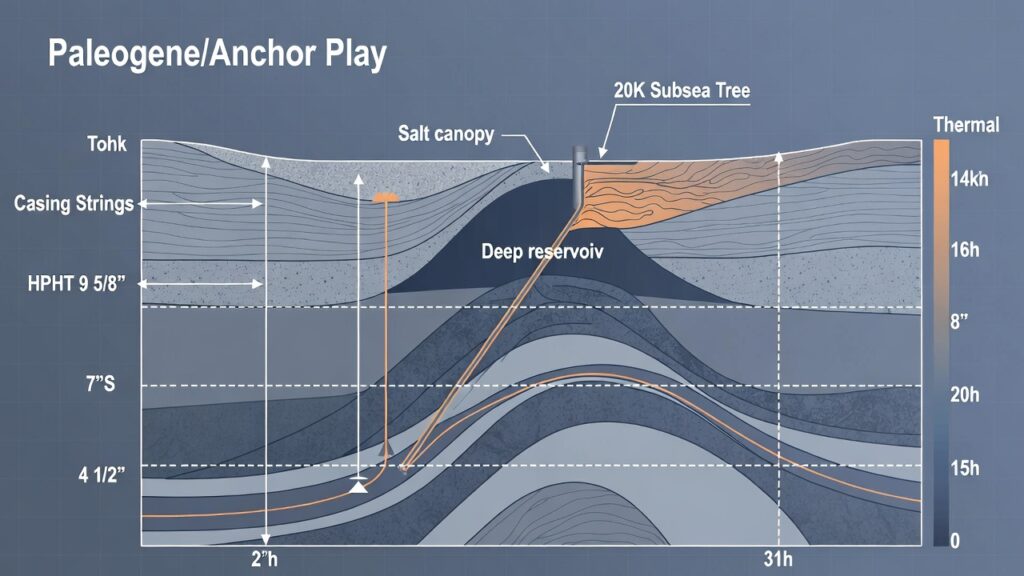
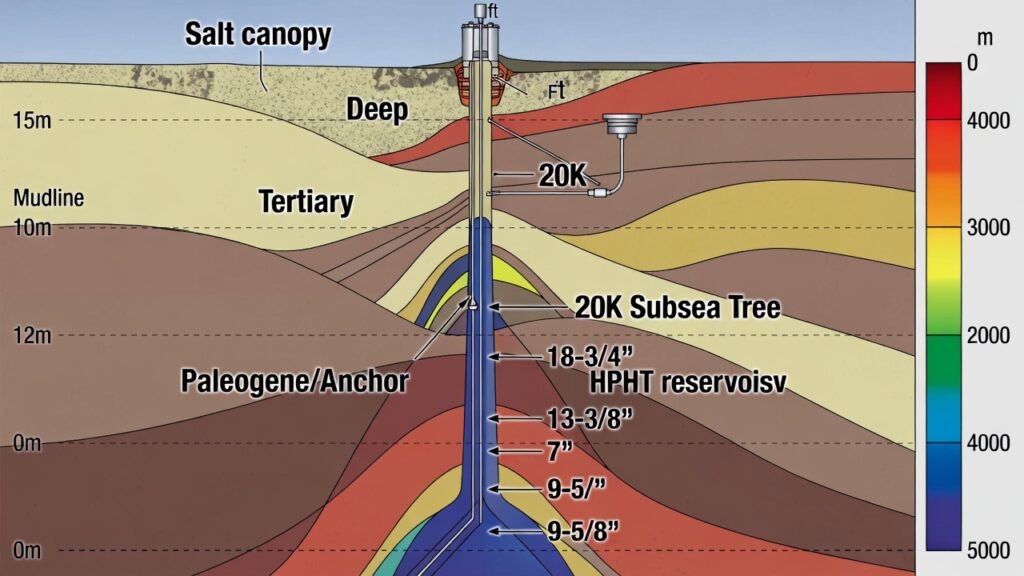
Figure 1: Geological cross-section of the Paleogene/Anchor play
(Showing salt canopy, deep reservoir, 20K subsea tree, HPHT casing strings, thermal/pressure gradients, and well path.)
North Sea HPHT Developments: Accelerating Exploration & Production in 2026
The North Sea remains a mature basin with ongoing HPHT focus, particularly in Norway’s Central Graben and UKCS areas. In 2026, Equinor and Wellesley launched a major Joint Exploration Project (JEP) targeting up to 15 HPHT exploration wells from 2027–2030 on the Norwegian Continental Shelf (NCS). This builds on recent successes like high departure HPHT wells and discoveries in Sleipner/Lofn areas.
- Key technical trends:
- HPHT wells reaching >4,600 m measured depth (e.g., Lofn 15/5-8 S at 4,636 m MD, 4,319 m TVDSS).
- Advanced drilling (e.g., Deepsea Atlantic rig) with MPD for narrow pressure windows.
- Subsea completions with HPHT-rated equipment (trees, packers, bridge plugs).
- Focus on near-field prospects via high-departure wells and OBN seismic for better imaging.
- Intervention tech like multiset well plugs and electric setting tools for HPHT environments.
North Sea HPHT emphasizes rapid tiebacks to existing infrastructure, low-emission operations, and digital twins for integrity monitoring—aligning with energy transition goals.
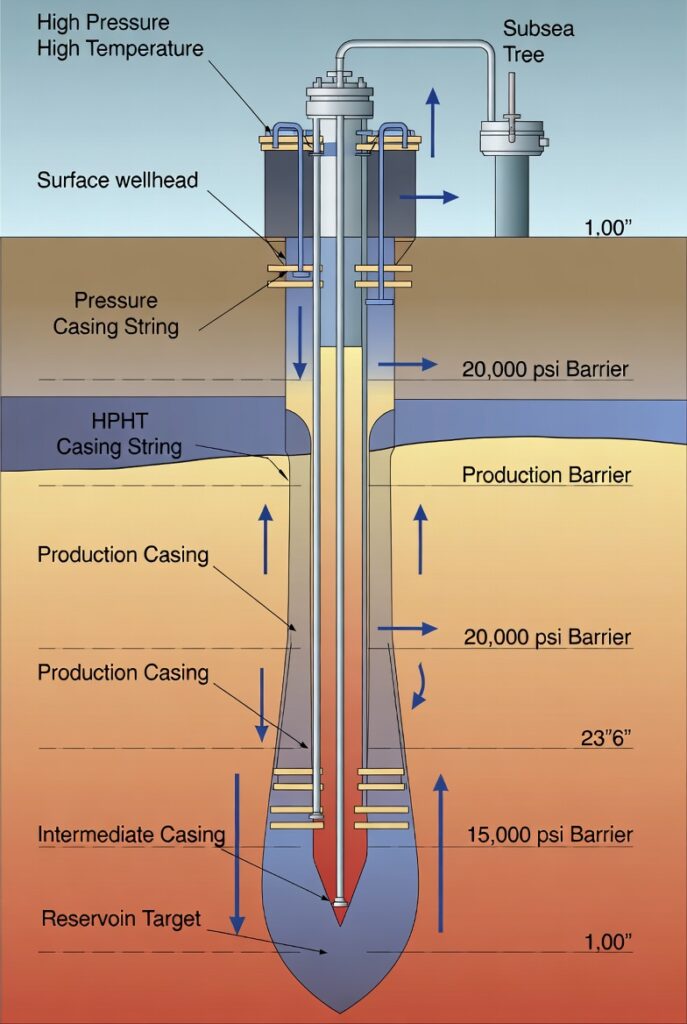
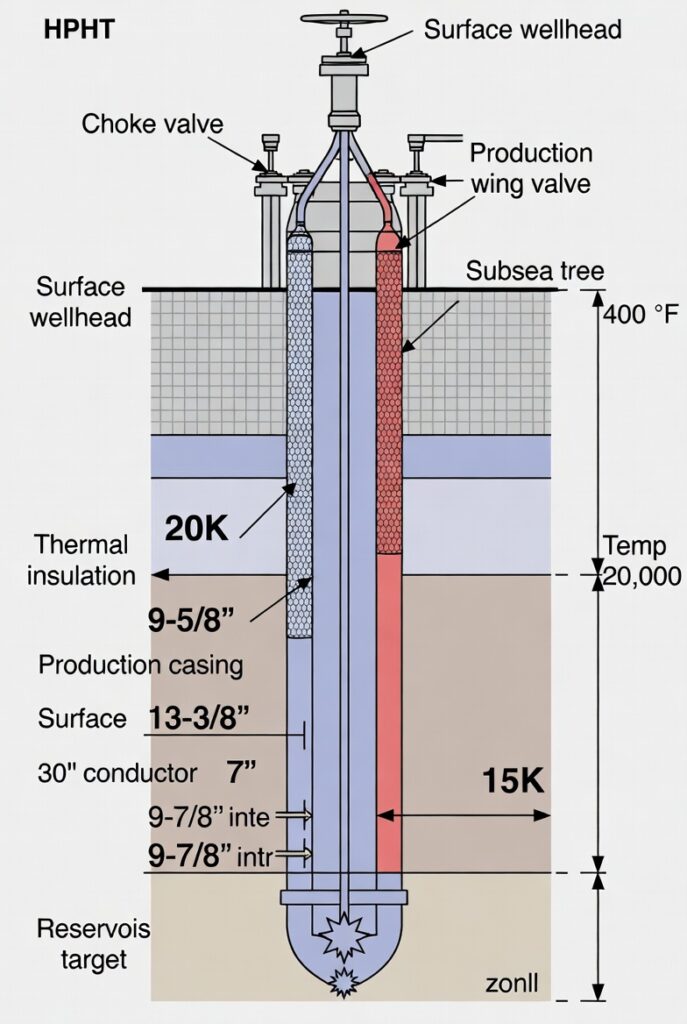
Figure 2: Typical HPHT well schematic (North Sea style)
(Showing surface/subsea tree, HPHT casing strings, pressure/temperature gradients, and reservoir target.)(Insert placeholder or use generated image if available; typical cross-sections show 20K/15K barriers, thermal insulation, and gradient labels.)
Enabling Technologies Across Both Regions
- 20K subsea trees & manifolds Handle 20,000 psi + 350°F+ (e.g., fatigue-resistant designs).
- HPHT casing & completion strings High-collapse alloys, premium connections for burst/thermal cycling.
- Thermal/pressure management Insulation, annulus pressure relief, real-time monitoring.
- Drilling & intervention MPD, high-departure trajectories, I3P-qualified equipment.
These advancements reduce conservatism in design, cut intervention risks, and extend field life in extreme HPHT plays.The Bottom Line for 2026
Anchor and North Sea HPHT efforts demonstrate that 20K tech is mature enough for commercial scale. The GoM and North Sea are leading the way in unlocking deep, hot, high-pressure reservoirs delivering energy security while advancing safety and sustainability.
What HPHT challenges are you facing in deepwater or North Sea ops?
Comment below or connect on LinkedIn let’s exchange field insights.Stay sharp, brothers. The deepest plays are yielding to innovation.
Oko Immanuel
Subsea Engineering Specialist | Offshore Pipeline Insight