By Oko Immanuel, M.Eng – Founder, Offshore Pipeline Insight
March 19, 2026
In 2026, energy security is no longer a binary choice between hydrocarbons and renewables—it’s a strategic balancing act. Extreme hydrocarbon developments (ultra-deepwater HPHT, Arctic, shale gas) remain essential for baseload supply and energy independence, while offshore wind (especially floating and maritime-integrated) is scaling rapidly to meet net-zero targets and diversify supply chains.
The real story is synergy: shared infrastructure, overlapping basins, cross-industry expertise, and co-location opportunities are enabling a hybrid offshore energy model that strengthens security rather than diluting it.
1. Extreme Hydrocarbons Still Anchor Security
Despite the energy transition narrative, extreme hydrocarbon plays are delivering material volumes and low-cost supply in 2026.
- Ultra-deepwater HPHT (GoM, Brazil, Guyana): Projects like Chevron Anchor (20K psi), BP Kaskida (sanctioned 2026), and ExxonMobil’s Guyana Stabroek ramp-up are adding hundreds of thousands of barrels per day with breakevens < $40/bbl.
- Arctic & high-latitude plays: Norway’s Barents Sea and Canada’s Flemish Pass continue to see selective exploration and tiebacks.
- Shale & tight gas: U.S. Permian and Marcellus provide swing capacity and LNG export feedstock.
These sources ensure reliable base load, buffer against geopolitical shocks, and fund the capital-intensive transition to renewables.
2. Offshore Wind: The Fast-Growing Complement
Offshore wind capacity is surging, with floating wind emerging as the key enabler for deeper waters.
- Global outlook: Installed capacity projected to exceed 100 GW by end-2026, with floating wind growing at >30% CAGR.
- Key markets: U.S. West Coast (California OCS >1,000 m depths), Northeast Atlantic, Japan, Norway, Scotland.
- Maritime synergies: Shared use of ports, vessels, subsea cables, and workforce skills from oil & gas.
Floating wind in extreme depths leverages HPHT-derived tech: dynamic cables, mooring fatigue models, subsea power distribution, and integrity monitoring.
3. Real-World Synergies Strengthening Security
The convergence is already happening across basins and infrastructure.
- Shared basins & infrastructure:
- U.S. GoM: Floating wind pilots co-locate with existing platforms (e.g., wind turbines on decommissioned rigs or hybrid hubs).
- North Sea: Equinor’s Hywind Tampen (floating wind powering oil platforms) and Dogger Bank extensions demonstrate hybrid operations.
- Namibia & Brazil: Orange Basin and Santos Basin exploration overlaps with future floating wind potential.
- Subsea & cable synergies:
- HPHT flowline insulation and thermal modeling → applied to subsea export cables for wind farms.
- Subsea boosting/compression → future subsea energy storage or hydrogen hubs.
- Workforce & expertise transfer:
- HPHT subsea engineers → design dynamic cables and moorings.
- ROV/AUV operators → inspect wind foundations and cables.
- Maritime wind hubs:
- Offshore wind farms as “energy islands” with co-located hydrogen production, battery storage, or data centers powered by both wind and nearby hydrocarbon tie-ins.
Figure 1: Offshore Energy Synergy Map – 2026 Basins
(Insert image: World map highlighting shared basins (U.S. GoM, North Sea, Namibia Orange Basin, Brazil Santos/Campos, Guyana-Suriname) with icons for HPHT wells, floating wind farms, subsea cables, and hybrid hubs. Color-coded arrows showing tech/expertise transfer.)
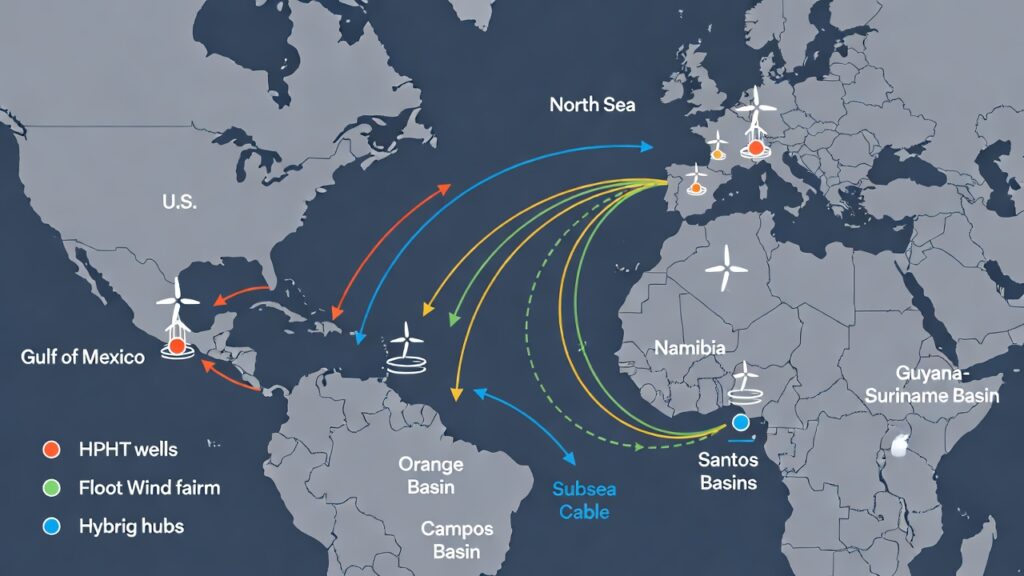
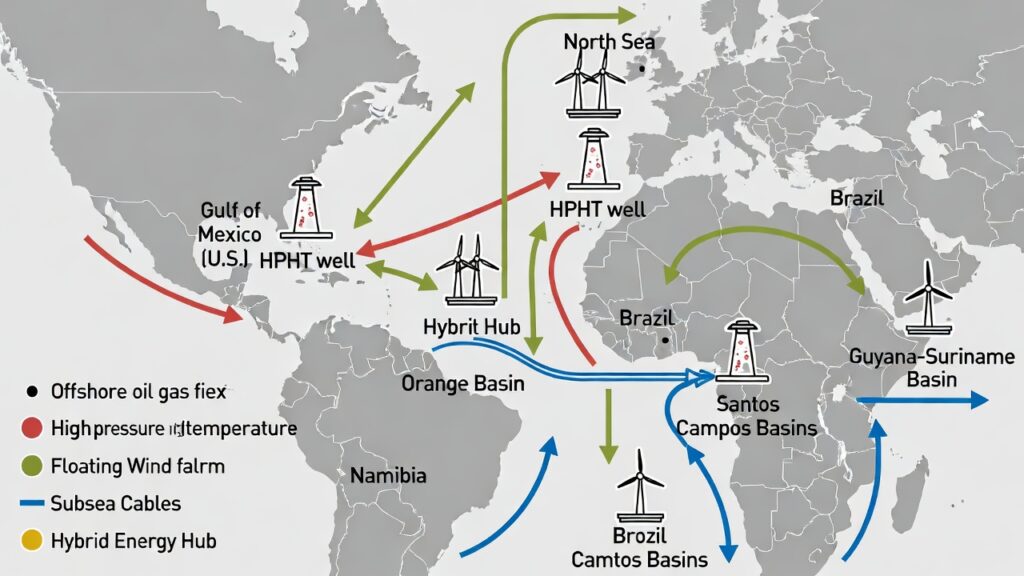
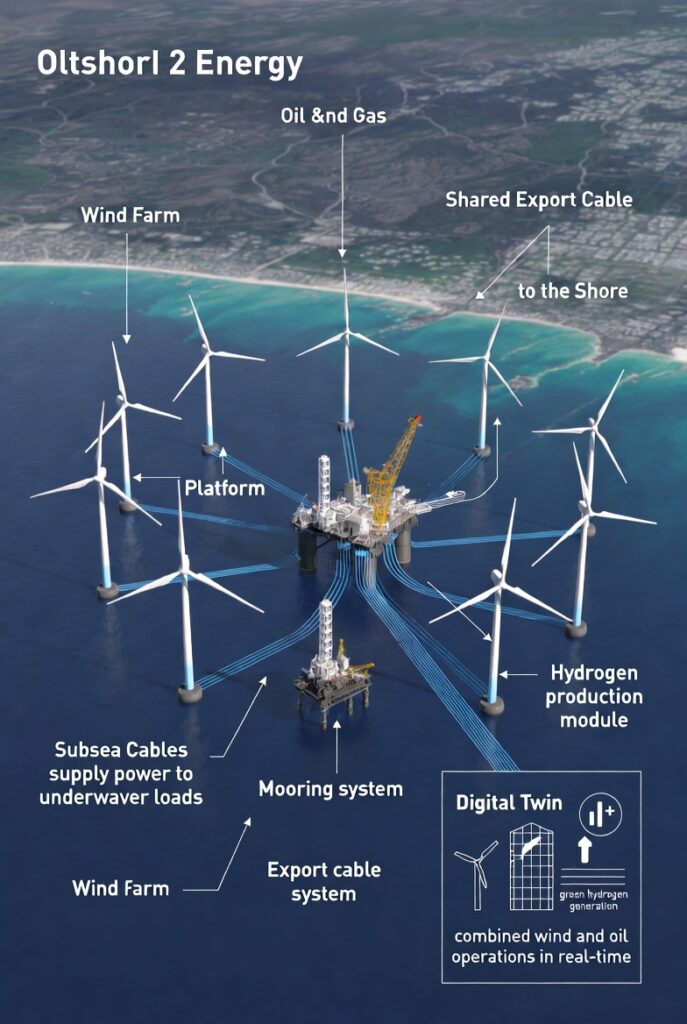
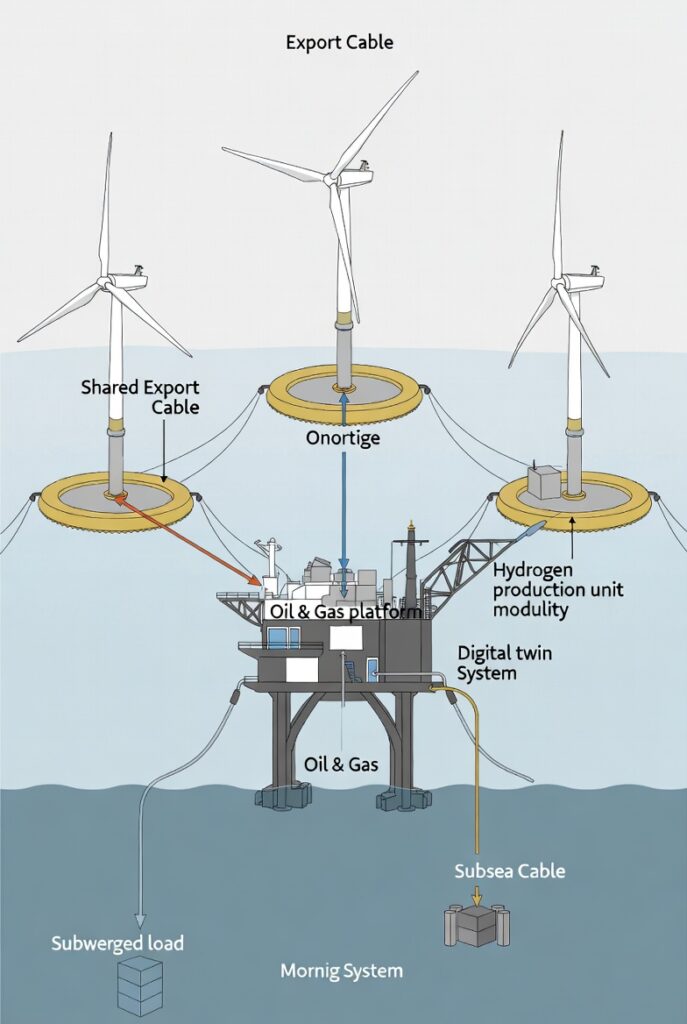
Figure 2: Hybrid Offshore Energy Hub Concept
(Insert image: Conceptual diagram of a floating wind farm co-located with an oil & gas platform: wind turbines powering subsea loads, shared export cable, mooring synergy, hydrogen production module, and digital twin monitoring.)
Energy Security Implications in 2026
- Diversification: Extreme hydrocarbons provide dispatchable baseload; offshore wind adds renewable volume and reduces import dependence.
- Resilience: Hybrid hubs (wind + gas/CO₂ storage) buffer against intermittency and geopolitical risks.
- Cost & efficiency: Shared infrastructure (cables, ports, vessels) lowers LCOE for wind and extends life of hydrocarbon assets.
- Transition bridge: Revenue from HPHT funds floating wind scale-up and CCS repurposing.
The result: a more secure, flexible energy system that leverages existing expertise while accelerating decarbonization.
The Bottom Line
In 2026, energy security is not about choosing between extreme hydrocarbons and offshore wind—it’s about intelligently combining them. HPHT expertise is the anchor, maritime wind is the sail, and shared basins/infrastructure are the hull carrying the transition forward.Engineers and energy professionals:
What synergies are you seeing in your basin—shared cables, workforce crossover, or hybrid hubs?
Share your thoughts in the comments or on LinkedIn.Stay sharp out there, brothers. The future is hybrid, deepwater, and secure.
Oko Immanuel
Subsea Engineering Specialist | Offshore Pipeline Insight
Think Harder