April 1, 2026 — With capital shifting back toward Gulf of Mexico upstream developments following recent policy moves like the “Offshore Swap,” many operators are accelerating subsea tie-backs especially in high-pressure high-temperature (HPHT) plays such as the Norphlet trend.These projects bring demanding flow assurance challenges: longer step-outs (often 5–20+ miles), reservoir fluids at 15,000–20,000 psi and 300–350°F+, multiphase flow with hydrate/wax risks, and the need to maintain production to existing hosts without new standalone facilities.
Here’s a practical, technical breakdown of the key strategies engineers are deploying today and what’s coming in 2026–2027.
Why HPHT Tie-Backs Are Gaining Momentum
Tie-backs remain the most capital-efficient way to develop new reservoirs.
Recent examples include:
- Chevron’s Ballymore (first oil April 2025): Three-well subsea tie-back (~3 miles) to the Blind Faith FPU in the emerging Norphlet (Upper Jurassic) play. Expected peak rates up to 75,000 bopd. This project required 20K psi-rated equipment and robust thermal management for HPHT fluids.
- Other active or near-term tie-backs: Argos Southwest Extension (BP), Dover (Shell), and upcoming phases like Silvertip and Longclaw.
Longer tie-backs increase cool-down time during shutdowns, raising risks of hydrate formation, wax deposition, and thermal expansion/contraction issues in flow lines.
Core HPHT Flow Assurance StrategiesSuccessful HPHT tie-backs combine passive and active methods. The goal is to keep arrival temperatures above critical thresholds (typically hydrate formation temperature + safety margin, and wax appearance temperature) while managing pressure, corrosion, and slugging.
1. Passive Insulation & Pipe-in-Pipe (PIP) Systems
- Wet insulation (syntactic polypropylene or polyurethane) or advanced pipe-in-pipe with aerogel or vacuum insulation keeps heat in during steady-state and transient conditions.
- For ultra-long or ultra-deep tie-backs, PIP with centralizers minimizes heat loss and handles thermal buckling via controlled expansion loops or buckle initiators.
- Design codes: API RP 1111, DNV-OS-F101, with detailed transient multiphase flow modeling (OLGA or similar) to predict cool-down curves.
2. Active Heating Technologies
- Direct Electrical Heating (DEH): Current passed through the flowline steel creates Joule heating. Proven but power-intensive; best for shorter step-outs or as backup.
- Electrically Heat-Traced Flowline (EHTF): Heating cables integrated or retrofittable along the pipe. Significantly lower power demand (10–15x less than traditional DEH in some configurations). Enables single-line tie-backs by providing targeted heating for viscosity control, hydrate prevention, and wax remediation. Recently achieved higher TRL with reeling installation techniques.
- Emerging: Post-lay heating systems (e.g., FlowHeat concept) that allow cable installation after pipeline laying via ROV — potentially reducing costs by up to 35% and enabling longer distances (up to 30–50 km target).
3. Chemical Inhibition & Management
- Low-Dosage Hydrate Inhibitors (LDHI) kinetic or anti-agglomerant reduce chemical volumes compared to thermodynamic inhibitors like methanol or MEG.
- Continuous or batch injection of wax inhibitors, corrosion inhibitors, and scale squeezes.
- For HPHT, compatibility with high temperatures and CRA materials is critical.
4. High-Integrity Pressure Protection Systems (HIPPS)
- Allows flowlines and risers to be designed to lower pressure ratings downstream of the subsea HIPPS valves, reducing wall thickness and material costs while protecting against full shut-in tubing pressure.
- Essential in many 20K psi HPHT developments.
5. Transient & Multiphase Flow Modeling
- Rigorous OLGA/LED AF simulations for startup, shutdown, blowdown, and pigging operations. Heat sharing in bundled systems is an emerging optimization for thermal management.
These strategies are discussed heavily at forums like the Subsea Tieback Forum 2026, where panels cover HPHT evolution from emerging tech to project enabler.
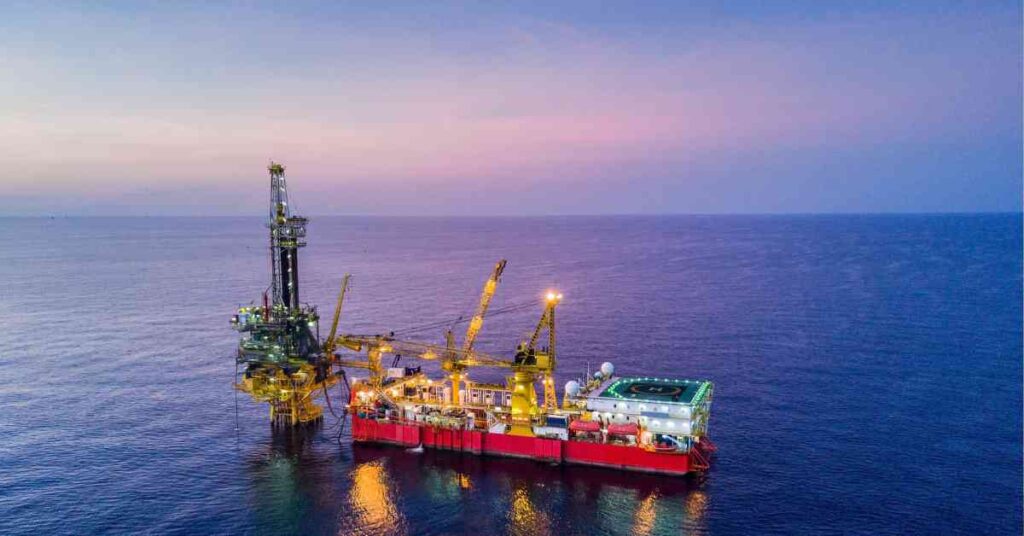
Typical Gulf of Mexico platform serving as host for multiple subsea tie-backs — the backbone for cost-effective HPHT developments.
Subsea Boosting for Long-Distance Tie-Backs
When natural reservoir pressure declines or tie-back distances increase friction losses, subsea boosting becomes the game-changer. It extends field life, unlocks marginal reservoirs, and enables longer step-outs without new hosts.
Key Technologies:
- Multiphase Pumps (MPP): Handle the full wellstream (gas volume fraction 0–100%, including solids tolerance in modern designs). Twin-screw or helico-axial types are common. Examples include Framo pumps with hundreds of thousands of operating hours globally.
- BP King Field (GoM): Two subsea multiphase pumps in ~5,600 ft water depth, 20-mile tie-back, handling high GVF.
- Wet-Gas Compressors: For gas-dominated streams; tolerate liquid fractions without full separation.
- Subsea Compression Systems: OneSubsea and others now offer multiphase-tolerant compression that can push tie-backs to 150 km range in some configurations. Boosts drawdown and overcomes pipeline pressure drop.
Benefits for Long Tie-Backs:
- Increases production rates and ultimate recovery.
- Reduces backpressure on wells.
- Enables single-line architectures when combined with active heating.
- Lower CAPEX than new hosts; faster deployment.
Integration with variable speed drives allows dynamic response to changing wellstream conditions. Power delivery for long step-outs uses high-voltage DC or advanced umbilicals.
Design Considerations:
- Materials for HPHT compatibility (CRA liners, high-strength steels).
- Sand tolerance and erosion management.
- Redundancy and intervention philosophy (e.g., light well intervention or ROV-retrievable modules).
Practical Lessons for 2026–2027 Projects
From recent GoM tie-backs like Ballymore:
- Early engagement of flow assurance in concept selection pays off — standardized equipment and repeatable designs cut costs and schedules.
- Combine insulation + selective active heating + boosting for optimal TOTEX.
- HIPPS + CRA flowlines help manage extreme pressures/temperatures economically.
- Monitor with fiber-optic DTS/DAS for real-time integrity and flow assurance data.
As electricity demand surges and operators prioritize reliable production, these technologies align perfectly with increased Gulf activity.
What’s Next?
Expect more hybrid solutions: EHTF or post-lay heating paired with multiphase boosting for ultra-long tie-backs, plus greater use of digital twins for predictive flow assurance.For pipeline engineers in the field: focus on thermal expansion analysis, piggability of heated lines, and qualification of new heating/power systems.
What challenges are you seeing in your current HPHT or long tie-back projects? Are boosting or EHTF on your radar for 2026 bids?
Drop your experiences in the comments or email me at oko@offshorepipelineinsight.com (mailto:oko@offshorepipelineinsight.com).
I’ll keep diving into these topics — next could be a closer look at 20K psi equipment qualification or flow assurance case studies from recent startups.
Oko Immanuel, M.Eng
Founder, Offshore Pipeline Insight
Texas A&M Subsea & Petroleum Engineering
Bridging Academia and the Field.