April 1 , 2026 — As Gulf of Mexico activity accelerates with redirected capital, longer subsea tie-backs, and rising natural gas demand from AI data centers and LNG exports, two technical themes stand out for pipeline and subsea engineers: subsea boosting synergies with HPHT flow assurance, and the potential knock-on effects of blue hydrogen production and exports on gas infrastructure.
Subsea boosting extends tie-back distances, unlocks marginal reserves, and pairs powerfully with insulation, active heating, and HIPPS. Meanwhile, hydrogen -primarily produced via steam methane reforming (SMR) of natural gas — could add incremental demand for feed gas while introducing new purity, compression, and pipeline material considerations.
Subsea Boosting Synergies: Enabling Longer, More Efficient HPHT Tie-Backs
Subsea boosting (multiphase pumps or wet-gas compressors) reduces back-pressure on wells, overcomes frictional losses over distance, and boosts recoverable reserves often by 10–30% or more depending on reservoir characteristics.
Key Technologies in Play:
- Multiphase Pumps (MPP): Handle mixed oil/gas/liquid streams with high gas volume fractions (GVF). Twin-screw or helico-axial designs tolerate solids and varying conditions.
- Wet-Gas Compressors: Optimized for gas-dominated streams with some liquids; ideal for gas-rich tie-backs feeding LNG or power generation.
- Recent Gulf examples include BP’s awards to SLB OneSubsea for standardized high-pressure boosting systems on Tiber and Kaskida developments, building on proven installations like the King Field (deepwater, long tie-back with multiphase pumps).
Synergies with HPHT Flow Assurance Strategies:
- Pressure Management: Boosting lowers required inlet pressure at the wellhead while HIPPS protects downstream flowlines/risers from full shut-in tubing pressure (SITP). This combination allows thinner-walled or lower-rated pipe, reducing material costs and thermal expansion issues in HPHT service (up to 20,000 psi / 350°F+).
- Thermal & Hydrate Control: Longer tie-backs (5–20+ miles, trending longer) increase cool-down risk. Subsea boosting maintains higher flow velocities, reducing residence time and helping keep temperatures above hydrate/wax appearance thresholds. Pair with:
- Pipe-in-pipe (PIP) or advanced wet insulation.
- Electrically Heat-Traced Flowlines (EHTF) or Direct Electrical Heating (DEH) for targeted remediation.
- Low-Dosage Hydrate Inhibitors (LDHI) — boosting can optimize chemical injection rates by improving mixing and transport.
- Flow Regime Optimization: Boosters help manage slugging and terrain-induced issues common in long, undulating tie-backs. When combined with real-time monitoring (fiber-optic DTS/DAS) and Agentic AI from drilling, operators achieve more predictable transient behavior during startup/shutdown/pigging.
- Overall System Efficiency: Reusing existing hosts via tie-backs (e.g., Silvertip Phase 3, Longclaw, Monument to Shenandoah FPU in 2026) spreads fixed costs and lowers carbon intensity. Boosting makes marginal or depleted reservoirs economic without new FPUs.
These synergies are particularly valuable in the current environment of capital discipline and efficiency focus — delivering more throughput with lower TOTEX while supporting higher gas volumes heading to LNG terminals or power plants.
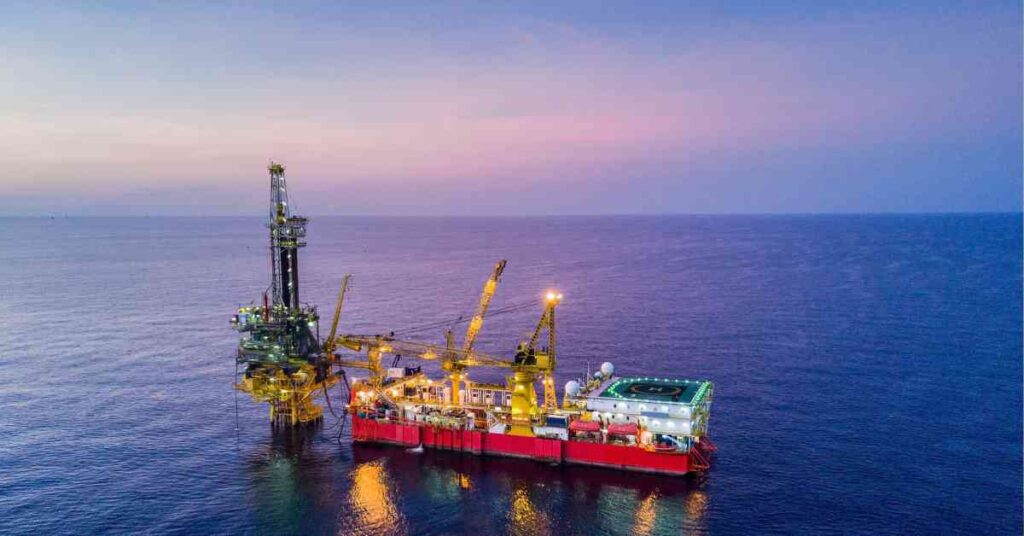
marineinsight.comGulf of Mexico platform serving as a tie-back host — where subsea boosting extends reach and pairs with HPHT flow assurance solutions.
Hydrogen Exports: Bcf/d Impact Calculations on Natural Gas Infrastructure
Blue hydrogen (produced from natural gas via SMR or autothermal reforming + carbon capture) is gaining attention as a low-carbon molecule for export or domestic use. While large-scale hydrogen exports from the U.S. are still emerging (most current focus is on domestic industrial/power use or ammonia carriers), the gas demand implications are calculable.
Basic Conversion Factors (Approximate):
- 1 kg of hydrogen (H₂) requires roughly 9.5–10.5 kg (or ~0.45–0.50 Mscf) of natural gas feedstock via efficient SMR, depending on process efficiency and whether co-product steam is utilized.
- Energy content: 1 kg H₂ ≈ 1.0–1.2 Mscf natural gas equivalent on a lower heating value (LHV) basis, but actual feedstock consumption is higher due to process energy needs.
- Volumetric: Producing 1 Bcf/d of hydrogen (as gas) would require roughly 4–6 Bcf/d or more of natural gas input (including process fuel), before accounting for CCS energy penalties. In practice, most hydrogen export concepts use ammonia (NH₃) or liquid organic hydrogen carriers (LOHC) as vectors, which changes the numbers slightly but still ties back to natural gas reforming.
Potential Scale and Pipeline Impact (2026–2030 Horizon):
- Current U.S. LNG export capacity is on track to approach or exceed 16–19 Bcf/d by end-2026, with further growth to 20+ Bcf/d in following years driven by projects like Rio Grande, Plaquemines, Golden Pass, and others.
- If even 5–10% of incremental gas demand shifts toward blue hydrogen/ammonia production (e.g., for export to Europe/Asia or domestic decarbonization), this could add 0.5–2+ Bcf/d equivalent natural gas demand in the near term, scaling higher by 2030.
- Example calculation for a mid-sized hydrogen export project:
- A 1 million tonnes per annum (MTPA) blue hydrogen facility ≈ 0.1–0.12 Bcf/d H₂ output (depending on purity/density).
- Feedstock need: Roughly 0.8–1.2 Bcf/d natural gas (SMR efficiency ~70–80%, plus CCS).
- Pipeline impact: This would require dedicated or expanded feed-gas laterals, higher-purity gas treatment upstream, and potentially new compression. For Gulf Coast integration with LNG terminals, co-located SMR + LNG could share infrastructure but demand upgraded materials for hydrogen embrittlement resistance in blending scenarios.
Pipeline & Subsea Considerations for Hydrogen:
- Blending vs. Dedicated Systems: Low-level blending (5–20% H₂ in natural gas pipelines) is feasible with minimal upgrades, but higher blends or pure H₂ require CRA-lined pipe, modified compressors, and revised integrity management (hydrogen embrittlement, leakage).
- Synergy with Existing Gas Infrastructure: Feed gas for hydrogen production can come from the same Gulf gathering systems and subsea tie-backs supporting LNG. Boosting helps maintain delivery pressure over distance.
- Flow Assurance Adjustments: Hydrogen has different density, viscosity, and Joule-Thomson behavior — potentially requiring recalibrated models for hydrate risk or multiphase flow in blended streams.
- Current reality: Hydrogen exports remain smaller-scale compared to LNG, but policy support and global demand could accelerate projects tied to Gulf Coast gas hubs.
The net effect is additional pull on natural gas infrastructure — reinforcing demand for robust subsea tie-backs and midstream pipelines while creating opportunities for hybrid gas/hydrogen system design.
Practical Takeaways for Offshore Pipeline Professionals
- Boosting + HPHT Synergies: Prioritize integrated designs early — boosting + EHTF/PIP + HIPPS often yields the best TOTEX and recovery for long tie-backs in 2026 projects.
- Hydrogen Gas Demand: Even modest blue hydrogen ramp-up adds Bcf/d-scale pressure on feed gas systems. Engineers should model scenarios with variable compositions and consider future-proofing for H₂ compatibility.
- 2026 Outlook: With stable GoM gas production (~1.6–1.7 Bcf/d) and rising LNG/data center demand, tie-back and boosting projects (e.g., to Shenandoah FPU or similar hosts) look well-supported.
What boosting or hydrogen-related challenges are you encountering in current designs or bids? Are you modeling H₂ blends in your flow assurance work?
Share below or email oko@offshorepipelineinsight.com
(mailto:oko@offshorepipelineinsight.com).
Next, we can explore digital twins for integrated subsea systems or specific material selections for HPHT/hydrogen service.
Oko Immanuel, M.Eng
Founder, Offshore Pipeline Insight
Texas A&M Subsea & Petroleum Engineering
Bridging Academia and the Field.