By Oko, Founder of Offshore Pipeline Insight
Published: April 10, 2026
The oil and gas industry has moved past basic AI dashboards and predictive recommendations. In 2026, agentic AI — autonomous, goal-oriented systems that can plan, reason, use tools, reflect on outcomes, and execute multi-step tasks is emerging as a game-changer for subsurface modeling and drilling optimization.
Unlike traditional machine learning that simply analyzes data and suggests actions, agentic AI agents actively observe real-time conditions downhole and at surface, adapt strategies on the fly, and coordinate across workflows to achieve objectives such as maximizing rate of penetration (ROP), minimizing non-productive time (NPT), or improving reservoir history matches.
What Makes Agentic AI Different?
Agentic AI systems function like digital teammates with autonomy:
- They ingest live data from sensors (MWD/LWD, pressure, vibration, cuttings analysis, seismic feeds).
- They reason using domain-specific knowledge (physics-informed models, historical well data, reservoir simulations).
- They plan and execute actions — adjusting drilling parameters, updating subsurface models, or triggering alerts.
- They learn from outcomes in closed-loop fashion, improving over time.
This shift is especially powerful in subsurface modeling (seismic interpretation, geological modeling, reservoir simulation) and drilling operations, where conditions change rapidly and decisions have high financial and safety stakes.
Real-World Applications in Drilling and Subsurface
- Real-Time Drilling Optimization
Agentic systems monitor torque, drag, weight-on-bit (WOB), RPM, and hydraulics continuously. They autonomously adjust parameters to optimize ROP while avoiding dysfunctions like stick-slip, vibrations, or hole cleaning issues.
Examples include Halliburton and Sekal’s automated on-bottom drilling system deployed with Equinor in the North Sea, combining autonomous directional control with dynamic rig equipment management in a closed-loop solution. - Autonomous Steering and RSS Integration
Agentic AI enhances rotary steerable systems (RSS) by enabling true closed-loop autonomy. Agents process real-time trajectory data and make sub-second steering corrections for precise geosteering — critical for long laterals and complex horseshoe (U-shaped) wells. - Subsurface Modeling and Reservoir Management
Agents accelerate seismic interpretation, fault mapping, and geological model building. ADNOC’s ENERGYai platform, powered by a 70-billion-parameter system from AIQ and SLB, has reduced geological model build times by up to 75% through autonomous seismic analysis.
SLB’s Tela AI platform uses multi-agent collaboration for subsurface data workflows, well planning, and reservoir optimization. ONGC has applied agentic frameworks to scale well modeling across hundreds of offshore wells, saving over 1,000 engineering hours. - Hybrid Workflows
Multi-agent systems coordinate across disciplines — geophysics, petrophysics, drilling engineering, and production — creating “self-healing” reservoir management where AI continuously updates models and recommends (or executes) interventions.
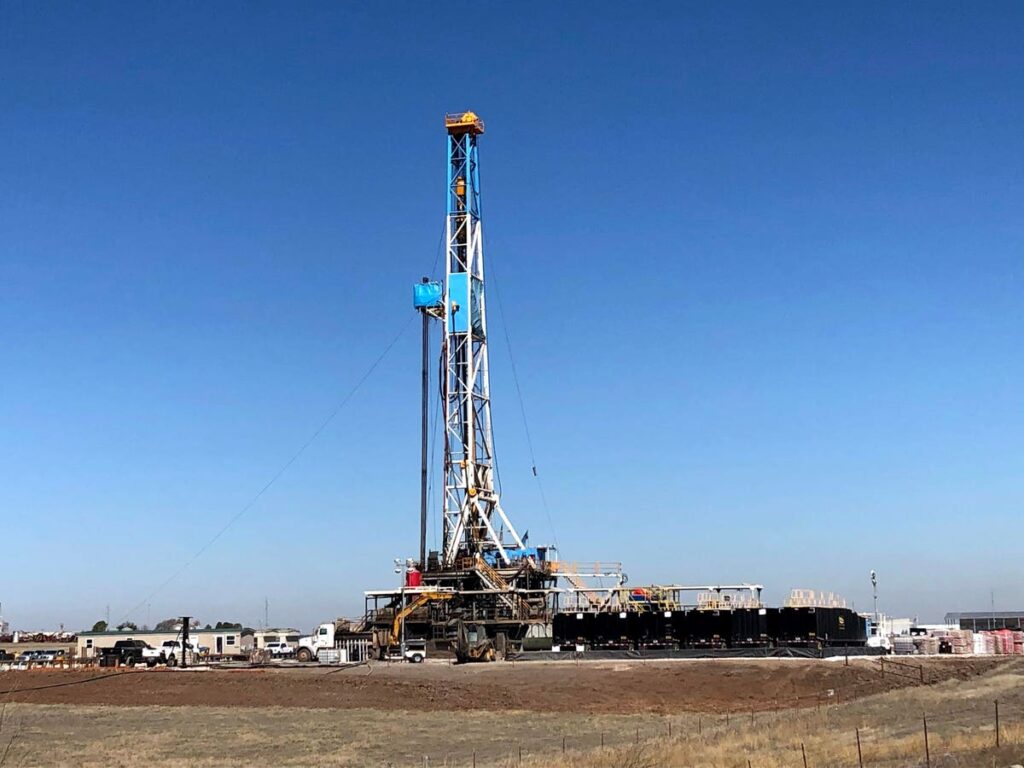
A modern drilling rig in action — agentic AI systems now observe real-time downhole conditions via sensors and autonomously optimize parameters such as ROP, torque, and trajectory for safer, faster operations.
Benefits for Operators and Midstream/Pipeline Implications
- Capital Efficiency : Reduced NPT (often 15–30% gains reported), faster well delivery, and extended inventory life on marginal acreage.
- Risk Reduction : Early detection and mitigation of drilling dysfunctions or subsurface uncertainties.
- Scalability — Handling vast datasets from seismic to real-time drilling logs that overwhelm human teams.
- Pipeline & Midstream Tie-In More predictable and concentrated production from optimized super-pads (enabled by long laterals + agentic drilling) allows better planning for gathering lines, trunk pipelines, and takeaway capacity. Real-time subsurface insights can also improve reservoir pressure management, affecting long-term flow assurance and CO₂/hydrogen transport scenarios in decarbonization projects.
In offshore environments, where intervention is costly, agentic systems paired with autonomous rigs and subsea robotics point toward “self-optimizing” fields with reduced human exposure.
Challenges and the Path Forward
Agentic AI still requires strong human oversight for safety-critical decisions, robust explainability (why the agent chose a certain action), and integration with physics-based models to avoid “hallucinations.” Data quality, cybersecurity, and governance remain key focus areas as adoption scales in 2026.
Leading players like SLB (Tela AI), Halliburton, Baker Hughes, ADNOC/AIQ, and Equinor are already moving from pilots to operational deployment. Industry conferences and workshops in 2026 are heavily focused on scaling agentic systems with human-in-the-loop governance.
Looking Ahead
By the end of 2026, expect broader rollout of agentic AI across upstream workflows — from real-time drilling self-optimization to autonomous reservoir management. For pipeline and midstream professionals, this means more reliable production profiles, optimized infrastructure sizing, and new opportunities in supporting low-carbon molecule transport tied to smarter subsurface operations.
This trend complements the long-lateral and horseshoe well designs we’ve covered previously: agentic AI provides the intelligent control layer that makes ultra-extended reach drilling both technically feasible and economically resilient.
What experiences have you had with AI agents in drilling or subsurface modeling?
How do you see agentic systems impacting pipeline routing, capacity planning, or offshore tie-ins in the basins you follow?
Share your thoughts below.