Written by Oko
Founder, Offshore Pipeline Insight
May 23, 2026
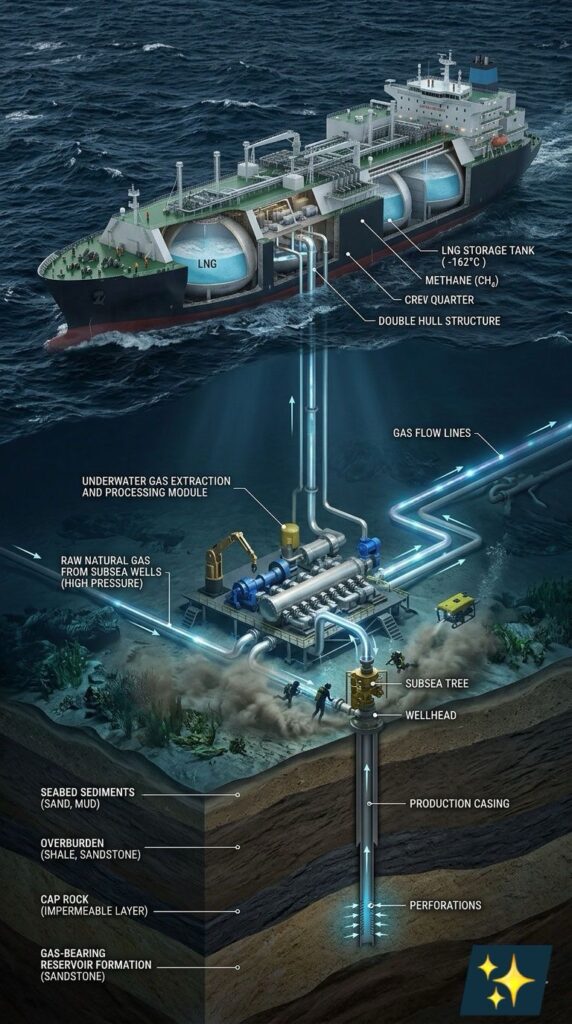
The offshore energy sector increasingly relies on natural gas as a cleaner transitional fuel. Advances in subsea technology allow operators to extract, process, and transport gas from remote deepwater fields directly to LNG carriers. The diagram below illustrates a complete offshore gas production and LNG export system — from reservoir to ship.
Comprehensive view of an offshore natural gas production chain showing subsea extraction, underwater processing, gas flow-lines, and direct loading onto an LNG carrier vessel.This integrated approach reduces the need for large fixed platforms, lowers costs, and minimizes environmental footprint while enabling monetization of stranded gas reserves.
Anatomy of the Offshore Gas Production System
The system starts at the reservoir and ends at the LNG carrier. Key components include:
- Reservoir and Well Construction: Gas-bearing formations (typically sandstone) are accessed through perforations in the production casing. Cap rock and overburden layers provide natural sealing.
- Subsea Tree and Wellhead: The subsea tree controls flow, injection, and monitoring at the wellhead.
- Underwater Gas Extraction and Processing Module: Modern subsea processing systems separate liquids, remove impurities, and boost pressure on the seabed.
- Gas Flowlines and Pipelines: Insulated flowlines transport processed gas to the surface or directly to export infrastructure.
- LNG Carrier Integration: Advanced vessels with cryogenic storage tanks (-162°C) receive gas via flexible risers or offshore loading systems.
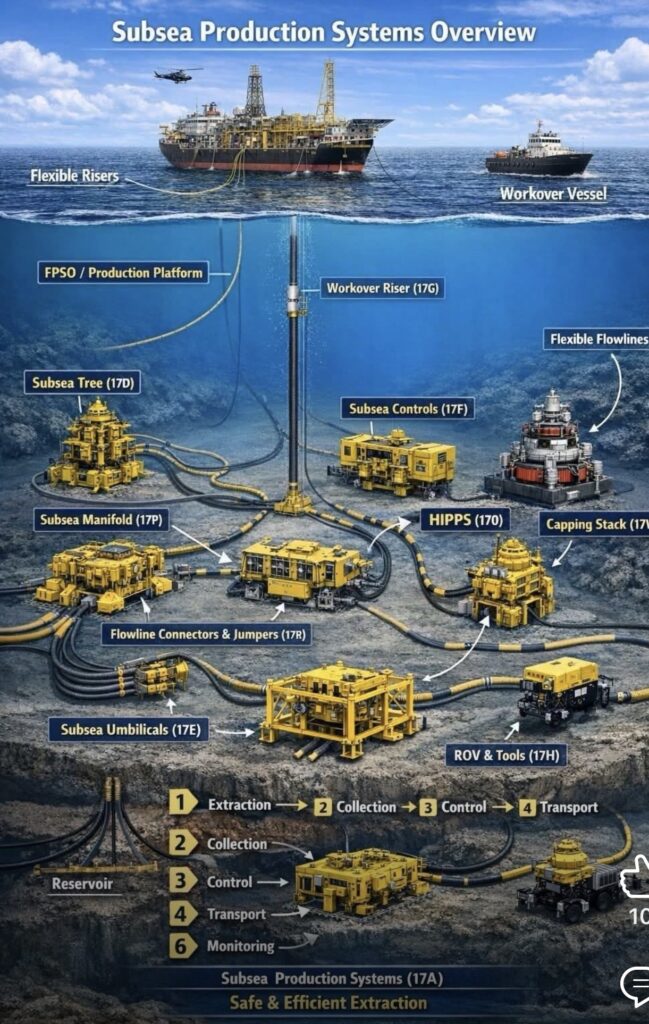
Typical subsea production system layout with manifolds, flowlines, risers, and connection to a floating production unit.Subsea Processing:
The Game Changer : Subsea processing brings separation, compression, and boosting closer to the reservoir. Benefits include:
- Reduced backpressure on wells → higher recovery rates
- Smaller or no topsides facilities
- Lower hydrate and wax formation risk through early separation
- More efficient multiphase transport
Modern systems handle high-pressure raw gas, remove water and condensates, and compress gas for efficient pipeline transport or direct LNG loading.
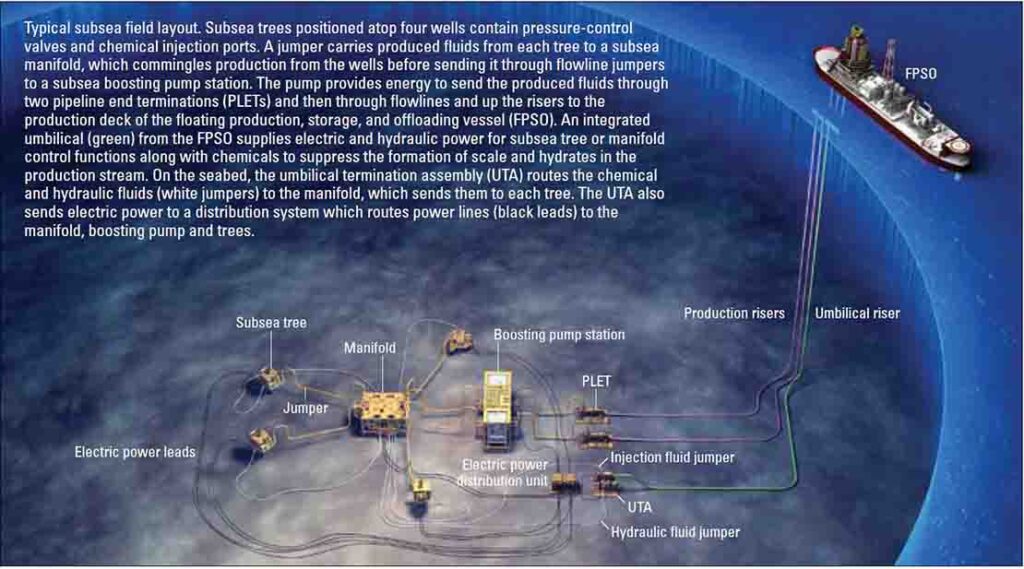
Detailed subsea infrastructure showing subsea trees, manifolds, boosting pumps, PLETs, and connections to FPSO or export systems.
Flow Assurance in Offshore Gas Systems
Gas systems face unique challenges:
- Hydrate Formation: High pressure + low temperature creates ice-like blockages.
- Liquid Holdup and Slugging: Condensate and water accumulation causes terrain-induced or hydrodynamic slugging.
- Corrosion: CO₂ and H₂S in raw gas accelerate internal degradation.
- Thermal Management: Insulation and chemical inhibition (methanol, glycol) are essential.
Engineers use advanced simulation tools (OLGA, PIPESIM) and real-time monitoring via fiber-optic sensing and digital twins to manage these issues.
Pipeline and Riser Design for Gas Export
Gas export pipelines differ from oil lines:
- Often larger diameters for high-volume transport
- Higher pressure ratings (up to 10,000+ psi in deepwater)
- Specialized materials for sour service
- Flexible risers or steel catenary risers (SCR) for dynamic environments
Direct loading to LNG carriers requires precise offshore transfer systems with cryogenic hoses and motion-compensated arms.
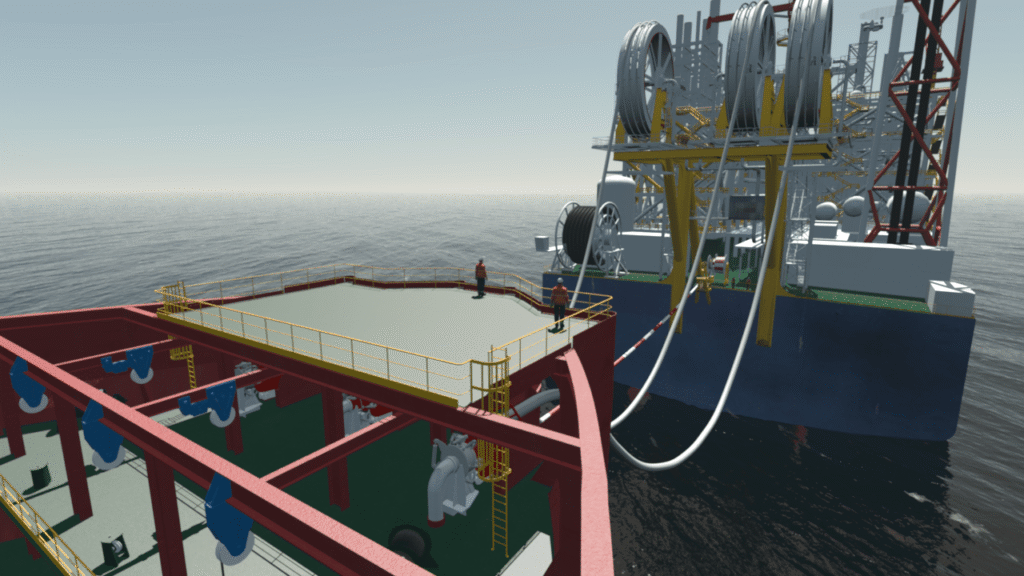
Offshore LNG loading operations
demonstrating the complex hose and manifold systems used between production facilities and LNG carriers.
Real-World Applications and Case Studies
Several landmark projects demonstrate this technology:
- Prelude FLNG (Australia): Shell’s massive floating LNG facility processes gas offshore and loads directly onto carriers.
- Gulf of Mexico and West Africa Developments: Operators use subsea processing to tie back remote gas fields to existing infrastructure.
- Norwegian North Sea Projects: Equinor and partners have deployed advanced subsea compression systems that boost gas recovery significantly.
- Emerging FLNG and FSRU Solutions: Convert gas to LNG at sea or provide flexible export options in regions without onshore terminals.
These projects show how integrated subsea-to-LNG systems improve project economics for marginal and stranded gas fields.
Integrity Management and Operational Challenges
Maintaining such complex systems requires robust strategies:
- Regular ROV/AUV inspections
- Intelligent pigging of export lines
- Cathodic protection and corrosion monitoring
- Emergency shutdown systems (ESD) and leak detection
- Cybersecurity for digitally connected subsea equipment
In 2026, AI-powered digital twins are increasingly used to predict maintenance needs and optimize operations across the entire chain.
Economic and Environmental ConsiderationsAdvantages:
- Monetization of previously stranded gas
- Lower CAPEX compared to traditional platforms
- Reduced flaring and emissions
- Faster project development timelines
Challenges:
- High initial technology costs
- Complex logistics in remote areas
- Stringent safety and regulatory requirements for LNG handling
- Weather dependency for loading operations
The global push for lower-carbon energy makes offshore gas-to-LNG systems attractive, especially when combined with carbon capture technologies.
Future Outlook (2027–2035)
The sector is moving toward:
- Greater use of all-electric subsea systems
- Integration with renewable energy (e.g., offshore wind powering compression)
- Advanced materials for deeper waters (>3,000m)
- Hybrid FLNG and pipeline export solutions
- Hydrogen and ammonia production from offshore gas
Digitalization and autonomy will further reduce human intervention while improving safety and efficiency.
Conclusion and Recommendations
The diagram represents the sophisticated integration of subsea engineering, pipeline technology, and marine logistics that defines modern offshore gas development. From reservoir to LNG carrier, every component must work in harmony to ensure safe, reliable, and economical operations.
Recommendations for Industry Professionals:
- Invest early in detailed flow assurance studies
- Adopt subsea processing where reservoir conditions allow
- Implement comprehensive digital monitoring systems
- Plan for flexible export solutions (pipelines + LNG carriers)
- Prioritize integrity management from day one
As global demand for natural gas grows, mastering these integrated offshore systems will be key to success in the energy transition era.