By Oko M.Eng | Offshore Pipeline Insight | August 28 2026
Natural gas is no longer only a local midstream problem. In Western Canada, Montney molecules are being lined up as feedgas for Pacific LNG. In West Texas and New Mexico, associated gas is still fighting for space in long-haul pipe. Across Eurasia and the Middle East, large-diameter export systems are being expanded, repaired, or politically rerouted. The engineering is different in each region. The commercial logic is the same: gas that cannot move has little value.
This article links three stories that pipeline professionals should read together: Montney LNG feedgas demand, Permian takeaway constraints, and selected international transmission systems that show how diameter, compression, and route design decide who gets to market.
Montney gas and the LNG feedgas question
The Montney Formation in northeast British Columbia and northwest Alberta is one of North America’s most important gas and condensate plays. It is also the logical source rock for Canada’s west-coast LNG plants. That does not mean every well automatically becomes an LNG cargo. Feedgas only exists when three things line up: productive wells, processing capacity, and a pipeline that can deliver sales-quality gas to the liquefaction fence line.
Canada’s current and proposed west-coast LNG slate is still narrow compared with the U.S. Gulf Coast. The projects that matter for Montney feedgas are:
- LNG Canada Phase 1 at Kitimat, about 14 million tonnes per year (mtpa)
- LNG Canada Phase 2, which would double that plant to about 28 mtpa if sanctioned
- Cedar LNG, about 3.75 mtpa
- Woodfibre LNG, about 2.1 mtpa
- Ksi Lisims LNG, a proposed floating LNG project of about 12 mtpa
A rough conversion used in project planning is that 1 mtpa of LNG requires on the order of 0.13–0.14 Bcf/d of feedgas, depending on composition, fuel use, and plant efficiency. On that basis:
- LNG Canada Phase 1 needs roughly 1.8–2.0 Bcf/d
- Phase 2 would need a similar additional increment
- Cedar and Woodfibre together need well under 1 Bcf/d
- Ksi Lisims at 12 mtpa would need around 1.6–1.7 Bcf/d if built at full nameplate
Those numbers explain why Coastal GasLink, Westcoast expansions, and Prince Rupert Gas Transmission are not side projects. They are the feedgas system. LNG Canada Phase 2, if sanctioned in 2027 as some analysts expect, would be fed largely by adding compression on Coastal GasLink rather than by laying an entirely new corridor. Ksi Lisims, by contrast, still depends on a new or revived Prince Rupert Gas Transmission route from the Western Canadian Sedimentary Basin to the northwest coast. First onshore construction contracts for that line were awarded in August 2026, but commercialization remains the hurdle.
There is already a constraint in the existing system. Westcoast’s T-South line has been tight enough in late August to cut some Canadian imports into the U.S. Pacific Northwest and lift Sumas prices. That is a reminder that Montney gas does not only serve LNG. It also serves British Columbia, the Pacific Northwest, and competing U.S. markets. Every cargo that leaves Kitimat is a cargo that does not move south on T-South.
For engineers, the Montney-to-LNG chain looks like this:
- Well pad and gathering
- Gas plant and NGL extraction
- High-pressure sales-gas transmission (typically 36- to 48-inch class pipe on the big corridors)
- Compressor stations sized for mountain terrain and winter operations
- Delivery to the LNG plant at a specified pressure, temperature, and hydrocarbon dew point
Miss any step, and the liquefaction trains sit idle even if the reservoir is prolific.
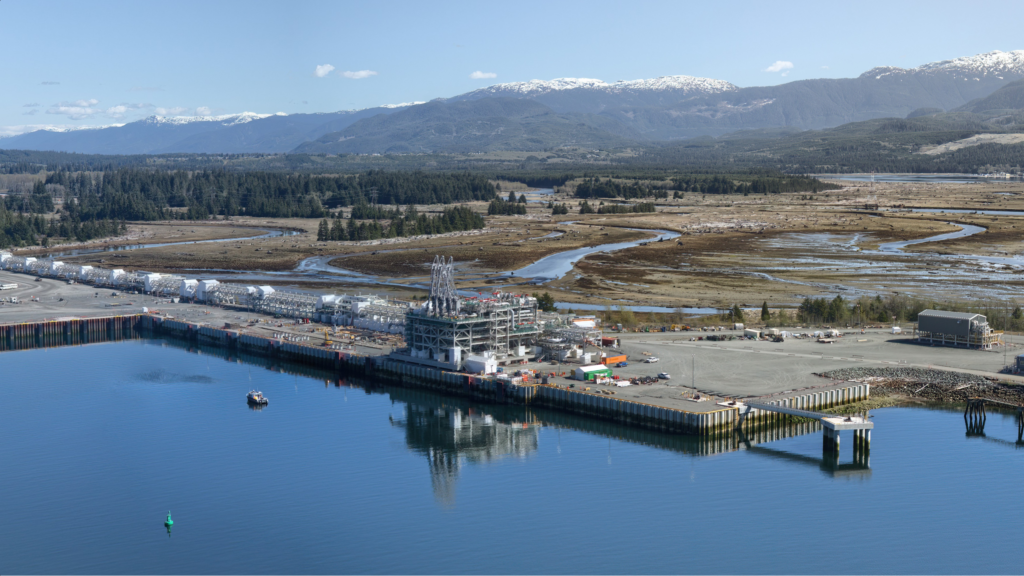
Caption: LNG Canada marine terminal at Kitimat — the Pacific outlet that turns Montney feedgas into export cargoes.
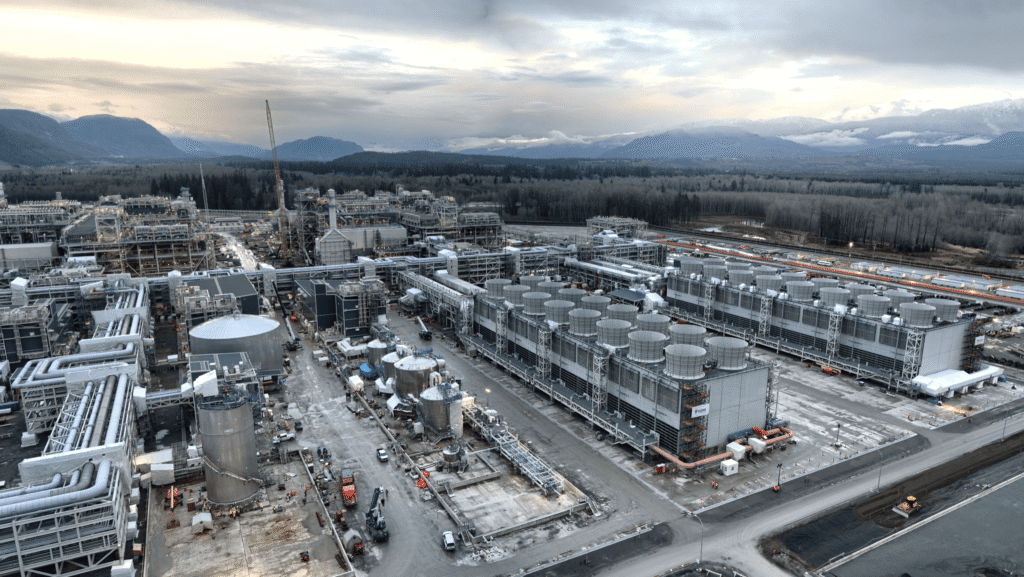
Caption: Process units at Canada’s largest LNG export plant. Liquefaction demand is what gives Montney pipelines their long-term pull.
Permian gas takeaway: the constraint is easing, not gone
The Permian problem is different. Operators are not waiting for a new LNG plant on the coast of Texas in order to drill oil wells. They drill for oil. The gas comes with it. When residue takeaway is short, Waha prices collapse and can go negative. That is not a theory. It happened for long stretches of 2024, 2025, and early 2026.The bottleneck began to break in mid-2026 when new steel entered service.
Gulf Coast Express expansion (Kinder Morgan)
A compression-driven expansion added about 570 MMcf/d and lifted the 500-mile GCX system to roughly 2.55–2.6 Bcf/d. The project was fully subscribed before gas flowed. This is a classic engineering lesson: you can add capacity without a new ditch if the existing pipe and class location allow more compression and the downstream interconnects can take the extra volume.
Hugh Brinson Pipeline (Energy Transfer)
Phased capacity toward northeast Texas and the Dallas–Fort Worth area, with a first phase around 1.5 Bcf/d and a longer-term system in the 2.2 Bcf/d range. Phase 1 includes a 42-mile, 36-inch Midland Lateral tying processing plants in Martin and Midland Counties into the mainline. That lateral is as important as the long-haul pipe. Gas that cannot leave the plant still has no market.
Blackcomb Pipeline (WhiteWater, MPLX, Enbridge)
A 365-mile, 42-inch line from the Waha area to Agua Dulce, designed for 2.5 Bcf/d and targeted for late 2026 service. Forty-two-inch pipe is the current workhorse diameter for new Permian gas egress: large enough to move serious volume, still constructible with standard mainline spreads.
Solitude Pipeline System (WhiteWater and partners)
FID in August 2026 for two 48-inch lines from the Permian to Katy, Texas. Phased capacity is 2.25 Bcf/d around late 2029 and another 2.25 Bcf/d in 2030, for 4.5 Bcf/d total. Forty-eight-inch pipe is a step-change. At typical high-pressure gas-transmission design factors, the extra diameter raises throughput sharply and lowers unit friction loss, at the cost of heavier wall, larger bends, bigger sidebooms, and more demanding welding and hydrostatic testing.
Taken together, projects already in service or due through 2027 add on the order of 5 Bcf/d from the Waha area. A second wave, including Solitude and other proposals, could add much more by the early 2030s. Some analysts now warn about a possible overbuild later in the decade. That would be a new problem. The old problem — negative Waha — is only beginning to fade.Engineering constraints that still matter:
- Compressor station spacing and available horsepower
- Gas quality and treating before residue lines
- Downstream capacity at Agua Dulce, Katy, and LNG interconnects
- Crossing density in the Permian, where new laterals fight existing oil, NGL, and produced-water lines
- The risk that crude takeaway, not gas takeaway, becomes the next limiter if oil pipes to Corpus Christi stay near full
Associated gas will keep growing as laterals get longer. Pipe built for 2026 volumes can look tight again by 2028 if another wave of wells arrives before the next 48-inch system is in service.
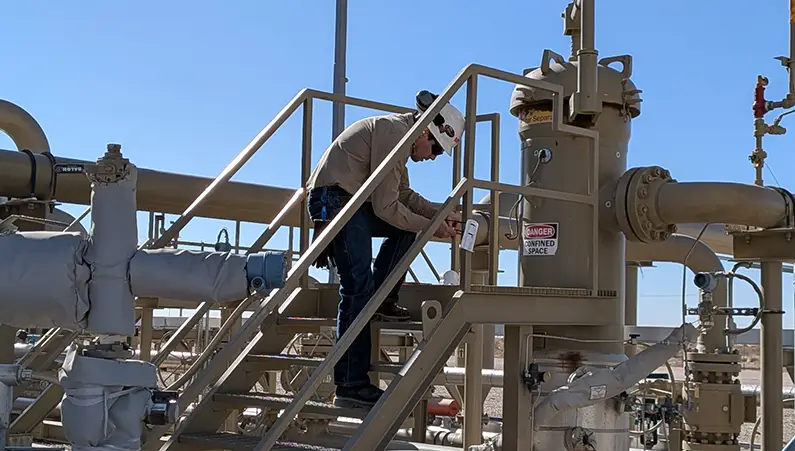
Caption: Field work on Permian gas facilities. Compression and treating are what turn wellhead gas into residue that long-haul pipelines can accept.
International pipelines: diameter, water, and geopolitics
The same design choices appear on other continents, at larger distances and under different politics.
Power of Siberia (Russia to China)
This is a long-distance, large-diameter gas export system from East Siberian fields to northeast China. Design export capacity is 38 billion cubic meters per year, roughly 3.7 Bcf/d, with discussion of higher volumes. Length exceeds 3,000 km. The engineering problems are cold-climate construction, river crossings, and compressor stations spaced across remote terrain. Unlike Permian laterals, this line is a single strategic corridor. If it is full or offline, there is no easy parallel path.
TurkStream (Russia to Turkey and Southeast Europe)
Two 32-inch offshore strings cross the Black Sea. System capacity is about 31.5 bcm/year. Water depth, buckle management, and wet-gas or dry-gas specification at landfall dominate the design. After Nord Stream went offline, TurkStream became one of the last major pipe routes moving Russian gas toward Europe. That makes it both an engineering asset and a political target. Offshore pipelines in contested waters need more than wall thickness. They need surveillance, repair contingency, and spare capacity onshore.
TANAP / TAP (Azerbaijan to Turkey to Italy)
The Southern Gas Corridor is a chain of onshore and offshore segments moving Caspian gas to Europe. TANAP across Turkey and TAP across Greece and the Adriatic were built as a diversification route, not a Permian-style associated-gas relief valve. Typical design themes are high-pressure dry gas, piggable laterals, and compressor stations placed for elevation change and market offtake. Capacity is much smaller than Power of Siberia, but the political value per cubic meter is high.
EastMed and Eastern Mediterranean pragmatism
The proposed EastMed line — on the order of 1,900 km, with a concept capacity around 10 bcm/year, expandable in theory to 20 — remains without FID. Deepwater length, crossing rights, and cost have kept it on the shelf. What is moving instead are shorter, more buildable links, such as a roughly 105 km subsea line from Cyprus’s Cronos field toward Egyptian infrastructure for liquefaction. That is the same lesson as Ksi Lisims versus LNG Canada Phase 2: the project that uses existing downstream plant is easier to finance than the project that needs a new continent-crossing pipe.
UAE Habshan–Fujairah crude line
Though it is an oil system, it belongs in this comparison because it is a strategic bypass. About 1.8 million bpd today, with expansion plans toward a doubling around 2027. Large-diameter onshore crude pipe plus storage and loading at Fujairah can reroute molecules around a maritime chokepoint. Gas engineers should study it for the same reason oil engineers study Permian residue lines: route diversity is a design parameter.
Central Asia–China Gas Pipeline
Lines A, B, and C are already operating. Line D, about 30 bcm/year, has been a long-running construction and diplomacy project. The engineering is high-volume, multi-string desert and mountain transmission with multiple border crossings. Quality specification, odorization policy, and compressor fuel use become political as well as technical issues when four countries sit on one corridor.
Design details that repeat everywhere
Whether the pipe is in the Montney foothills, the Permian caliche, the Black Sea, or Yakutia, the same technical file appears:
- Diameter and grade: X70 and X80 dominate new high-pressure gas lines. 42-inch is common; 48-inch is used when the volume justifies the heavier construction spread.
- Design pressure: often 1,200–1,480 psig on modern North American gas transmission; export systems elsewhere are set by the receiving grid and compressor philosophy.
- Coating and CP: FBE plus abrasion-resistant overcoat in rock; sacrificial or impressed-current cathodic protection from day one.
- Compression: gas turbine or electric drive. Electric drive wins where the grid is strong. Turbines win where the station is remote and fuel gas is already in the pipe.
- Inspection: the line must be piggable. Launchers, receivers, bend radius, and consistent internal diameter are not optional extras.
- Crossings: HDD and microtunneling for rivers, roads, and foreign pipelines. In the Permian the crossing density is extreme. In British Columbia the issue is mountains, winter access, and watercourses.
The difference is not the welding procedure. The difference is whether the line is solving associated-gas congestion, feeding an LNG train, or carrying state-to-state supply.
What links Montney, the Permian, and the rest of the world
Montney LNG feedgas demand is a pull from the Pacific. Permian takeaway is a push from the wellhead. International trunk lines are political arteries. All three fail in the same way: when compression, diameter, or a single route cannot keep up with the molecules behind them.
For Offshore Pipeline Insight readers, the practical conclusion is simple.
Watch the feedgas pipes into Kitimat and Prince Rupert as closely as the 42-inch and 48-inch systems leaving Waha. Then watch the long export corridors that other countries are expanding or replacing. The next constraint is rarely a surprise. It usually shows up first as a basis blowout, a full interconnect, or a compressor station that has no more horsepower left.