Six trains are sanctioned. Five more are on the drawing board. The gas still has to cross Louisiana pipe.
20 September 2026
Cameron Parish does not need another slogan about the LNG boom. It needs cranes, pile templates, compressor packages and a feedgas lateral that does not slip the schedule.
On 15 May 2026, Caturus took FID on Commonwealth LNG, a six-train, 9.5 mtpa export plant on the Louisiana Gulf. It closed $9.75 billion in project financing. Total commitments around the deal were reported at $21.25 billion. Chairman Ben Dell put all-in development, including financing fees, near $12.5 billion, with the EPC slice around $8.4 billion.
First operations are aimed at 2030. The company says construction is underway and on schedule. About 8.5 mtpa of the 9.5 mtpa is already under long-term sale and purchase agreements.
Four months later, on 15 September, Caturus announced a five-train, 7.75 mtpa expansion. If that second phase is built, the site would reach about 17.25 mtpa in the early 2030s. That is no longer a mid-scale plant. That is a second Cameron LNG. For this site the question is not whether America can sell molecules. It is whether Cameron Parish can absorb another full construction cycle — tanks, trains, jetty, power and the pipes that keep the cold boxes full.
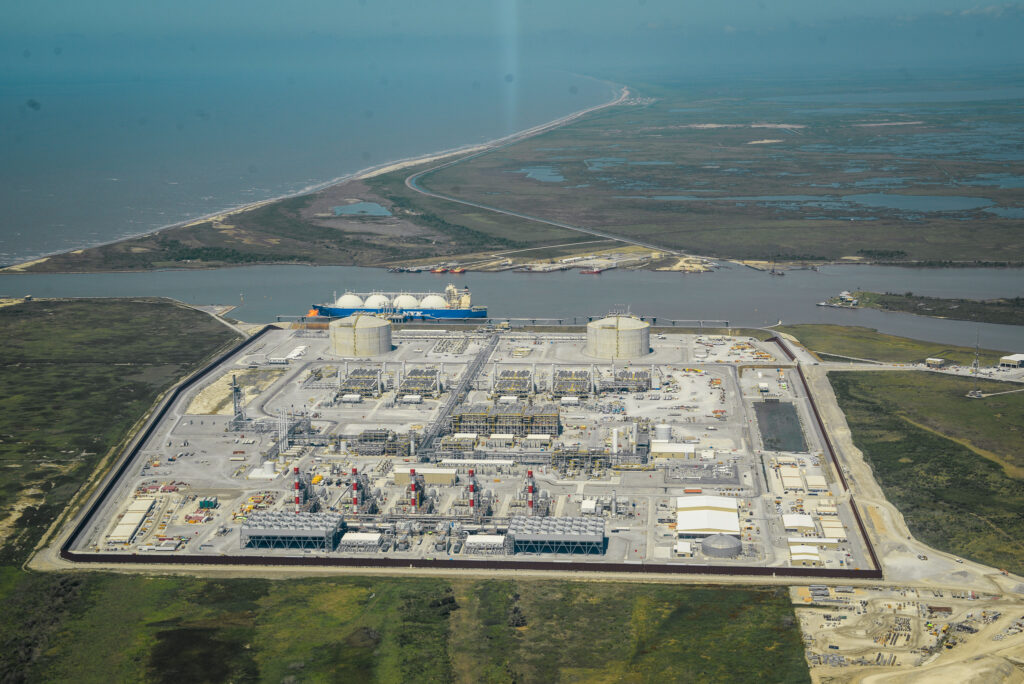
Caption: A finished Gulf Coast LNG site is tanks, a channel and a carrier. Commonwealth is still in the dirt-and-steel years that come first.
Who Caturus is, and why the money showed up
Caturus is a privately held integrated gas platform controlled by Kimmeridge, with Mubadala Energy at about 24.1 percent and CPP Investments raising its stake to about 31 percent after putting in $1.2 billion. Other names around the financing include EOC Partners, BlackRock-managed funds and an Ares infrastructure vehicle.
The company sells a “wellhead-to-water” story: own or control upstream gas, then liquefy it on the parish waterfront.That is different from a merchant terminal that only buys gas at the fence.
The offtake list for Phase 1 is a map of who still wants U.S. LNG: EQT, Glencore, Mercuria, PETRONAS and Aramco Trading Phase 1 is billed at more than $3 billion a year in export revenue once it runs. DOE authorization covers the 9.5 mtpa base case, including non-FTA destinations An expansion to 17.25 mtpa will need its own paper.
The financing close is what developers like to print. The construction close is what decides whether 2030 is real. Long-lead gear was already moving before FID. That is how you compress a Gulf Coast schedule when every other project is bidding the same turbines.
What is actually being built
Technip Energies is the EPC partner. Equipment already identified for the base plant:
- six Baker Hughes mixed-refrigerant compressors driven by LM9000 gas turbines
- six Honeywell main cryogenic heat exchangers
- four Titan 350 gas-turbine generators from Solar Turbines
The jetty is designed for carriers up to 216,000 cubic metres. Modular construction is the stated method for both Phase 1 and the proposed five-train add-on, using the same supply chain and contractors.
Translate that into a site. You need soil improvement in a parish that sits on marsh and fill. You need pile driving, pipe racks, a flare, boil-off, firewater, nitrogen and a high-voltage feed. You need a marine spread that can set a loading platform without blocking a channel that already serves other terminals. You need welders, heavy-haul and housing in a market already strained by every LNG job between Lake Charles and Sabine.
This is not Delfin’s model. Delfin sends the plant to a Korean yard and asks an old 42-inch Gulf line to wake up. Commonwealth pours the plant in Louisiana. The labour hours stay in the parish.
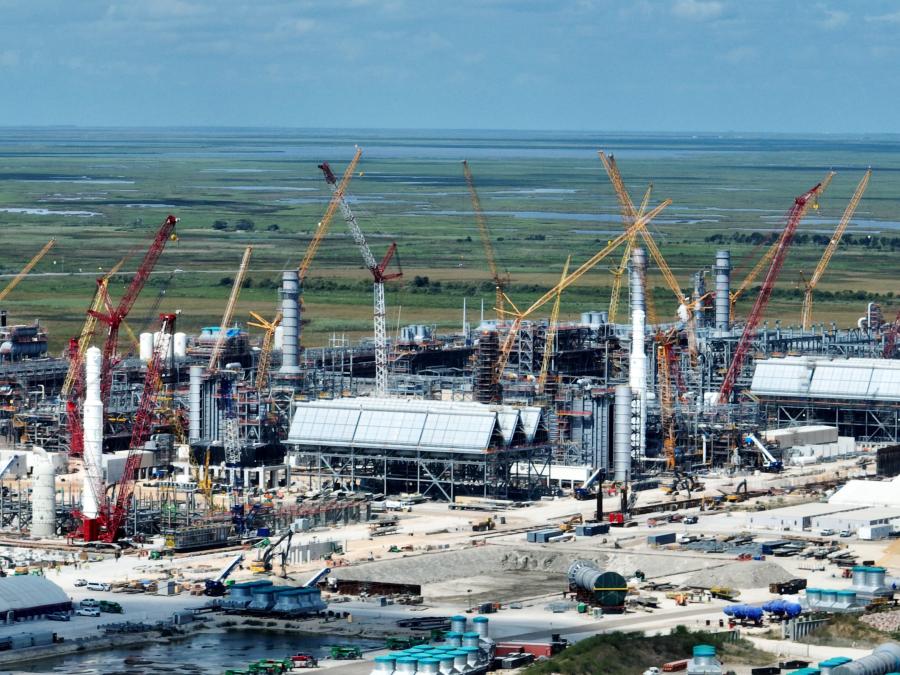
Caption: A Gulf LNG construction site is a forest of cranes over wet ground. That is the view Commonwealth is buying with $9.75 billion of project money.
The pipeline problem nobody puts on the groundbreaking stage
Nine-point-five million tonnes a year is not an abstract export number. It is roughly 1.2 billion cubic feet a day of feedgas when the plant is running hard. Seventeen mtpa would want something close to 2.2 Bcf/d. That gas has to come from Haynesville, Permian associated gas, and whatever Caturus can assemble in its own upstream book. It has to travel laterals, headers and interconnects that other terminals are also pulling on.
Cameron Parish is not short of pipe on a map. It is short of spare firm capacity on the days every train on the coast is in service. That is why integrated ownership matters. If Caturus can back a train with its own production, it is not only a merchant bid on Transco or Kinder Morgan. If it cannot, Commonwealth becomes another demand sink stacked on the same takeaway constraints that already show up as basis blowouts.
Cameron Parish is not short of pipe on a map. It is short of spare firm capacity on the days every train on the coast is in service. That is why integrated ownership matters. If Caturus can back a train with its own production, it is not only a merchant bid on Transco or Kinder Morgan. If it cannot, Commonwealth becomes another demand sink stacked on the same takeaway constraints that already show up as basis blowouts.
For field engineers the interesting drawings are not the tank roof.
They are:
- the gas pipeline tie-in and metering at the fence
- pig launchers and isolation so a lateral can be repaired without killing a train
- condensate and NGL handling if the inlet gas is richer than the design case
- how compression is staged so six trains do not start against an empty header
Walkdowns and Excel trackers earn their keep on those systems. A delayed heat exchanger is visible in a monthly report. A late interconnect is how a 2030 COD becomes 2031.
Why the expansion announcement came so fast.
Announcing 7.75 mtpa before Phase 1 has produced a single cargo looks aggressive. Commercially it is rational. Buyers who missed the 2024–25 FID wave want a 2030s tranche. Caturus already has a site, an EPC, a modular template and a community conversation. Repeating five more trains on the same pad is cheaper than opening a greenfield parish.
President Tim Wyatt said the upstream portfolio is meant to feed the extra capacity. That sentence is the whole second-phase risk register. No extra gas, no extra trains. Treat the expansion as a development case, not a second FID. The company still has to sell the volume, finance it and permit it. What is real today is Phase 1 steel and a public claim that the same machine can be copied.
Compare the two Louisiana stories. Delfin is about $5 billion and 4.4 mtpa on a hull. Commonwealth is more than double that capital for a little more than double the first-phase tonnes — and a path to 17 mtpa if the copy-paste works. One project tests brownfield offshore pipe. The other tests whether Cameron Parish can host another full onshore cycle without running out of people, barge slots and goodwill.
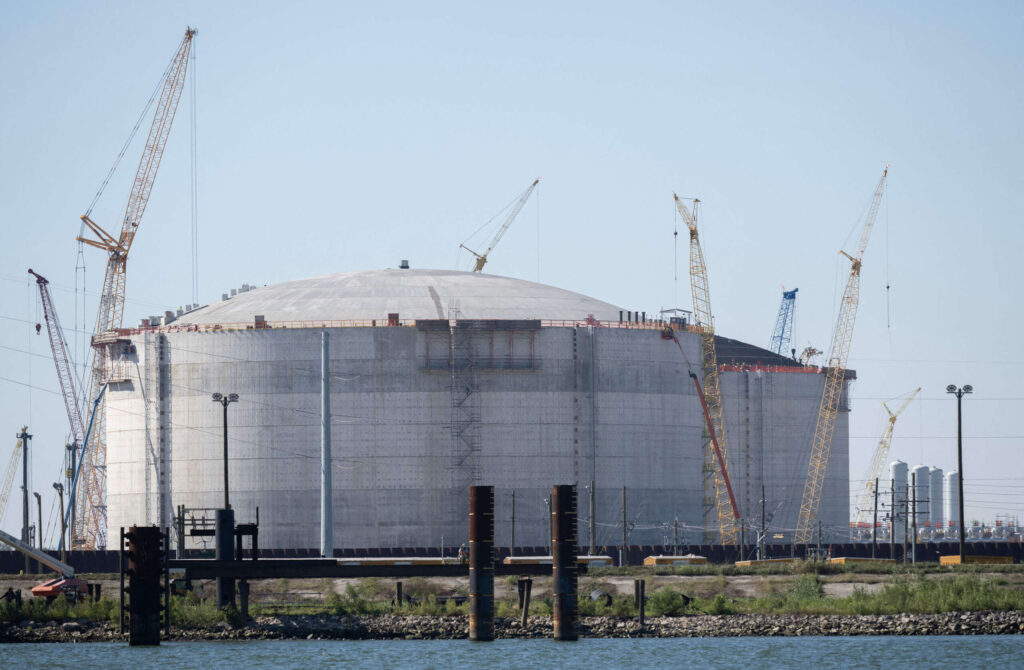
Caption: An LNG tank under construction is a multi-year concrete job. Add five more trains and you are not finished with the skyline in 2030.
Construction reality in a crowded corridor
The Calcasieu Ship Channel and the Cameron shoreline already carry other terminals and a queue of schemes. That crowding shows up as competing bids for the same heavy-lift yards, channel limits when two terminals want a carrier on the same tide, housing and overtime that move with every FID, and a hurricane season that can take a month out of a pour schedule.
Technip ordering long-lead equipment before FID was an attempt to get ahead of that queue. Baker Hughes LM9000s and Honeywell cold boxes are not sitting on a shelf in Lake Charles. If the expansion reuses the same vendors, Phase 2 will be bidding against Phase 1’s own remaining deliveries.Hurricane design will govern tank anchorage, pipe-rack bracing and how you shut a jetty down when the Gulf is a brown wall. Integrity work after first gas will look like every other coastal plant: coating, settlement on fill, and chloride. None of that is new. All of it is why a 2030 target is a construction target, not a ceremony.
What this means for pipelines and LNG together
Put Commonwealth next to Delfin, LNG Canada Phase 2 talk, Papua LNG and the Hormuz / Yanbu mess. The pattern is the same. Capital goes to liquefaction because that is what offtakers sign. Value is created only if gas can reach the fenceand LNG can leave the jetty.
Haynesville and Permian takeaway projects are not a separate beat from this plant. They are the same molecule on a different drawing. If a Delaware lateral is late, a Cameron train is short. If a ship cannot load because a channel is constrained, the pipe behind the plant packs and producers feel it as a price.Caturus calling itself an integrated production-plus-LNG platform is a commercial claim. The engineering test is whether that integration is real at 1.2 Bcf/d, then at 2 Bcf/d.
What to watch
- Monthly construction progress versus the 2030 COD — foundations, tank walls, first compressor on site.
- Whether the remaining 1.0 mtpa of Phase 1 is sold, and on what tenor.
- Regulatory path and offtake for the 7.75 mtpa expansion. Do not count those trains until there is a second financing close.
- Firm feedgas: announced interconnects, not just “upstream portfolio.”
- Channel and marine package: first jetty steel and dredge windows.
- Local labour and housing. A parish can only run so many peak construction rosters at once.
Bottom line
Commonwealth LNG is no longer a permit story. It is a Cameron Parish construction job with $9.75 billion of project money, Technip in the chair, six trains sold almost full, and a public plan to nearly double the site. The plant will be judged in 2030 on whether those trains make cargoes. It should be judged now on whether the pipes, people and channel can carry a second cycle before the first one is finished.Tanks are visible from the road. The gas header is what keeps them cold.