Exxon is taking the Papua LNG wheel. Shell’s Kitimat partners may decide Phase 2 as early as October. Both stories are pipeline stories wearing an LNG badge.
20 September 2026
The Pacific does not need another Gulf Coast clone. It needs gas that can reach an ice-free berth on a short haul to Asia.
Two projects are trying to prove that at once. In Papua New Guinea, ExxonMobil is taking operatorship of Papua LNGfrom TotalEnergies as the joint venture lines up a fourth-quarter FID on a roughly $14 billion, 5.6 mtpa development tied to the existing PNG LNG plant. In British Columbia, partners in LNG Canada could sanction Phase 2 as early as October, adding 14 mtpa and doubling Kitimat to 28 mtpa. Prime Minister James Marape wants P’nyang next in the PNG queue. Coastal GasLink has to grow if Kitimat grows
That is one Pacific map: highlands pipe to Caution Bay, Montney pipe to Douglas Channel, and two operators who already know how to run a train.
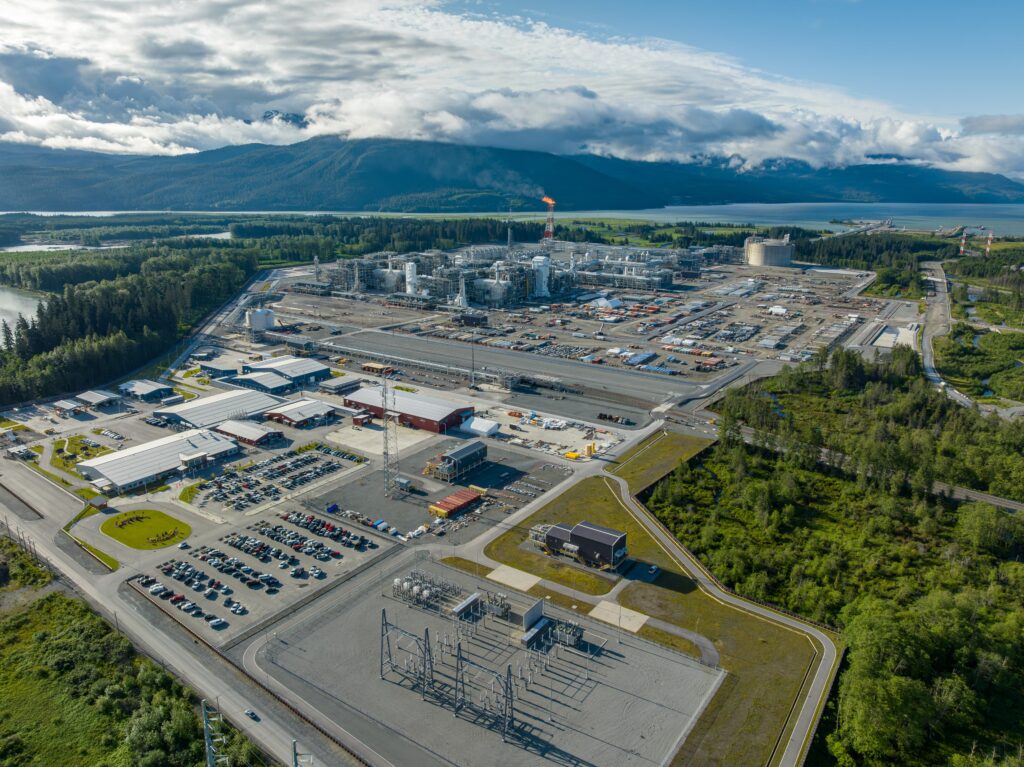
Caption: LNG Canada at Kitimat already exists. Phase 2 is not a dream pad. It is two more trains on a site that shipped its first cargoes in 2025.
Papua LNG: cut the cost, hand Exxon the keys
Papua LNG will develop the Elk and Antelope fields in Gulf Province and send gas to liquefaction near Port Moresby / Caution Bay. Nameplate LNG is 5.6 mtpa. The project website also cites 6 mtpa of total liquefaction when you count about 2 mtpa of tolling through existing PNG LNG trains, plus three new electrified (eLNG) trains at Caution Bay. Resources are described as more than 1 billion barrels of oil equivalent.
The commercial reset in early September is what made FID talk serious again.
- Estimated capex is down to about $14 billion after nearly $4 billion of design cuts and EPC rebids since 2024.
- EPC tendering finished in September 2026; award recommendations sit with the co-venturers.
- ExxonMobil becomes operator so construction and operations can share people, camps, marine and the existing PNG LNG plant.
- TotalEnergies sells 9.1 percent (after the state back-in) and keeps 20 percent plus its offtake.
- Post-deal ownership: ExxonMobil 34.1 percent (operator), Santos 21 percent, TotalEnergies 20 percent, ENEOS Xplora 2.4 percent, Kumul Petroleum and MRDC 22.5 percent combined.
- A marketing JV with Kumul will sell 2.4 mtpa. TotalEnergies has a heads of agreement for 1.5 mtpa into its own book. Production offtake for Total stays in that range even as equity falls.
- The gas agreement with Port Moresby has been amended. FID is aimed at Q4 2026. The operatorship shift is described as effective from the start of 2026 once conditions are met.
Analyst Saul Kavonic put the industrial logic in one line: Papua LNG helps extend the life of PNG LNG, which would otherwise start to decline around 2028. Two plants, one operator, one set of highlands-to-coast habits. This is not a greenfield island. It is a tie-in to an 8 mtpa machine that has been running since 2014, fed by hundreds of kilometres of highlands pipe.
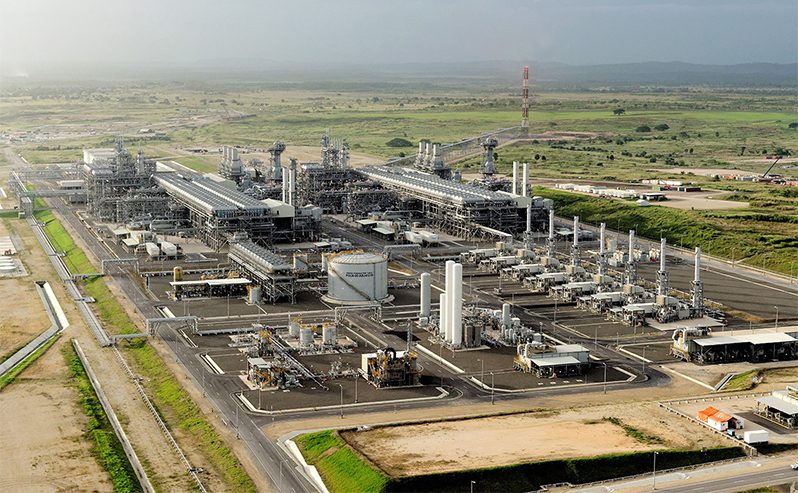
Caption: The existing PNG LNG plant at Caution Bay is the reason Exxon is getting the keys. Shared downstream steel is how $4 billion came out of the budget.
Why operatorship matters more than the press headline
On paper TotalEnergies remains a 20 percent owner and a 1.5 mtpa buyer. In the field, Exxon already runs PNG LNG: Hides and Angore production, the long export line, the two trains, the jetty, the community agreements and the security envelope. Putting Papua LNG under the same operator is how you stop building a second company to do the same job 20 kilometres away.
The split of work on the project site is still useful. TotalEnergies’ TEP PNG has been overseeing upstream and midstream. ExxonMobil PNG Antelope is to build and tie the new downstream trains into PNG LNG infrastructure. After the transfer, that line will blur. That is the point.
For pipeline people the midstream is the risk that does not fit in an FID slide. Elk-Antelope gas still has to be gathered, treated and moved to Caution Bay. Brownfield tie-ins at an operating plant are how schedules slip:live hydrocarbons, shared utilities, and a jetty that cannot shut because PNG LNG cargoes are already sold.
Electrified trains are a climate and a grid story. They only run if the power is real. Watch that package as closely as the EPC award.
P’nyang is the next PNG chapter, not this one
Marape’s sequencing is public: Papua LNG first, then P’nyang, then Wildebeest, stretched over 10 to 15 years so the country does not go from boom to idle camp. He has called P’nyang a signature project of his government and cited a 63 percent state benefit share, against about 49 percent on Papua LNG and 48 percent on PNG LNG. Landowners and Western Province were given extra equity in the P’nyang gas agreement.
Exxon has told him all three stay in the portfolio. That is not an FID. P’nyang only moves if Papua LNG actually sanctions and if the state can live with the construction gap. Combined, Papua plus P’nyang have been discussed as $20–25 billion over a decade. Treat that as a corridor, not a purchase order.Wildebeest is even further back. Do not put it in a 2026 construction forecast.
LNG Canada Phase 2: the other Pacific FID clock
Phase 1 at Kitimat is already in service. Two trains, about 14 mtpa, built by the JGC–Fluor joint venture. Phase 2 would add two more trains and 14 mtpa, taking the site to 28 mtpa. Some Canadian materials still say “up to 30.” The working number in the latest Reuters reporting is 28. Ownership: Shell 40 percent, Petronas 25, Mitsubishi 15, PetroChina 15, Kogas 5
Three people familiar with the talks told Reuters the partners could take FID as early as October. LNG Canada’s public line is more careful: each partner must clear its own commercial, fiscal, regulatory and governance tests, and the company “hopes” for a decision before year-end. Both can be true. October is the early case. December is the official window.
The work that is not a rumour:
- Joint-venture partners approved hundreds of millions in extra pre-FID spend in May.
- Ottawa, Victoria and LNG Canada signed an investment-cooperation deal to close remaining items.
- A limited notice to proceed went to JGC Fluor BC LNG II for planning, early engineering and long-lead work.
- LNG Canada and Coastal GasLink agreed to cooperate on a pipeline expansion so Phase 2 has feedgas. LNG Canada would take a more active development role; CGL would stay in technical support.
- MNT Investments, for five neighbouring First Nations, has an option to put up to C$1 billion into Phase 2.
- Ottawa has parked the project with the Major Projects Office and talks about $33 billion of private capital around the full scheme.
Phase 1 already has a 225,000 m³ tank, dual flares, a wharf that can berth two carriers, and LMS100-driven refrigeration. Phase 2 is a copy on the next pad, plus more pipe from the Montney.
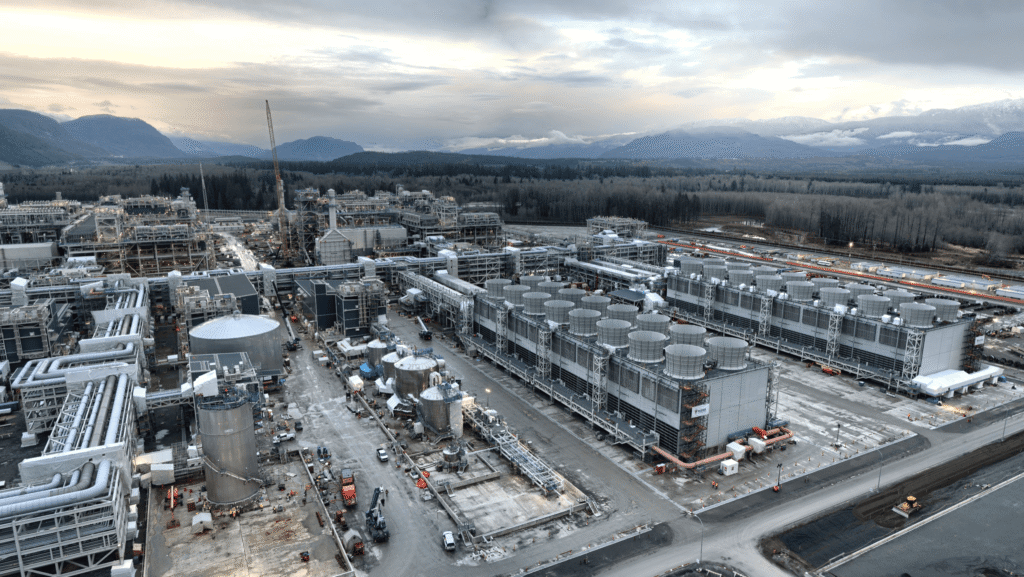
Caption: Kitimat’s trains already sit in the rain and the mountains. Doubling them is a construction decision. Filling them is a Coastal GasLink decision.
Two coasts, one rule: no pipe, no FID that matters
Papua LNG without a reliable Elk-Antelope export line is a plant on a beach. LNG Canada Phase 2 without extra CGL capacity is two empty trains facing Japan.
That is the same lesson as Delfin and Commonwealth, written in different weather. Delfin needs UTOS. Commonwealth needs 1.2 Bcf/d at the Cameron fence. Kitimat needs Montney molecules through the Coast Mountains. Caution Bay needs highland gas that does not leak, wash out or sit behind a landowner blockade.
Asia is the customer in both cases. Kitimat’s pitch is a shorter voyage than the U.S. Gulf and no Panama bottleneck. PNG’s pitch is existing Asian relationships and a plant that already knows those ports. Hormuz and Red Sea risk only make that Pacific routing more valuable. It does not remove the construction risk on the slope.
What to watch before ChristmasPapua LNG
- Co-venturer approval of EPC awards.
- A dated FID in Q4, not another “approaching.”
- How the Exxon–Total transition is staffed on the ground.
- Midstream construction plan: length, diameter, landfall and tie-in at Caution Bay.
- Power for the electrified trains.
P’nyang
6. Any calendar that is more than “after Papua.”LNG Canada
7. October versus December on Phase 2 FID.
8. A firm CGL expansion scope and who pays for compression.
9. Whether JGC–Fluor converts LNTP into a full Phase 2 EPC.
10. First Nations equity close on the C$1 billion option.
Bottom line
The Pacific is not waiting on another feasibility study. Papua LNG has cut a third of its old cost, given Exxon the operator chair, and pointed at a year-end FID so PNG LNG does not fade after 2028. LNG Canada has a live plant, a live contractor and a Phase 2 file that may be decided next month. P’nyang is the PNG sequel if the first chapter is actually written.
For this audience the cargo is not the story. The highlands line and the Coastal GasLink expansion are the story. If those hold, Asia gets another decade of non-Gulf LNG. If they slip, you will have two beautiful plants waiting on a weld.