
An FSRU is a ship that makes pipeline gas. The project is not the hull. The project is how that gas leaves the rail and enters a steel line on land.This follows the LNG-vs-pipeline-gas piece. Send-out on a floating unit is the same physics as a land terminal — plus weather, mooring and a flange that must let go in an emergency.
What an FSRU actually does
A Floating Storage and Regasification Unit is an LNG carrier with extra kit:
- Tanks hold LNG at about −162 °C.
- Low-pressure pumps lift liquid from the tank (~3–5 bar).
- High-pressure booster pumps take it to grid pressure — often ~60–100 bar, sometimes designed toward 150 bar.
- Vaporizers turn liquid into gas at roughly +5 to +15 °C.
- Metering, then sendout into a pipeline.
A cargo ship (LNGC) parks alongside or nearby and pumps cold liquid into the FSRU. The FSRU pumps warm high-pressure gas to shore. Two different fluids. Two different arms.EXMAR’s Abidjan lease is this package: ship + hook-up + a header into Côte d’Ivoire’s system. Excelerate conversions are the same idea with a different hull.
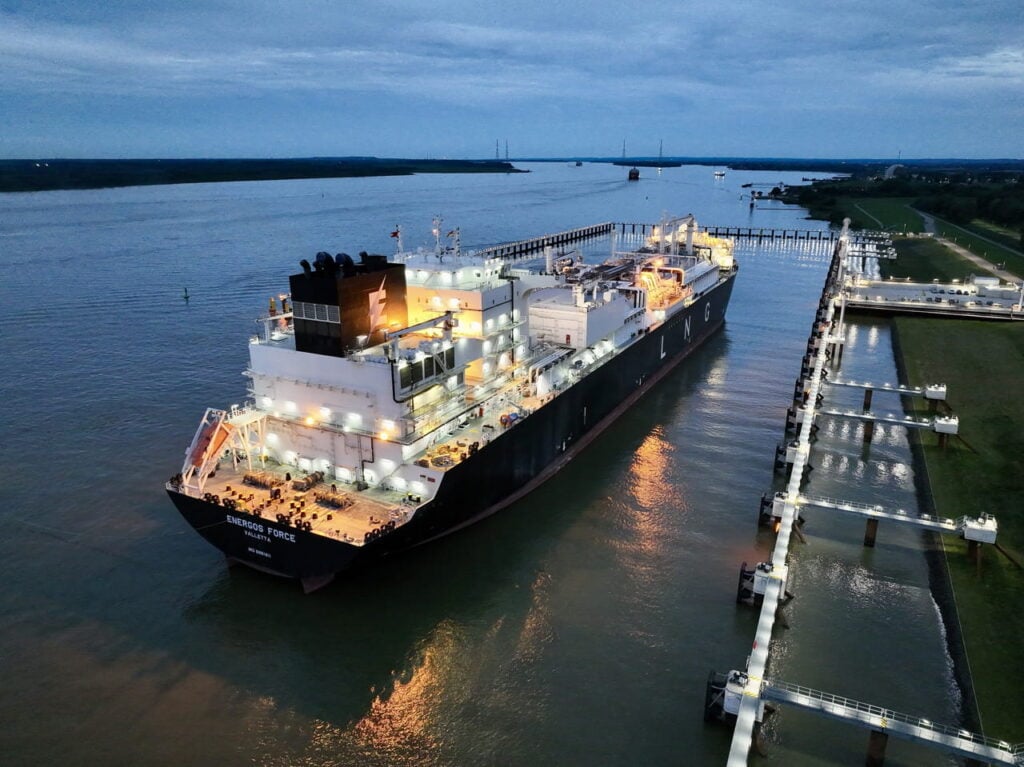
Caption: The FSRU looks like an LNG ship because it is one. The terminal is the jetty, the arms and the pipe that leaves the picture.
Two arms people mix up
Cryogenic LNG arm (or hose)
Carries liquid at −160 °C and low pressure between the LNGC and the FSRU (ship-to-ship) or, at a land plant, between ship and tank. Stainless, insulated, emergency release. This is not the grid connection.
High-pressure natural gas (HPNG) arm
Carries regasified gas from the FSRU to the jetty pipe. Warm. High pressure. Often 16-inch class, ANSI 900. Specs follow OCIMF marine loading-arm practice, but the duty is gas, not LNG. Many jetties install two arms: one working, one spare. Downstream you often get a pig launcher before the line goes down the trestle.
If the geometry is ugly, designers use high-pressure flexible hose instead of a rigid chickson arm. Same job: get 80–100 bar gas off a moving deck without leaking.
Kitchen version: the LNG arm is the tap from the keg into the fridge. The HP arm is the beer line to the taproom. Mix them up and you have a very expensive ice sculpture — or a flange that cannot hold pressure.
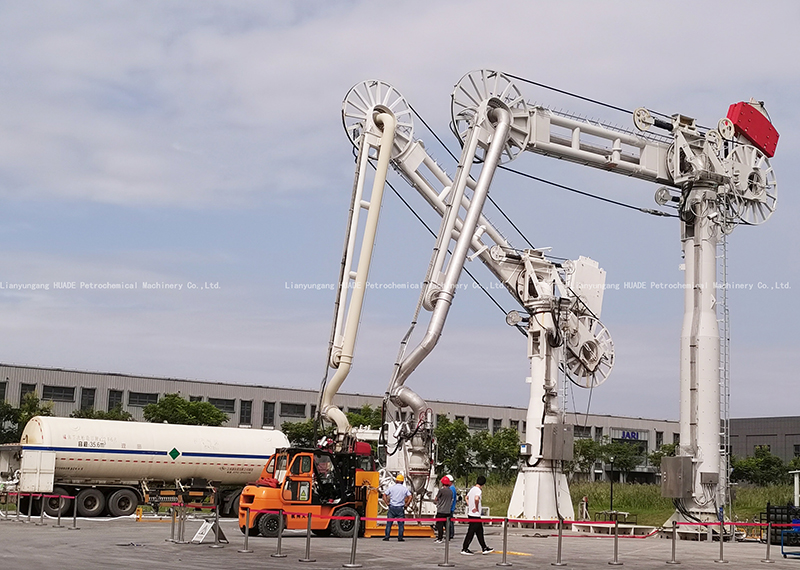
Caption: Loading arms look like cranes because they must follow the ship. On an FSRU jetty, the tall ones for LNG and the HP gas arms are different machines.
Jetty vs turret (and why it changes the pipe)
Jetty-moored (most common)
The FSRU ties to a purpose-built jetty: breasting dolphins, quick-release hooks, gangway, pipe trestle to shore. The HP arm sits on a loading platform. An LNGC may berth on the other side (side-by-side) or use a second berth. Civil works are heavy. Operations are familiar. Weather limits are the berth’s limits.
Offshore buoy / turret / STL-style
The FSRU weathervanes on a single-point mooring. Sendout goes down a riser or flexible to a subsea pipeline, then to a landfall. No long trestle. Harder hook-up, harder pigging, harder inspection. Better where the coast is shallow, crowded, or politically allergic to a jetty.
Island / nearshore dolphin field
A short jetty in open water, trestle to beach. Germany’s first floating terminals looked like this: a lot of steel in the water before the ship arrived.
The pipeline engineer cares about one question: where does the first piggable, buryable line begin?On a jetty it begins after the arm and the launcher. On a turret it begins at the PLEM on the seabed.
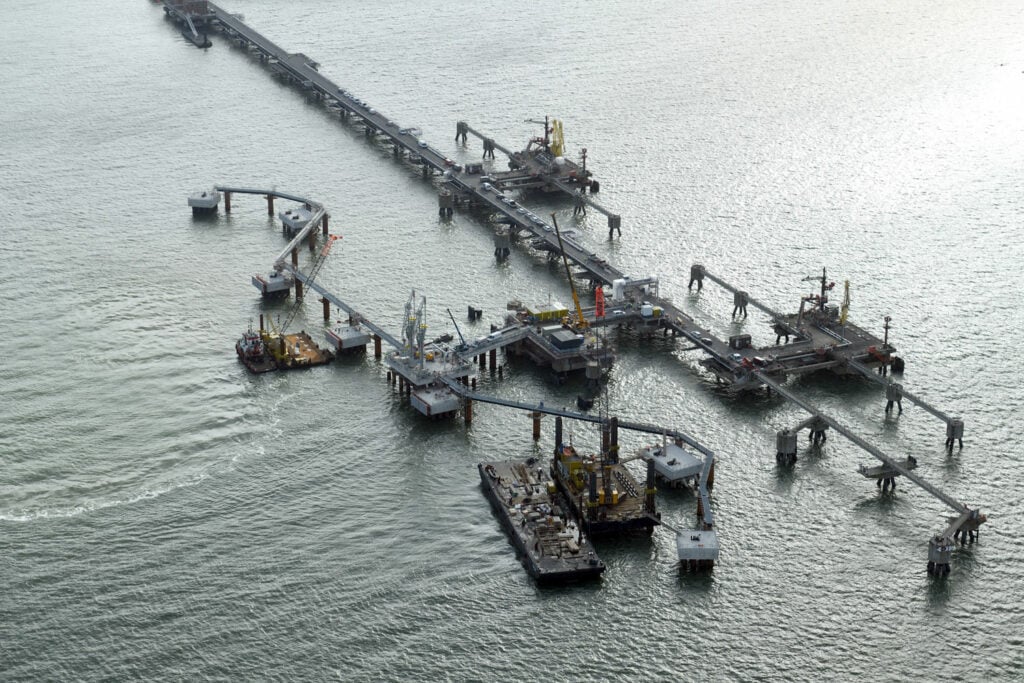
Caption: This is the hook-up: dolphins, trestle, pipeway. The FSRU has not even docked. First gas still waits on that steel.
The onshore header — where FSRU projects stall
The ship can be on hire. The vaporizers can be ready. Gas still dies at the header if:
- the sendout pressure does not match the grid (too high, you need a let-down station; too low, the grid will not take it)
- Wobbe / calorific value is off spec (nitrogen injection or liquid ballasting)
- there is no odorization where the code wants it
- the landline has no metering / fiscal skid the shipper will accept
- the ESD (emergency shutdown) between ship and jetty is not interlocked with the grid ESD
- the beach crossing or trestle is late
- nobody agreed who owns the flange: ship, port, or pipeline company
A 17 km, 36-inch high-pressure line from jetty to grid (Saros-class) is a normal pipeline job: welding, burial, hydrotest, walking/buckle check. It is also the item that misses first-gas dates.
Mooring kit is not decoration either. Quick-release hooks on a “permanent” FSRU rust in place because they are rarely used — until the night you need them. Ship-to-ship mooring is short lines and high snatch loads. The civil EPC and the ship owner must rate the same hooks.
What to put on the spreadsheet
- HP arm FAT / PERC (emergency release) test
- spare arm available
- design sendout pressure vs grid MAOP
- pig launcher on the jetty, not “later onshore”
- ESD cause-and-effect between FSRU, jetty and header
- as-built KP of the landline, cover, hydrotest pack
- LNGC berth window vs FSRU sendout (you can empty a tank and still not accept a cargo if STS is down)
Same discipline as SURF: the pretty vessel is not the critical path. The flange is.
Bottom line
An FSRU turns LNG into pipeline gas on a hull.
The HP sendout arm (or hose) is how that gas leaves the hull.
The jetty or turret is how the hull stays put.
The onshore header is how a country actually burns the molecule.Miss any one and you have expensive storage with no customers — which is not a terminal.
Read with: LNG sendout vs pipeline gas · Hydrates · SURF.
FSRU, LNG, pipelines, sendout, technical
By Oko Immanuel . Offshore Pipeline Insight