February 18, 2026,
Written by Oko Immanuel  – Petroleum/ Subsea Engineer & Former Roughneck
The World’s Major Oil Producer in 2025: The United States Maintains Its Lead In 2025, the United States Solidified its position as the world’s largest oil producer, continuing a multi-year streak that began in the late 2010s. According to data from the U.S. Energy Information Administration (EIA) and other global energy reports, the U.S. produced an average of approximately 20–22 million barrels per day (including crude oil, lease condensate, and other petroleum liquids), accounting for roughly 20–22% of total global production.
This output far outpaced the next closest producers. Saudi Arabia, long considered the dominant force in OPEC and global oil markets, ranked second with production around 10.8–11.1 million barrels per day (about 11% of the world total). Russia followed closely in third place at roughly 10.5–10.8 million barrels per day, while Canada and China rounded out the top five with outputs in the 5–6 million barrels per day range each.
Key Drivers Behind U.S. Dominance in 2025The U.S. surge is largely driven by the shale revolution, particularly in regions like the Permian Basin (Texas and New Mexico), which accounted for a significant portion of the country’s output. Technological advancements in hydraulic fracturing (fracking) and horizontal drilling, combined with improved efficiency and lower breakeven costs, allowed U.S. producers to ramp up production even amid fluctuating global prices and OPEC+ quotas.In contrast, Saudi Arabia and other OPEC+ members (including Russia) continued to manage supply through voluntary cuts and production agreements, aiming to support prices. These restraints limited their output growth compared to the more flexible U.S. market, where private companies respond quickly to price signals
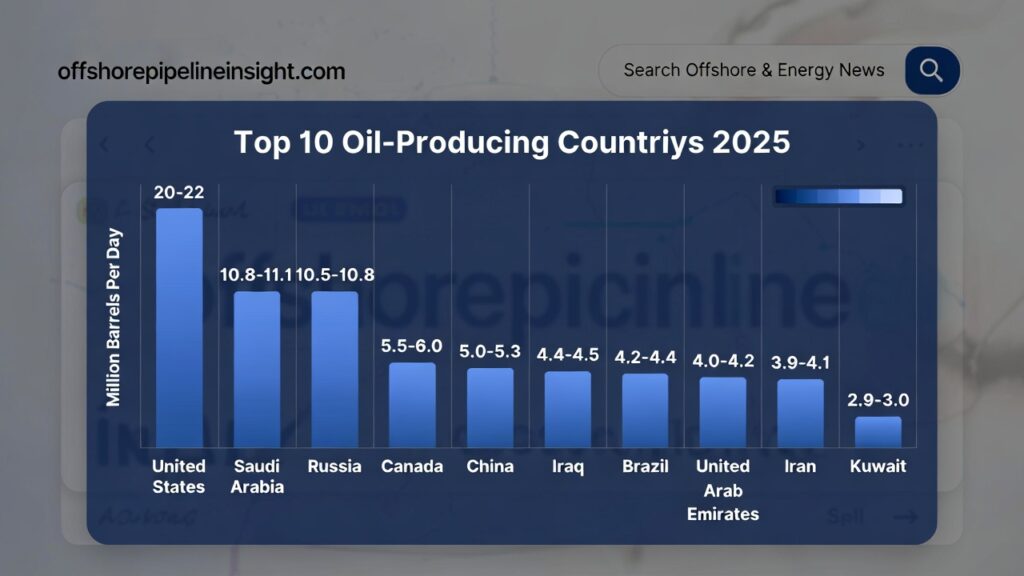
Global Context and Top ProducersHere are the approximate top oil-producing countries in 2025 (based on average daily crude and condensate production, sourced from EIA, OPEC, and industry estimates):
- United States — ~20–22 million b/d (world leader)
- Saudi Arabia — ~10.8–11.1 million b/d
- Russia — ~10.5–10.8 million b/d
- Canada — ~5.5–6 million b/d
- China — ~5–5.3 million b/d
- Iraq — ~4.4–4.5 million b/d
- Brazil — ~4.2–4.4 million b/d
- United Arab Emirates — ~4.0–4.2 million b/d
- Iran — ~3.9–4.1 million b/d
- Kuwait — ~2.9–3 million b/d
Together, the top 10 countries accounted for about 70–75% of global oil production in 2025, with the U.S. alone contributing more than Saudi Arabia and Russia combined in many months
Looking Ahead :The U.S. lead in 2025 reflects a structural shift in global energy markets, with non-OPEC+ production (especially from the Americas) growing faster than OPEC-controlled supply. While geopolitical factors, energy transition policies, and price volatility could influence future rankings, the United States’ position as the world’s top oil producer remained unchallenged in 2025.This data highlights the evolving dynamics of the global oil industry, where technological innovation and market responsiveness increasingly determine who produces the most.
Subsea & Offshore Pipeline Engineer
Texas A&M Petroleum & Subsea Engineering Alum
Former Roughneck