By Oko Immanuel,M.Eng in Subsea Engineering
Published: February 25, 2026
Managed Pressure Drilling (MPD) has become essential for safely drilling High-Pressure High-Temperature (HPHT) wells in deepwater offshore environments. In 2026, with narrow mud windows, high bottom-hole pressures (>15,000 psi), and temperatures (>150 °C), MPD allows precise bottom-hole pressure (BHP) control, reduces kick/loss risks, and improves drilling efficiency.
Why MPD Is Critical in Offshore HPHT Wells
Conventional overbalanced drilling often fails in HPHT due to:
- Pore pressure and fracture gradient within 0.2–0.5 ppg
- Rapid gas expansion during influx
- High ECD fluctuations from circulation and temperature effects
- Deepwater riser friction and cold seawater cooling the annulus
MPD maintains constant BHP within the mud window, enabling drilling where static mud weight alone would cause losses or kicks.
Main MPD Techniques Used in 2026 Offshore HPHT Wells
- Constant Bottom Hole Pressure (CBHP)
- Back-pressure applied at surface (choke manifold) to compensate for ECD changes when pumps are off.
- Primary method for narrow-margin HPHT wells.
- Mud Cap Drilling (MCD)
- Sacrificial fluid column above the annulus used when losses exceed influx.
- Common in deepwater HPHT with severe losses.
- Dual Gradient Drilling (DGD)
- Subsea mud-lift pump or riserless mud recovery reduces hydrostatic pressure in the riser.
- Reduces ECD in long deepwater risers.
- Return Flow Control (RFC)
- Subsea pressure control device (e.g., subsea choke) for riser gas handling.
- Growing in 2026 for ultra-deepwater HPHT.
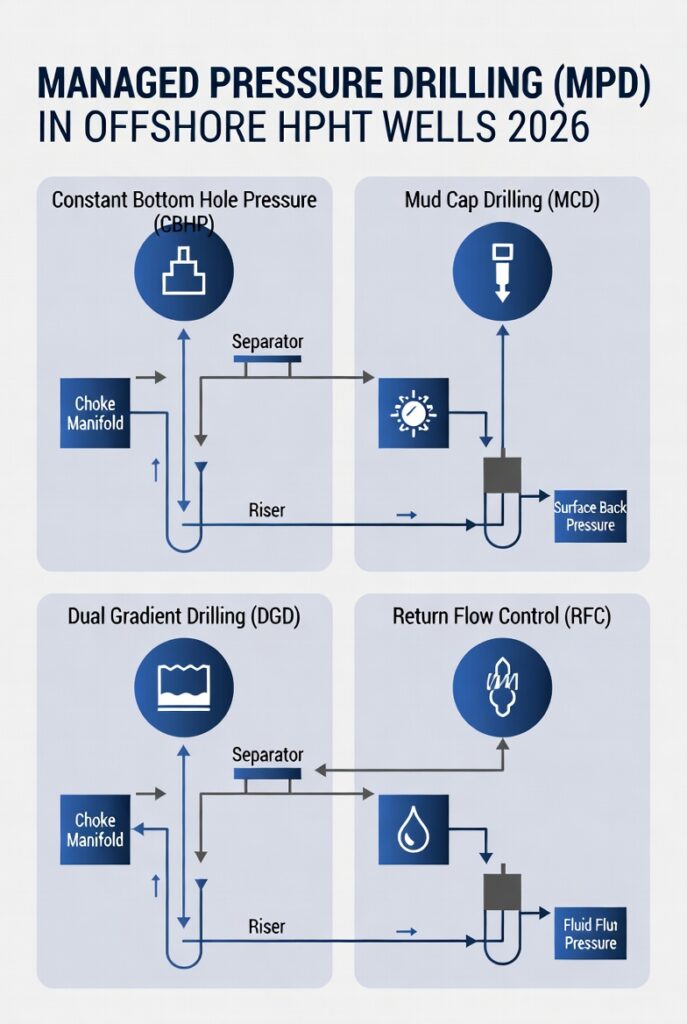
H3. MPD Managed Pressure Drilling (MPD) in offshore HPHT wells 2026
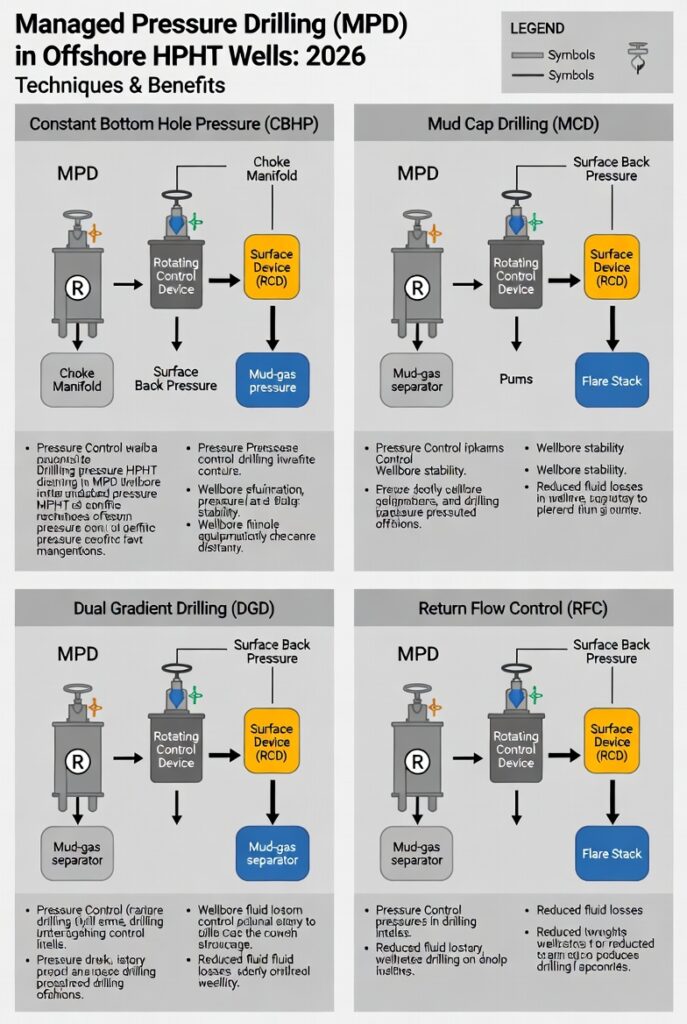
Figure 2. Managed Pressure drilling in HPHT offshore wells: 2026 Techniques and benefits.
Key Benefits in Offshore HPHT Drilling
- Improved Well Control: Early kick detection and immediate BHP adjustment — reduces influx volume and blowout risk.
- Lower Mud Weight : Drill with lighter mud → reduced ECD-induced losses.
- Faster ROP : Less frequent mud-weight changes → continuous drilling.
- Narrow Margin Drilling : Enables access to reservoirs previously undrillable.
- Riser Fatigue Reduction : Lower mud weight decreases top tension and VIV.
- Cost Savings : Fewer sidetracks, casing strings, and lost circulation events.
Integrity & Flow Assurance Parallels to Subsea Pipelines
- ECD Management : Similar to pipeline flow assurance (preventing hydrate/wax blockages via pressure/temperature control).
- Riser Fatigue : HPHT pipeline cyclic loading models apply directly to marine riser fatigue analysis.
- Digital Twins :Pipeline twins predict buckling; drilling twins forecast ECD, kick risk, and riser fatigue.
- Monitoring : PWD tools in MPD mirror pipeline fiber-optic sensing for real-time pressure/temperature.
Practical 2026 Engineer Tips
- Use MPD with PWD for real-time ECD calculation (ECD = MW + APL/TVD).
- Set CBHP back-pressure 50–100 psi above pore pressure during connections.
- Model riser fatigue with HPHT-style cyclic analysis (DNV-RP-C203).
- Integrate digital twins for predictive kick detection and MPD optimization.
- Test mud systems for HPHT compatibility hydrate inhibition and barite sag prevention are critical.
MPD is no longer optional in deepwater HPHT drilling it’s the enabling technology that makes narrow-margin wells drill able and safe.
Lessons from HPHT pipeline integrity continue to strengthen MPD systems.
What MPD technique has been most effective in your HPHT projects?
Share in the comments!
Share on LinkedIn for drilling & subsea pros.
Subscribe for HPHT series updates, offshore wind insights, and energy transition news.