By Oko Immanuel, MSc in Subsea Engineering.
Published: February 25, 2026
Wax deposition remains one of the most persistent flow assurance threats in long HPHT subsea flowlines (>50 km tie-backs, pressures >10,000 psi, temperatures >150 °C). As fluids cool below the Wax Appearance Temperature (WAT) and Pour Point, paraffin molecules crystallize, adhere to the pipe wall, and build layers that reduce diameter, increase pressure drop, and can cause complete blockages.In 2026, with ultra-long tie-backs and increasing water cut in mature fields, operators balance chemical inhibition and thermal management (or hybrid solutions) to keep production flowing reliably while controlling OPEX and environmental impact.
Wax Deposition Mechanisms in HPHT Flowlines
- Wax Appearance Temperature (WAT): Temperature where first wax crystals form (typically 30–60 °C in HPHT crudes).
- Pour Point: Temperature where oil loses flowability due to wax network formation.
- Deposition zone: Occurs where bulk fluid temperature drops below WAT but wall temperature is still above WAT (cold wall effect).
- Long tie-backs: Extended cooling distance → thicker deposits over time.
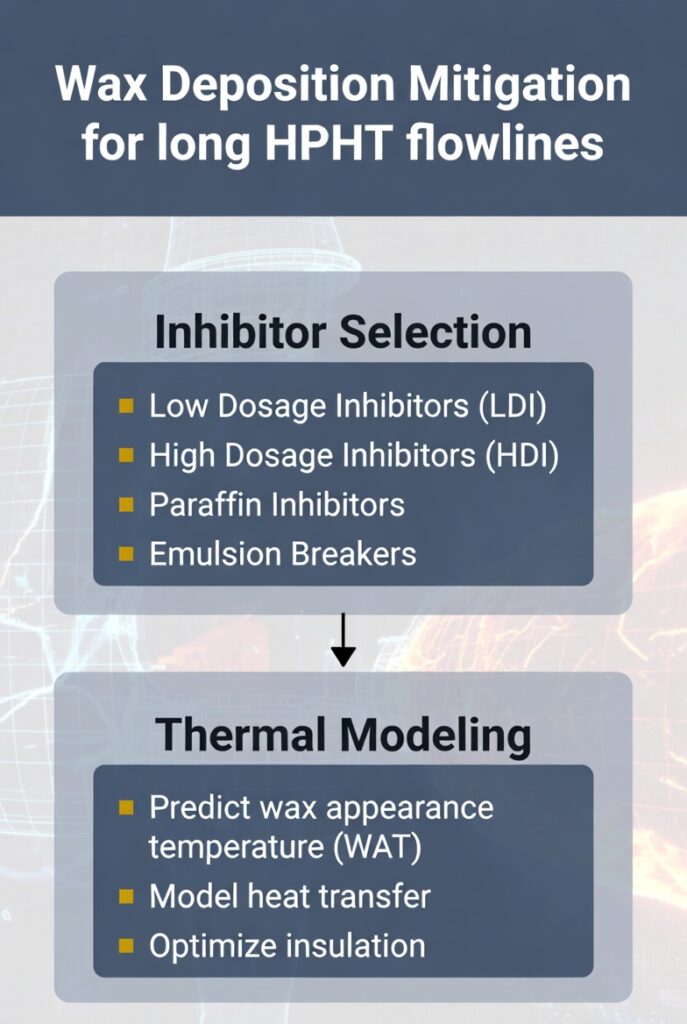
H2 Figure 1. Wax Deposition Mechanisms in HPHT Flowlines
Chemical Inhibition Strategies
- Thermodynamic Hydrate Inhibitors (THI) – Wax Inhibitors
- Solvent-based or crystal modifiers that lower WAT and/or inhibit crystal growth.
- Common chemistries: ethylene-vinyl acetate (EVA) copolymers, alkyl acrylate polymers, polyalkylmethacrylates.
- Dosage: 50–500 ppm depending on wax content and WAT depression required.
- 2026 trend: High-efficiency, low-dosage paraffin inhibitors (LDPI) with better performance in high-temperature environments.
- Dispersants & Anti-Agglomerants
- Keep wax particles suspended in bulk fluid rather than depositing on walls.
- Effective in high water-cut systems where wax/water emulsion forms.
- Advantages
- Lower CAPEX (no hardware beyond injection system)
- Flexible dosage adjustment during field life
- Proven in many HPHT fields (e.g., Gulf of Mexico, North Sea)
- Disadvantages
- High OPEX (chemical cost + umbilical logistics)
- Potential compatibility issues with other chemicals (scale/corrosion inhibitors)
- Limited effectiveness in very long tie-backs (>100 km)
Thermal Management Strategies
- Passive Insulation
- Pipe-in-pipe (PIP), syntactic foam, polyurethane, aerogel blankets.
- Goal: Extend cool-down time so fluid temperature stays above WAT during shut-in (typically 12–48 hours required).
- Active Heating
- Direct Electrical Heating (DEH) current through pipe wall or trace cables.
- Hot fluid circulation or trace-heated pipe-in-pipe (THPIP).
- 2026 advancement: DEH systems now qualified for HPHT pressures/temperatures; hybrid insulation + DEH for ultra-long tie-backs.
- Advantages
- No chemical injection → lower OPEX and environmental footprint
- Effective for long tie-backs and high water-cut systems
- Enables extended shut-in periods
- Disadvantages
- High CAPEX (insulation + power umbilical)
- Power supply requirements (topsides or subsea power generation)
- Installation complexity in deepwater
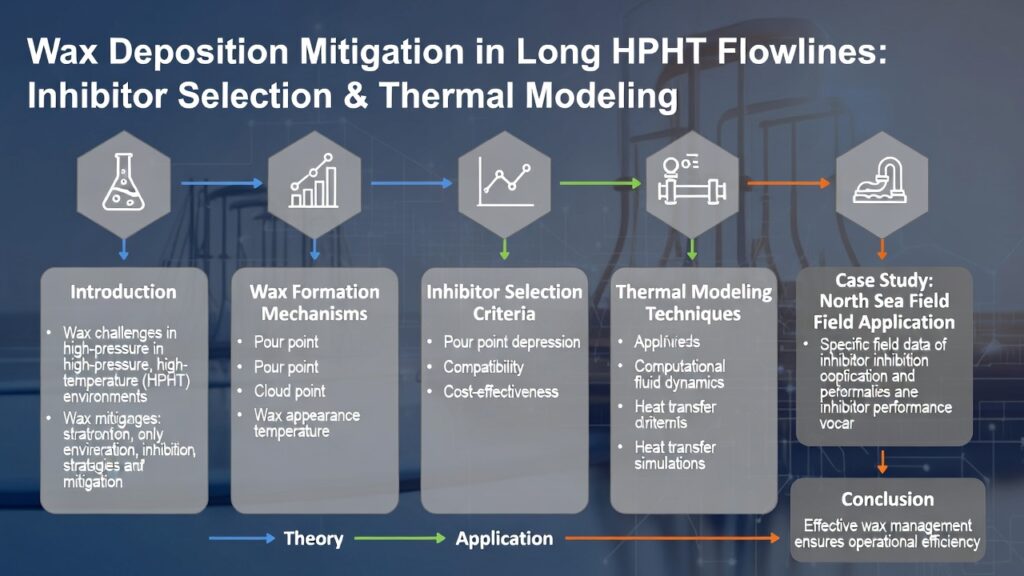
Hybrid & Emerging Approaches in 2026
- Insulation + Low-Dosage Inhibitors Combine passive thermal with minimal chemical for cost/opex balance.
- Cold Flow : Allow controlled wax slurry transport still field-trial stage but gaining interest for ultra-long tie-backs.
- Digital Twins & Predictive Tools Real-time thermal modeling (OLGA/PIPESIM) + sensor data to predict deposition rate and optimize pigging/inhibitor injection.
Practical 2026 Engineer Tips
- Determine WAT/Pour Point early via live oil analysis not just stock tank samples.
- Model thermal cool-down (OLGA/PIPESIM) for worst-case shut-in duration.
- For short tie-backs (<50 km): Chemical inhibition + basic insulation usually sufficient.
- For long tie-backs (>80 km): Evaluate DEH or hybrid insulation + LDPI.
- Always qualify inhibitors at HPHT conditions high temperature degrades many chemistries.
- Use fiber-optic DTS for real-time temperature profiling to validate models and detect early deposition.
Wax deposition mitigation in long HPHT flowlines remains a balance of cost, reliability, and environmental considerations. Chemical inhibition is proven, thermal is future-proof for long tie-backs, and hybrids are increasingly the norm in 2026.
What wax mitigation strategy are you using in your HPHT flowlines?
Share in the comments!
Share on LinkedIn for flow assurance & subsea pros.
Subscribe for HPHT series updates, offshore wind insights, and energy transition news.