By Oko Immanuel February 27 2026
Founder & Owner, Offshore Pipeline Insight
Texas A&M Subsea Engineering Alumnus | Former Roughneck
As we hit the end of February 2026, the push toward net-zero emissions is more urgent than ever. Amid fluctuating oil prices, surging LNG demand, and the rapid expansion of offshore wind, Carbon Capture, Utilization, and Storage (CCUS) commonly known as CCS—emerges as a game-changer. This technology not only helps decarbonize heavy industries but also bridges traditional hydrocarbon operations into a sustainable future. For offshore pipeline professionals like us, CCUS means repurposing subsea infrastructure for CO₂ transport and injection, unlocking new opportunities in basins like the Gulf of Mexico, North Sea, and beyond.
In this deep dive, we’ll explore how CCS works, its offshore applications, real-world examples, and why it’s crucial for subsea integrity experts tackling HPHT challenges. Drawing from my Texas A&M subsea engineering roots and roughneck experience, I’ll break it down practically focusing on pipeline repurposing, integrity management, and energy transition synergies.
Understanding CCS/CCUS: The BasicsAt its core, CCS captures carbon dioxide (CO₂) from industrial sources before it enters the atmosphere, transports it safely, and stores it permanently underground. When “utilization” is added (CCUS), captured CO₂ can be repurposed for enhanced oil recovery (EOR), chemical production, or even building materials, turning a liability into an asset.
The process breaks down into three key phases:
- Capture: CO₂ is separated from emissions using technologies like post-combustion (amine solvents for flue gases), pre-combustion (gasification), oxy-fuel combustion, or direct air capture. Post-combustion is popular for retrofitting existing plants, capturing up to 90%+ of CO₂.
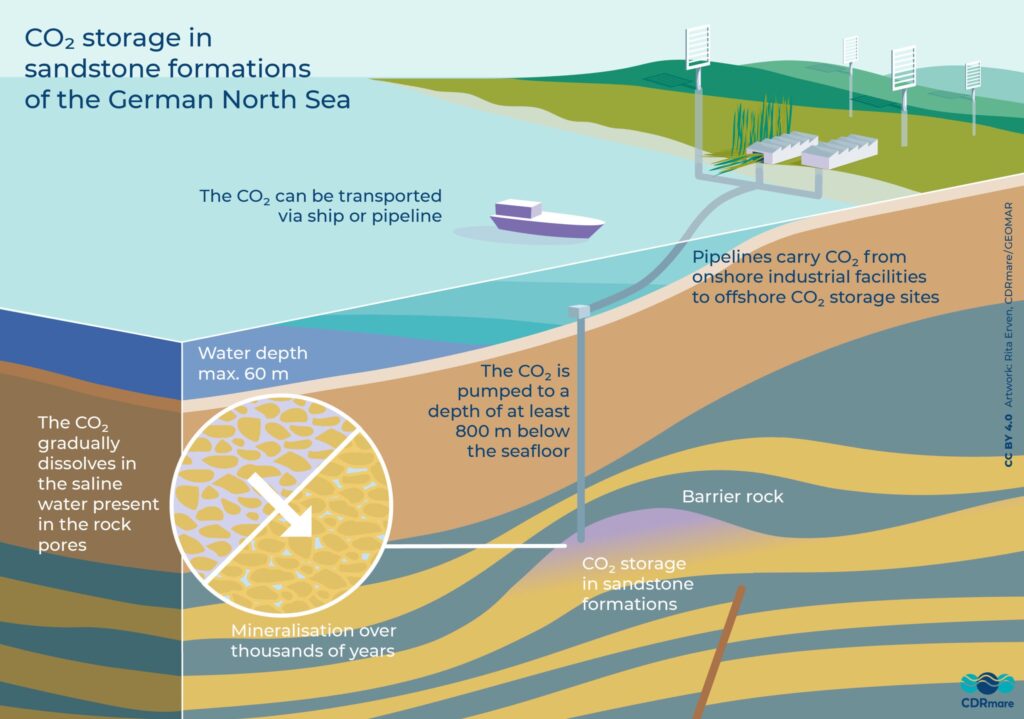
- Transport: Captured CO₂ is compressed into a dense, supercritical state and moved via pipelines (the most efficient for large volumes) or ships. Offshore, this often involves subsea pipelines—repurposed from oil/gas service—to handle high-pressure flows without phase changes or corrosion issues.
- Storage/Sequestration: CO₂ is injected deep into geological formations (>800–1,000 meters) where it’s trapped long-term. Options include depleted oil/gas reservoirs, deep saline aquifers, unmineable coal seams, or basalt rocks for rapid mineralization.
Multiple trapping mechanisms ensure security:
- Structural trapping: Impermeable caprock acts as a seal.
- Residual trapping: CO₂ gets stuck in rock pores.
- Solubility trapping: Dissolves in underground brine.
- Mineral trapping: Reacts to form stable carbonates over time.
Global storage capacity is massive estimated at hundreds of gigatons making CCS a viable bridge to renewables.
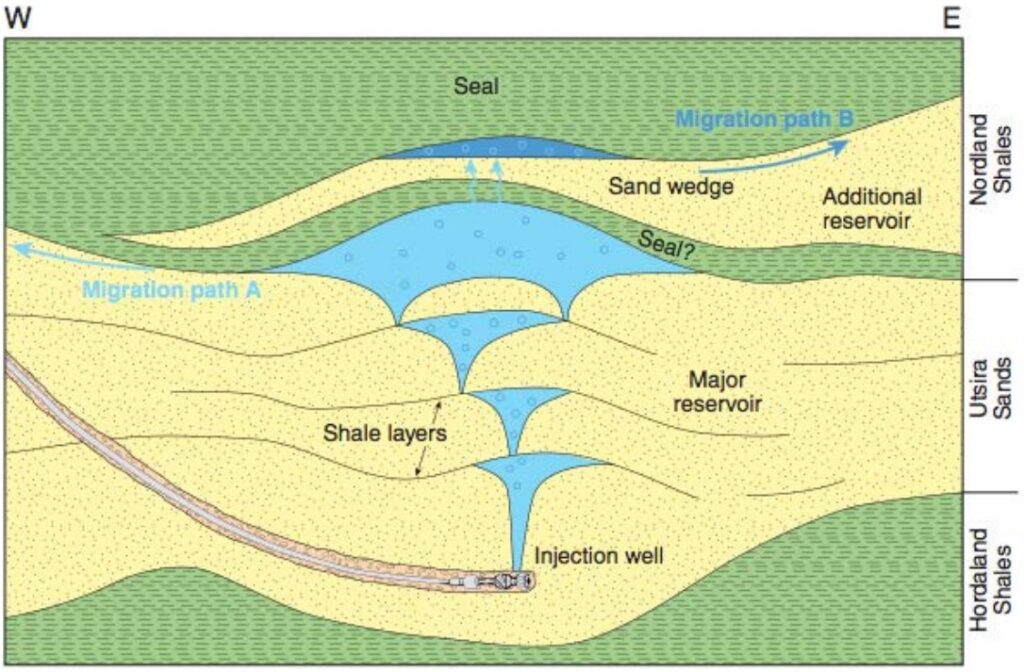
“Sleipner field offshore CO₂ injection: Platform-based delivery via subsea infrastructure and storage in the Utsira saline formation beneath the North Sea seabed. This pioneering project (operational since 1996) demonstrates secure sub-seabed sequestration with real-time monitoring. Source: RPS Group (inspired by Equinor/Sleipner operations)”
Offshore Advantages: Why Subsea Pipelines Are KeyOffshore environments are ideal for CCS: vast sub-seabed storage sites, proximity to coastal emitters (e.g., refineries, power plants), and reduced public resistance compared to onshore. The natural water column adds pressure stability, enhancing CO₂ containment.For subsea pros, the real excitement lies in infrastructure repurposing. Existing HPHT pipelines, flowlines, and tiebacks designed for harsh deepwater conditions can be adapted for CO₂ service with upgrades for corrosion resistance (e.g., from water or impurities) and fracture control. Digital monitoring tools (fiber optics, AI-driven sensors) ensure integrity, drawing parallels to traditional pipeline life extension strategies.Challenges? Absolutely managing dense-phase CO₂ flow to avoid two-phase issues, ensuring wellhead metallurgy withstands corrosives, and complying with regulations like the London Protocol. But the payoffs include extended asset life, new revenue from CO₂ transport fees, and alignment with energy majors’ net-zero pledges.
Real-World Example: The Sleipner ProjectA standout case is Norway’s Sleipner field in the North Sea, operational since 1996. Here, CO₂ is stripped from natural gas production, compressed, and injected via platform-based subsea infrastructure into the Utsira saline formation ~1,000 meters below the seabed.
Over 20 million tons of CO₂ have been stored with zero leaks, thanks to rigorous monitoring (4D seismic, well data).Sleipner CO₂ Storage SchematicSleipner field offshore CO₂ injection: Platform-based delivery via subsea infrastructure, injection wells, and permanent storage in the Utsira saline formation beneath the North Sea seabed.
This real-world project demonstrates secure sub-seabed sequestration with comprehensive monitoring (capture → transport → store → monitor phases, including CO₂ plume in depleted/saline reservoir). Source: RPS Group (based on Equinor/Sleipner operations)Projects like Northern Lights (expanding in 2026) and emerging Gulf of Mexico hubs (e.g., ExxonMobil’s initiatives) are scaling this model, integrating CCS with offshore wind for hybrid low-carbon platforms.
2026 Outlook: Trends and Opportunities : This year, CCS investments surge amid policy support (e.g., US Inflation Reduction Act extensions, EU carbon pricing). Global capacity could hit 100+ million tons annually by 2030, with offshore sites leading due to scale. For oil & gas, CCUS enables “blue” hydrogen production and EOR, boosting recovery by 10–20% in mature fields.Subsea trends to watch:
- Hydrogen Synergies: Pipelines co-transporting CO₂ and hydrogen for offshore hubs.
- Digital Twins: AI models for predictive integrity in CO₂ lines.
- HPHT Adaptations: Leveraging deepwater tech for high-pressure injection.
Yet, hurdles remain: high upfront costs (~$50–100/ton captured), regulatory harmonization, and public education on safety.
Key Takeaways for Offshore Professionals : CCS/CCUS isn’t just environmental it’s a business enabler. Repurposed subsea pipelines cut deployment time/costs, while HPHT expertise ensures safe, reliable operations. From my days as a roughneck to Texas A&M subsea labs, I’ve seen how innovation under pressure drives progress. In 2026, embrace CCS to future-proof your projects.
What do you think? Is CCS the missing link in your offshore strategy, or do challenges like integrity management hold it back?
Comment below with your insights share real-world experiences from the field or questions on repurposing pipelines.
Don’t forget to share this article with your network to spark the conversation!
Stay tuned to Offshore Pipeline Insight for more on HPHT, subsea trends, and energy transition tools.
Gig ’em, Aggies!#CCS #CCUS #CarbonSequestration #OffshoreStorage #SubseaPipelines #EnergyTransition #GigEm #AggieEngineers