March 1, 2026By Oko Immanuel
Founder & Owner, Offshore Pipeline insight.
M.Eng in Subsea Engineering | Former Roughneck | Texas A&M AlumnusIn
offshore oil and gas production, especially in deepwater and HPHT environments, the journey from reservoir to surface processing is critical for flow assurance, integrity, and efficiency. The diagram below illustrates a typical oil production process starting at the wellhead, through chemical injection, 3-phase separation, sampling, and final export of oil, gas, and produced water.This process is foundational for subsea tieback systems, where remote wells connect via pipelines to existing platforms or onshore facilities. As we move into 2026, with maturing fields and energy transition pressures, understanding this flow is essential for pipeline engineers tackling HPHT challenges, corrosion, and repurposing for CCUS/hydrogen.Oil Production Process Diagram
Typical offshore oil production process: Wellhead multiphase flow → Chemical injection → 3-phase separator → Oil, gas, and water separation with sampling points → Export and laboratory analysis. Source: Oil Gas World (adapted for offshore context).
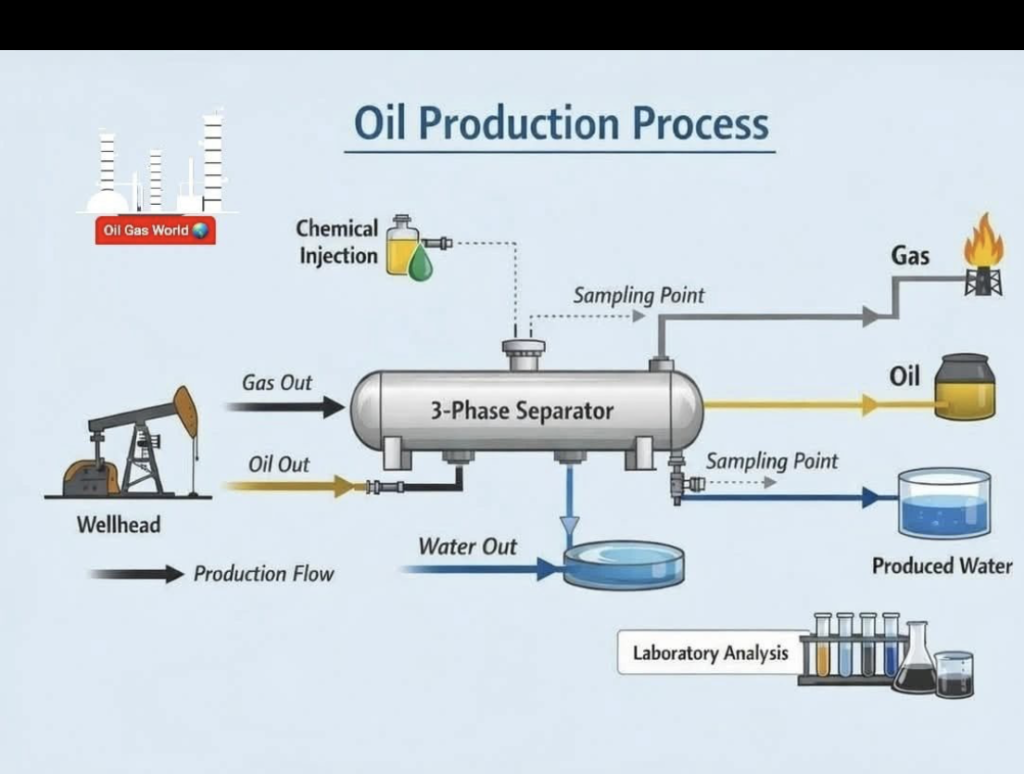
1. Wellhead – The Starting PointThe process begins at the wellhead, where the multiphase fluid (oil, gas, water, and sometimes solids) emerges from the reservoir. In offshore settings:
- Subsea wellheads are installed on the seabed.
- Christmas trees control flow and pressure.
- Initial production flow enters the subsea manifold or flowlines.
In deepwater tiebacks, this fluid travels through insulated pipelines to minimize heat loss and hydrate formation.
2. Chemical Injection – Enhancing SeparationChemical injection occurs early (often at the wellhead or manifold) to address issues like:
- Emulsions (oil-water mixtures) → Demulsifiers break them.
- Corrosion → Inhibitors protect pipelines and equipment.
- Hydrates/Scale → Methanol or inhibitors prevent blockages.
Injection points are critical for long subsea tiebacks, as chemicals must be dosed accurately to maintain integrity over long distances.
3. 3-Phase Separator – Core Separation StageThe heart of the process is the 3-phase separator (horizontal or vertical vessel), where gravity and residence time separate the stream into:
- Gas (top) → Routed to compression, flare, or export.
- Oil (middle layer) → Sent to storage, stabilization, or further processing.
- Produced water (bottom) → Treated and discharged/re-injected.
Key mechanisms:
- Inlet diverter breaks momentum.
- Weir plates maintain levels.
- Mist extractors remove entrained liquids from gas.
In offshore platforms, separators handle high pressures (HPHT) and variable flows. For subsea tiebacks, separation often occurs topside, but emerging subsea separation (e.g., compact systems) reduces topside load and enables longer tiebacks.
4. Sampling Points – Quality Control & Integrity MonitoringDedicated sampling points allow operators to collect representative samples of oil, gas, and water for laboratory analysis. This ensures:
- Product quality (BS&W – basic sediment & water content).
- Process optimization.
- Early detection of corrosion, scale, or emulsion issues.
In subsea systems, sampling is challenging — often done topside or via ROV/AUV tools.5. Final Outputs & Export
- Oil → Stabilized and exported via tanker or pipeline.
- Gas → Compressed for pipeline export or used for reinjection.
- Produced water → Treated (hydrocyclones, flotation) and reinjected or discharged.
In subsea tiebacks, export pipelines carry stabilized fluids over long distances — demanding robust integrity management (corrosion monitoring, pigging, flow assurance).
Offshore Tieback Relevance in 2026Many modern fields use subsea tiebacks to existing platforms (e.g., recent North Sea examples like Solveig Phase 2 or Irpa). The process diagram remains similar, but challenges include:
- Longer flowlines → Increased pressure drop, hydrate risk.
- HPHT conditions → Advanced materials, insulation.
- Transition → Repurposing for CO₂/hydrogen transport.
Engineers must focus on pipeline design, chemical dosing, and monitoring to ensure safe, efficient production. What do you think?
Have you encountered separation challenges in subsea tiebacks, or do you see subsea separation becoming mainstream?
Comment below with your experiences or questions—share this post with your network!
Stay tuned to Offshore Pipeline Insight for more practical HPHT, subsea integrity, and energy transition insights.
Gig ’em!#OffshoreOilProduction #SubseaTieback #3PhaseSeparator #PipelineIntegrity #EnergyTransition #GigEm #AggieEngineers