By Oko Immanuel
Founder & Owner, Offshore Pipeline Insight
M.Eng in Subsea Engineering | Former Roughneck | Texas A&M Alumnus
March 1, 2026
Cape Station, developed by Fervo Energy in Beaver County, Utah (northeast of Milford), stands as the world’s largest next-generation geothermal project using Enhanced Geothermal Systems (EGS). It combines oil & gas-style horizontal drilling, multi-stage fracturing, and advanced monitoring to unlock clean, firm, 24/7 base load power from hot dry rock a true crossover success story for the energy transition.
Project Overview & Capacity
Cape Station is a multi-phase development targeting a total of 500 MW upon full completion:
- Phase I: 100 MW (initial commercial delivery expected in 2026, with first power potentially as early as late 2026 or early 2027 based on ongoing construction).
- Phase II: Additional 400 MW, targeted for online by 2028. This makes it the largest EGS project globally, with the potential to power hundreds of thousands of homes with reliable, carbon-free energy.
The project leverages proven O&G technologies:
- Horizontal laterals (5,000+ ft) to maximize heat exchange surface area.
- Hydraulic fracturing to create permeable reservoirs in hot dry rock.
- Fiber-optic sensing for real-time temperature, flow, and seismic monitoring.
- Organic Rankine Cycle (ORC) power plants for efficient conversion of hot fluid to electricity.
Key Milestones & Status (as of March 2026)
- Construction Progress: Drilling and power plant buildout are advancing rapidly. Fervo has reported significant improvements in drilling efficiency (times decreasing with each well) and completed appraisal campaigns confirming high-temperature resources (up to 400°F+ at Cape Station depths).
- Funding & Partnerships:
- Raised $462 million in Series E (Dec 2025, led by B Capital).
- Secured $206 million additional financing (June 2025) for Phase I acceleration.
- Partnerships with Baker Hughes (ORC equipment for Phase II), ABB (medium-voltage electrification and motor control), and Turboden (ORC turbines).
- Recent Highlights:
- In Feb 2026, Fervo drilled its hottest well to date at a nearby greenfield site (Project Blanford, >555°F at ~11,200 ft), building confidence for Cape Station scalability.
- Phase I remains on track for commercial operations in 2026, with full permitting and construction underway.
- Economic & Community Impact: Expected to bring jobs and economic benefits to southwest Utah, with minimal surface footprint compared to traditional geothermal or fossil plants.
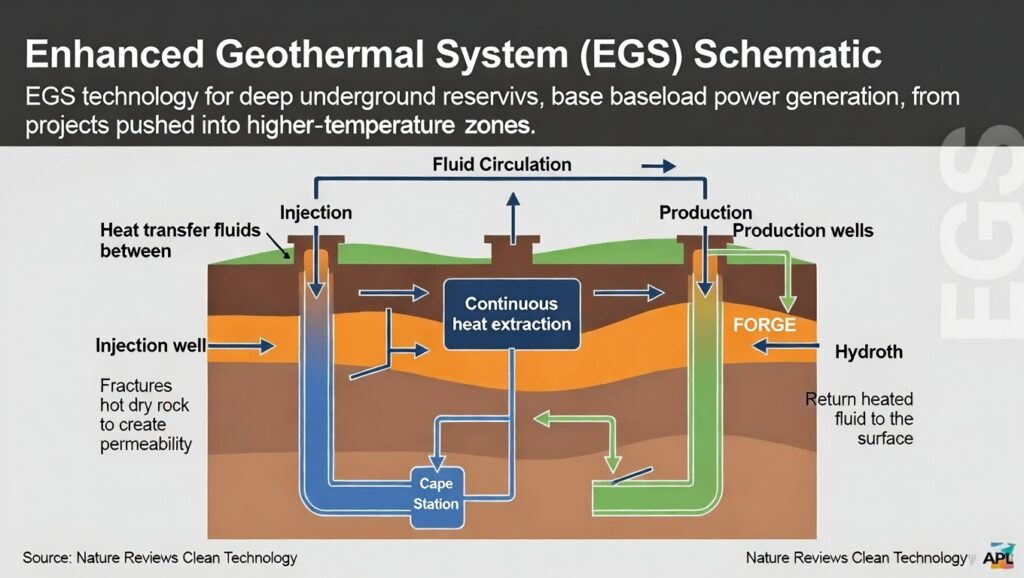
Diagram: Enhanced Geothermal System (EGS) at Cape Station
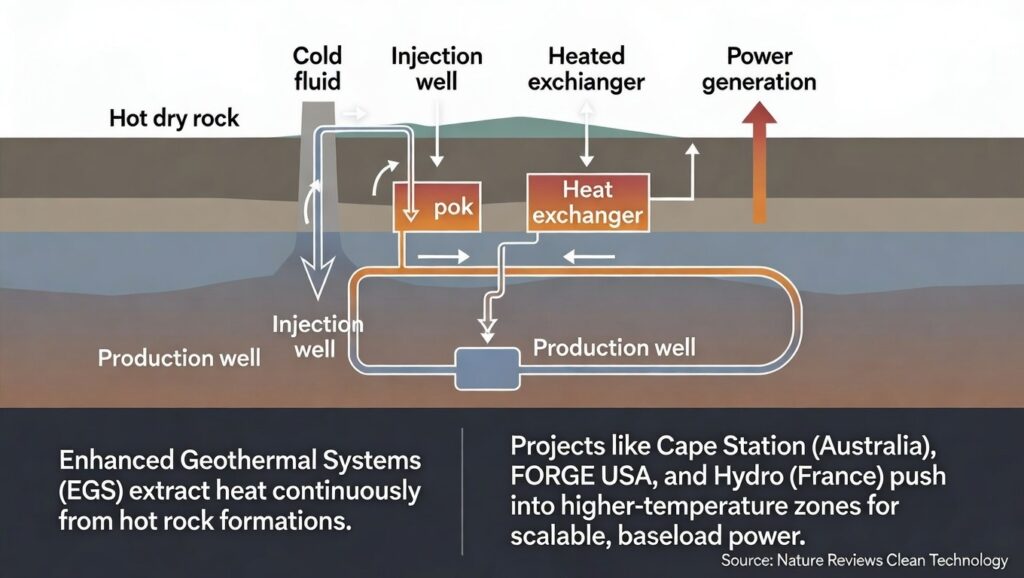
H2 Here is a clear schematic of the EGS process used at Cape Station, showing fluid circulation loops that continuously extract heat:Enhanced Geothermal System (EGS) Schematic – Fracturing & Fluid Circulation
EGS cross-section: Injection well fractures hot dry rock to create permeability, production wells return heated fluid to the surface. Fluid circulation loops extract heat continuously. Projects like Cape Station, FORGE, and Hydroth push into higher-temperature zones for scalable, baseload power. Source: Nature Reviews Clean Technology.
Why Cape Station Matters for Subsea & Pipeline Pros
- Demonstrates O&G crossover success: Horizontal drilling, fracking, and monitoring techniques from shale/deepwater directly enable commercial EGS.
- Flow assurance parallels: Handling hot fluids over long distances mirrors HPHT subsea pipelines corrosion, scaling, and thermal management are shared challenges.
- Future potential: Offshore geothermal could use subsea tiebacks and insulated pipelines for heat extraction positioning subsea expertise for hybrid O&G/geothermal projects.
Cape Station is proof that geothermal can scale rapidly with O&G innovation a game-changer for clean, firm energy in 2026 and beyond.
What do you think? Could subsea pipeline tech play a role in future offshore geothermal developments? Comment below with your thoughts or experiences share this post to spark discussion!
Stay tuned to Offshore Pipeline Insight for more on HPHT, subsea integrity, energy transition crossovers, and emerging projects.
Gig ’em!#GeothermalEnergy #CapeStation #EGS #FervoEnergy #EnergyTransition #GigEm #AggieEngineers