March 3, 2026By Oko Immanuel
Founder & Owner, Offshore Pipeline Insight
M.Eng in Subsea Engineering | Former Roughneck | Texas A&M Alumnus
Offshore wind is scaling rapidly in 2026, with global capacity exceeding 100 GW and annual additions of 30–35 GW. The backbone of every wind farm is the subsea cable system – inter-array cables connecting turbines to the offshore substation and high-voltage export cables delivering power to shore. For subsea pipeline engineers, the parallels are striking: cable burial, protection, corrosion prevention, integrity monitoring, and flow assurance techniques transfer almost directly from pipelines to cables.This article explores key integrity challenges in offshore wind subsea cables and how proven pipeline monitoring methods can reduce risks, extend asset life, and lower OPEX.
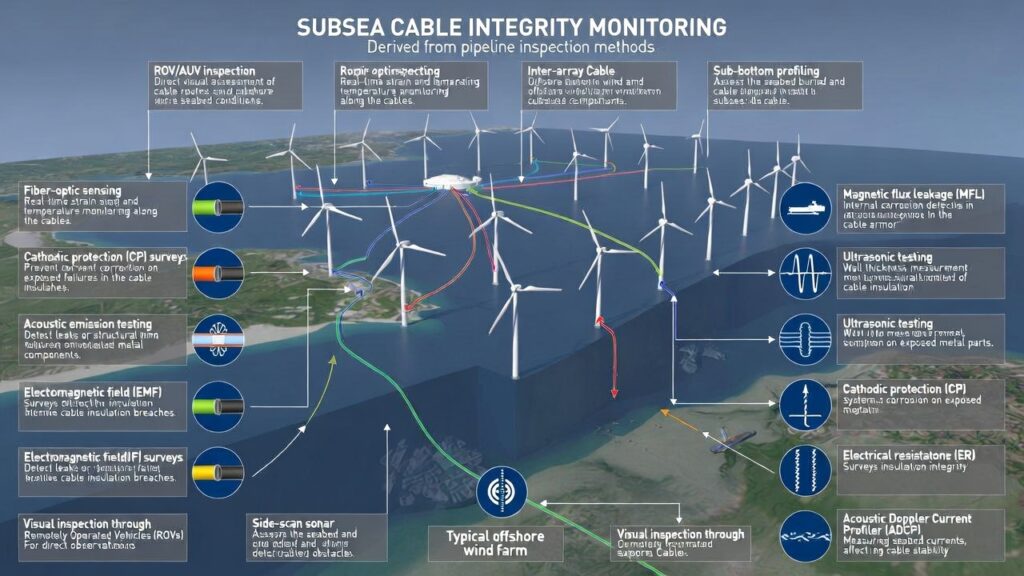
Diagram/photo : Subsea Cable Integrity Monitoring MethodsSubsea Cable Integrity Monitoring – Lessons from Pipeline Techniques Typical offshore wind farm layout showing inter-array cables (connecting turbines to substation) and export cable (to shore). Pipeline-derived monitoring methods (ROV/AUV inspection, fiber-optic sensing, CP surveys) apply directly to cable protection and integrity
Core Subsea Cable Integrity Challenges in 2026
- Mechanical Damage
- Fishing gear, anchors, seabed currents, and installation stresses cause cuts, abrasion, or fatigue.
- Export cables in shallow water are especially vulnerable.
- Corrosion & Degradation
- Seawater exposure attacks armor wires and sheaths.
- Cathodic protection (CP) systems must be monitored to prevent stray current corrosion.
- Thermal & Electrical Stress
- High currents generate heat; poor burial or backfill leads to hotspots and insulation breakdown.
- Partial discharge and water ingress degrade XLPE insulation over time.
- Free Spans & Burial Loss
- Scour and sediment movement create unsupported spans, increasing fatigue and vibration risk.
- Joint & Termination Failures
- Transition joint bays (onshore/offshore) and subsea joints are weak points due to thermal expansion and water ingress.
Lessons from Pipeline Monitoring That Apply Directly
Pipeline integrity tools have decades of field-proven performance in harsh subsea conditions. Here’s how they translate to offshore wind cables:
- ROV/AUV Inspection
- Pipeline lesson: Routine visual and sonar surveys detect dents, coating damage, and anode depletion.
- Cable application: AUVs with high-resolution cameras and multibeam echo sounders inspect cable burial depth, scour, and external damage without diver intervention.
- Cathodic Protection Monitoring
- Pipeline lesson: CP surveys (close-interval, DCVG) ensure protection against corrosion.
- Cable application: Permanent reference electrodes and remote monitoring units track CP status on armor wires and export cable sheaths.
- Fiber-Optic Distributed Sensing
- Pipeline lesson: DTS/DAS detects leaks, third-party interference, and strain.
- Cable application: Fiber integrated into power cables monitors temperature (hotspots), strain (free spans), and acoustic events (anchor drag, fishing impact).
- Acoustic & Pressure Wave Detection
- Pipeline lesson: Negative pressure wave detects sudden leaks.
- Cable application: Acoustic sensors detect cable movement or impact; pressure monitoring in fluid-filled cables identifies breaches.
5. Burial & Protection Design
Cable application: Same methods jetting/ploughing for burial, rock berm protection in high-risk areas.
Pipeline lesson: Burial depth (1–3 m), rock dumping, and concrete mattresses protect against external threats.
Best Practices for 2026
- Use hybrid monitoring: Combine fiber-optic DTS/DAS with periodic ROV surveys.
- Design for life extension: Apply pipeline-grade CP systems and burial standards.
- Leverage AI: Predictive analytics on sensor data to forecast hotspots or span risks.
- Comply with standards: IEC 61400-3 (wind turbines), DNV-ST-0359 (subsea power cables), and API RP 1111 (pipeline parallels).
Offshore wind subsea cables are the “new pipelines” your pipeline monitoring expertise is directly transferable and highly valuable.
What cable integrity challenges are you seeing in offshore wind projects? Comment below — share this post with your network!
Stay tuned for more HPHT, subsea integrity, and energy transition insights.
Gig ’em!#OffshoreWind #SubseaCables #PipelineIntegrity #EnergyTransition #SubseaEngineering #GigEm #AggieEngineers