March 2, 2026By Oko Immanuel
Founder & Owner, Offshore Pipeline Insight
M.Eng in Subsea Engineering | Former Roughneck | Texas A&M Alumnus.
Subsea cable failures in offshore wind farms remain one of the highest-risk and most costly issues in the sector. In 2026, with global capacity exceeding 100 GW, failures still account for 80% of insurance claims and can cause outages lasting weeks to months, with repair costs often exceeding $10–50 million per incident. Many root causes mirror those in subsea pipelines: mechanical damage, corrosion, thermal stress, free spans, and installation defects. This post reviews three real-world case studies and the key integrity lessons that pipeline professionals can apply.
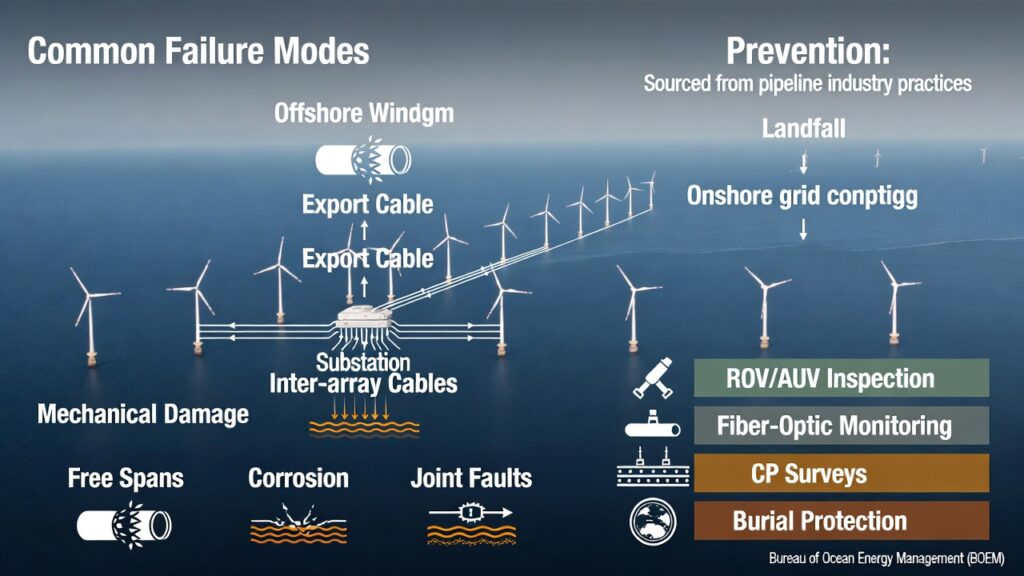
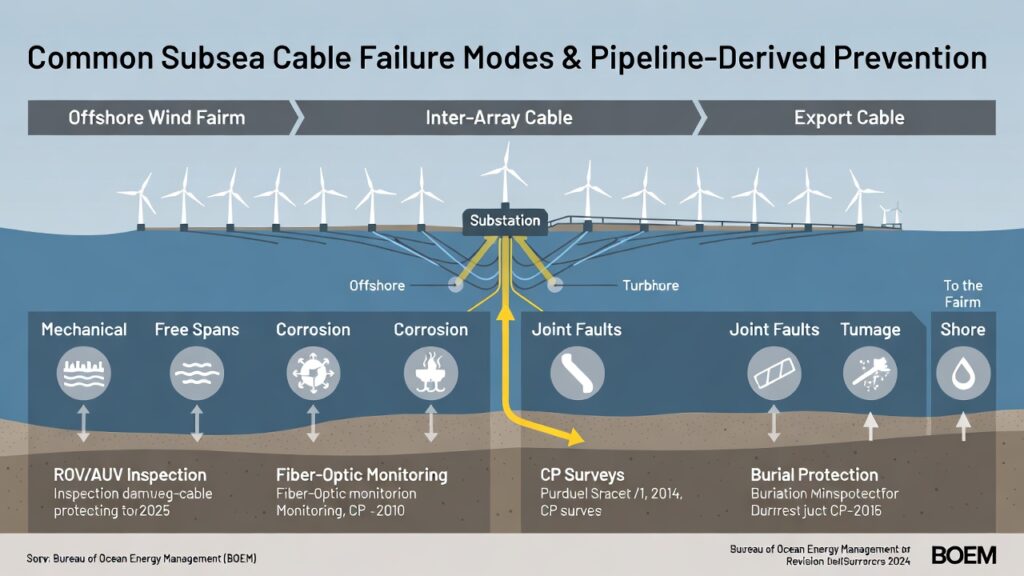
Diagram: Common Subsea Cable Failure Modes & Pipeline-Derived Prevention
Subsea Cable Failure Modes & Integrity Monitoring
Typical offshore wind farm showing inter-array cables (turbine to substation) and export cable (to shore). Failure modes include mechanical damage, free spans, corrosion, and joint faults all mitigated by pipeline techniques: ROV/AUV inspection, fiber-optic monitoring, CP surveys, and burial protection. Source: Bureau of Ocean Energy Management (BOEM).
1. Greater Gabbard Offshore Wind Farm (UK, 2010–2015) – Export Cable Failures
- What happened: Multiple high-voltage export cable faults occurred shortly after commissioning. Failures were linked to excessive cable movement on the seabed, poor burial depth, and seabed mobility (scour and sediment shifts) in the southern North Sea.
- Root cause: Insufficient burial (less than 1 m in some sections) and inadequate protection against tidal currents and fishing activity. Thermal expansion during high load caused additional stress at joints.
- Consequence: Repeated outages, millions in lost production, and full cable replacement in sections.
- Lesson for pipelines: Burial depth and rock berm protection must be designed for local seabed mobility. Pipeline-derived tools like side-scan sonar and sub-bottom profilers (used in pipeline route surveys) could have identified scour risks pre-installation.
2. Borkum Riffgrund 1 & 2 (Germany, 2015–2020) – Inter-Array Cable Damage
- What happened: Several inter-array cables (33 kV) suffered insulation breakdown and armor damage due to anchor strikes and fishing gear interaction.
- Root cause: Cables were laid on the seabed in high-traffic fishing areas with minimal protection (no rock dumping in some zones). Poor post-lay surveys missed exposed sections.
- Consequence: Frequent repairs, downtime, and increased insurance premiums for the operator.
- Lesson for pipelines: External interference is a shared risk. Pipeline best practices ROV/AUV post-lay surveys, acoustic beacon tracking, and proactive rock placement directly apply to cable protection in busy offshore zones.
3. Beatrice Offshore Wind Farm (UK, 2019–2022) – Export Cable Joint Failures
- What happened: High-voltage export cable joints failed due to water ingress and thermal cycling stress during operation.
- Root cause: Manufacturing defects in joint kits, combined with insufficient sealing during installation and thermal expansion in HPHT-like conditions near the platform.
- Consequence: Major outage periods, high repair costs, and lessons adopted across the sector for improved joint testing.
- Lesson for pipelines: Joint integrity is critical similar to subsea pipeline welds and connectors. Pre-commissioning hydrostatic testing, CP monitoring, and fiber-optic strain sensing (proven in HPHT pipelines) can prevent similar failures in export cables.
Key Takeaways for Pipeline Professionals in 2026
- Subsea cables face many of the same threats as pipelines mechanical interference, corrosion, thermal stress, and installation quality.
- Pipeline tools (ROV surveys, CP monitoring, fiber sensing, burial standards) are directly transferable and increasingly used in wind farms.
- Early adoption of these methods reduces downtime and costs a competitive edge for engineers transitioning to renewables.
The offshore wind sector needs pipeline expertise more than ever.
What cable or pipeline failure lessons have you learned?
Comment below — share this post!
Stay tuned for more HPHT, subsea integrity, and energy transition insights. Gig ’em!
#OffshoreWind #SubseaCables #PipelineIntegrity #EnergyTransition #SubseaEngineering #GigEm #AggieEngineers