Oko Immanuel
Petroleum / Subsea Engineer
Founder, Offshore Pipeline Insight
Texas A&M
March 06, 2026
As of March 06, 2026, the subsea pipeline sector is experiencing rapid evolution driven by the energy transition, technological advancements, and the need for efficient, sustainable infrastructure. With over 113 new offshore pipelines scheduled to commence operations this year , the industry is focusing on deeper water installations, enhanced integrity management, and integration with renewable energy systems. Market projections indicate strong growth: the subsea pipeline engineering services market, valued at $7.77 billion in 2025, is expected to expand at a CAGR of 10.81% from 2026 onward, reaching $17.67 billion by 2033 . This surge is fueled by rising offshore oil and gas exploration, renewable projects like floating offshore wind, and innovations in materials, robotics, and digital tools. Below, I’ll explore key innovations, trends, and implications based on current developments.
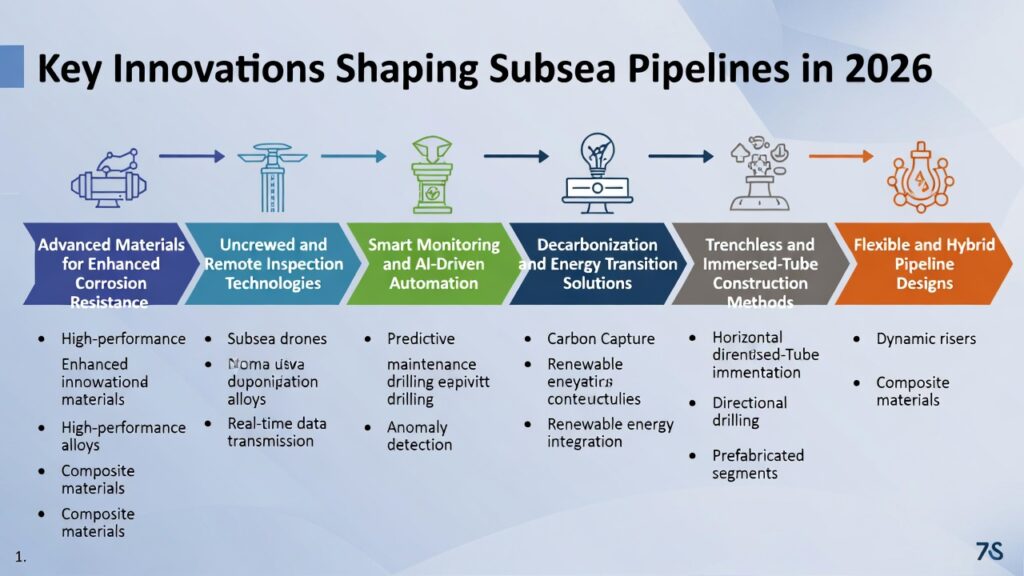
Key Innovations Shaping Subsea Pipelines in 2026
- Advanced Materials for Corrosion Resistance and Durability
Innovations in high-grade composite materials and advanced coatings are addressing marine corrosion challenges, extending pipeline lifespans and reducing maintenance costs . For instance, mechanically lined pipes (MLP) are seeing improvements in fabrication and inspection, enabling use in harsher environments like high-pressure/high-temperature (HPHT) fields. Companies like Cladtek are pioneering these through case studies, with applications in projects like the ETH-PiP v2.0 for the FENJA field, which features a 38km electrically trace-heated pipeline the longest of its kind . - Uncrewed and Remote Inspection Technologies
Remote and autonomous systems are revolutionizing pipeline inspections. Reach Subsea secured a major 2026 contract from Equinor/Gassco to inspect 3,500 km of subsea pipelines using uncrewed technology, starting in Q2 . This approach maintains data quality while reducing risks and costs. Broader trends include autonomous underwater vehicles (AUVs) and electrically powered intervention systems, improving accuracy by 20–25% . - Smart Monitoring and AI-Driven Automation
Integration of AI, machine learning, and digital twins is enabling predictive analytics and real-time monitoring. “Intelligent wells” with downhole autonomy allow pipelines to self-optimize without surface intervention . Wireless technologies, like TAQA’s PulseEight, are being designed into new systems from day one, shifting focus from hardware to data-driven control. This is part of a larger push toward smart pipeline systems, with over 48% of interventions now using light well intervention (LWI) vessels, cutting costs by 25% and mobilization time by 30%
4.Decarbonization and Energy Transition Solutions
Pipelines are adapting for low-carbon applications, such as CO₂ transport for carbon capture and storage (CCS) and hydrogen integration. Innovations include bidirectional cryogenic floating ball valves for LNG systems, simplifying designs and lowering CAPEX . For renewables, subsea pipelines are linking with floating offshore wind farms, using dynamic cables and modular systems to support green hydrogen production . The North Sea’s “supergrid” pact for 100GW of offshore wind highlights subsea infrastructure’s role in energy security
5.Trenchless and Immersed-Tube Construction Methods
Drawing from projects like China’s rapid underwater roadway (completed in three months using prefabricated immersed-tube sections) , subsea pipeline installation is adopting similar techniques to minimize disruptions. Automated welding and modular riser systems are reducing installation costs and enabling ultra-deepwater projects . In India, BPCL laid a 2.3 km deep-sea pipeline, showcasing feats in harsh conditions
6.Flexible and Hybrid Pipeline Designs
The flexible subsea pipelines market is projected to reach $7.1 billion by 2025 (with continued growth into 2026), emphasizing adaptability for deepwater and floating production storage and offloading (FPSO) systems . Hybrid designs combine rigid and flexible elements for better fatigue resistance, especially in dynamic environments like spar platforms or semi-submersibles .
Major Trends and Market Dynamics
| Trend | Description | Impact in 2026 |
|---|---|---|
| Market Expansion | Offshore pipeline market growing at 5.8% CAGR (2026-2035), driven by deepwater exploration and renewables . | 385 total pipelines commencing, with top offshore ones averaging longer than 2025 but shorter than records like Mexico’s 715km Southeast Gateway . |
| Sustainability Focus | Emphasis on carbon-neutral frameworks and materials innovation for decarbonization . | Reduced footprints in design, construction, and operations; integration with AI for reservoir analytics . |
| Digital Transformation | AI, data analytics, and predictive maintenance revolutionizing operations . | Enhanced reliability amid climate volatility and regulations. |
| Regional Hotspots | Asia-Pacific leading with offshore ramps and frontier drilling; North Sea focusing on tiebacks and wind . | Job creation (e.g., 90k+ from North Sea pact) and energy security. |
| Challenges | Ageing infrastructure, regulatory hurdles, and supply chain localization . | Push for resilient, high-value projects. |
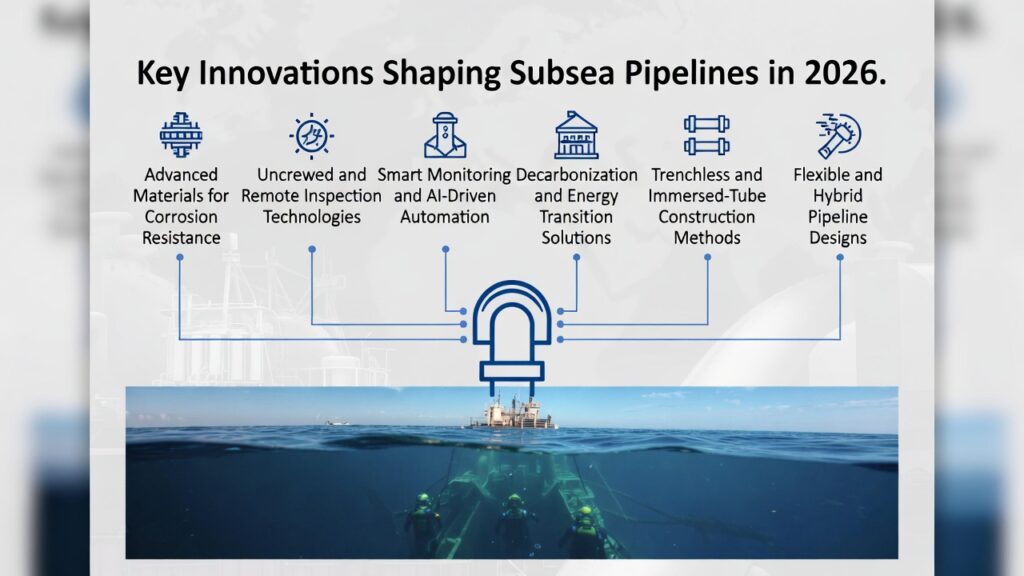
Key Innovations Shaping Subsea Pipelines in 2026
Author’s Contact : oko@offshorepipelineinsight.com