Oko Immanuel
Petroleum / Subsea Engineer
Founder, Offshore Pipeline Insight
Texas A&M Alumnus.
March 07, 2026
In early 2026, the U.S. Bureau of Ocean Energy Management (BOEM) is aggressively advancing offshore oil and gas leasing under the One Big Beautiful Bill Act (OBBBA) and the emerging 11th National Outer Continental Shelf (OCS) Oil and Gas Leasing Program (2026–2031). This expansion includes mandatory Gulf of Mexico (now often referred to as Gulf of America) lease sales and renewed analysis for Pacific Region (California) areas potentially unlocking significant new production while driving demand for subsea tiebacks, export pipelines, and infrastructure upgrades.
This post examines the key 2026 developments: Gulf lease sales schedule, California programmatic EIS kickoff, and implications for pipeline tieback systems in deepwater and ultra-deepwater environments.
Gulf of Mexico Lease Sales: Momentum Under OBBBA
The OBBBA mandates at least 30 Gulf lease sales over the coming years, providing long-term predictability for operators. BOEM has accelerated activity in 2026:
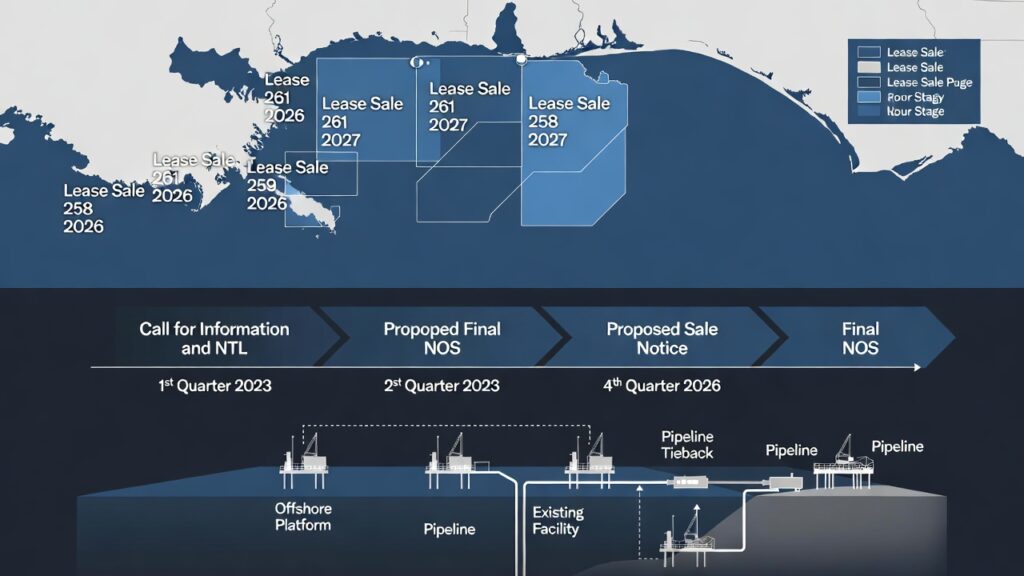
- Lease Sale BBG2 (Big Beautiful Gulf 2): Final Notice issued February 2026; held March 11, 2026. Offered 80 million acres (15,066 blocks) across Western, Central, and Eastern planning areas, water depths 9 ft to >11,100 ft.
- Lease Sale BBG3: Proposed Notice February 2026; scheduled August 12, 2026. Similar scope (~80 million acres), continuing the high-volume approach.
- Overall schedule: Multiple sales per year (e.g., March and August in 2026, 2027), supporting continued deepwater exploration and tieback developments.
This diagram shows the Gulf of Mexico lease areas and recent/proposed sale blocks (BOEM data):A timeline chart outlines the BOEM lease sale process and 2026 milestones:
California Offshore Leasing: Programmatic EIS Launch
After decades of moratoriums (no new Pacific leases since 1984), BOEM initiated a Programmatic Environmental Impact Statement (PEIS) in February 2026 for potential sales in Northern, Central, and Southern California Planning Areas.
- Key steps: Notice of Intent (NOI) February 27, 2026; 30-day public scoping period.
- Purpose: Analyze a representative lease sale to inform 2027 Central/Southern California sales (first under 11th Program), plus future offerings.
- Scope: All unleased OCS blocks with economically recoverable resources (estimated 9.81 Bbo oil, 13.82 Tcf gas in California areas).
- Context: Part of the 11th Program’s six Pacific sales (2027–2030); strong state opposition (California Natural Resources Agency, Coastal Commission) citing environmental risks and conflicts with state policies.
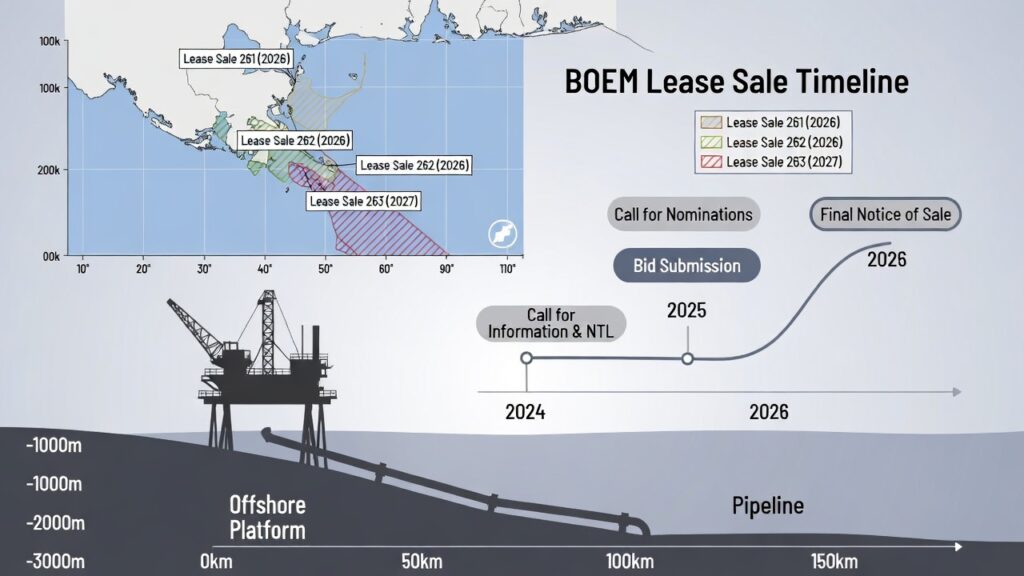
This schematic illustrates a typical offshore platform-to-pipeline tieback configuration, relevant for potential new California developments connecting to existing onshore/export infrastructure:
Pipeline Tieback Implications
Expanded leasing will boost demand for subsea tiebacks connecting new wells/platforms to existing facilities via flow lines, risers, and export pipelines reducing CAPEX vs. standalone developments.
- Gulf focus: Deep/ultra-deep tiebacks (e.g., >5,000 ft water depth) require advanced materials (HPHT-resistant), fatigue-resistant risers (SCRs, lazy-wave), and integrity monitoring (fiber-optic sensing, ILI).
- California potential: If sales advance, tiebacks would link to legacy platforms or onshore terminals; challenges include seismic risks, environmental sensitivities, and longer export distances.
- Integrity & engineering: New tiebacks demand rigorous flow assurance (hydrate/wax management), corrosion control, and dynamic analysis for risers/flowlines.
- Market impact: Increased activity supports pipeline construction (e.g., larger diameters for export), subsea processing/boosting, and life extension of existing infrastructure.
Closing Thoughts
The 2026 leasing push Gulf sales accelerating and California analysis restarting signals renewed federal commitment to domestic offshore production. For pipeline/subsea engineers, this means more tieback opportunities, but with heightened focus on integrity, environmental compliance, and transition synergies (e.g., repurposing for CO₂/H₂).
What leasing developments or tieback challenges are you watching in 2026?
Share in the comments!Oko Immanuel
Petroleum / Subsea Engineer
Founder, Offshore Pipeline Insight
Texas A&M Alumnus.
March 07, 2026
Author’s Contact : oko@offshorepipelineinsight.com