Oko Immanuel
Petroleum / Subsea Engineer
Founder, Offshore Pipeline Insight
Texas A&M Alumnus.
March 07, 2026
In 2026, artificial intelligence (AI) and digital twins have transitioned from emerging concepts to essential tools in offshore pipeline integrity management. Driven by increasing regulatory pressure for zero-incident operations, rising costs of unplanned downtime, and the complexity of deepwater and energy-transition assets (H₂/CO₂ pipelines), operators are deploying these technologies to achieve predictive, condition-based maintenance rather than reactive or time-based approaches.
This technical blog examines the core innovations in AI-driven anomaly detection and digital twin workflows, their integration into pipeline integrity programs, and real-world applications being deployed or scaled in 2026.
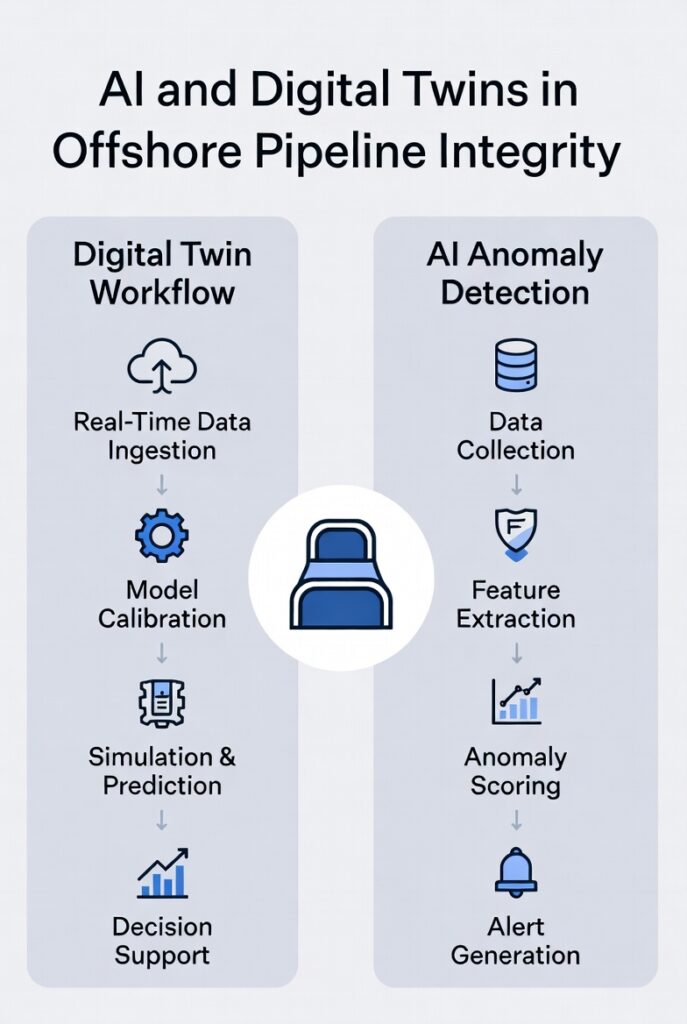
Digital Twins: Virtual Mirrors for Physical AssetsA digital twin is a dynamic, real-time virtual replica of an offshore pipeline system that mirrors its physical state, behavior, and performance using live sensor data, historical records, and physics-based models.Core workflow components (2026 standard implementation):
- Data ingestion : Real-time streams from fiber-optic distributed acoustic/temperature sensing (DAS/DTS), pressure/temperature gauges, cathodic protection monitors, ROV/AUV inspections, and ILI runs.
- Model calibration & synchronization Finite element models (FEM) of pipe-soil interaction, thermal buckling, fatigue, and corrosion are continuously updated with sensor data.
- Simulation & prediction : What-if scenarios (e.g., pressure cycling from H₂ production, thermal gradients in HPHT lines) and forward-looking fatigue life estimates.
- Decision support : Risk-based prioritization of inspections, maintenance triggers, and operational adjustments.
This diagram illustrates the end-to-end digital twin workflow for offshore pipeline integrity:
AI-Driven Anomaly Detection: Moving Beyond Threshold Alarms.
Traditional SCADA systems rely on fixed thresholds; AI introduces pattern recognition, anomaly scoring, and predictive alerts.
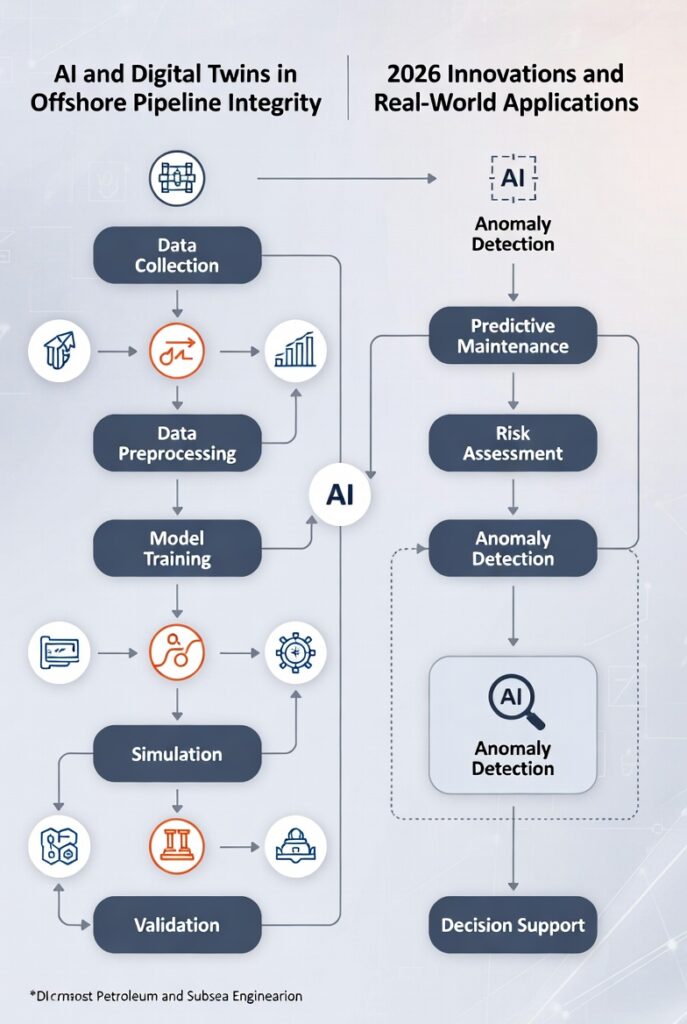
Typical AI anomaly detection flowchart (2026 implementations)
- Data collection & preprocessing: Multi-sensor fusion, noise filtering, feature engineering (e.g., strain rate, acoustic signatures).
- Model training : Supervised (labeled leak/corrosion events) and unsupervised (auto encoders, isolation forests) machine learning on historical/normal data.
- Real-time inference : Anomaly scoring (e.g., deviation from normal behavior) using LSTM networks, CNNs for acoustic patterns, or hybrid physics-informed models.
- Alert generation & prioritization : Confidence scores + explainability (SHAP values) to reduce false positives and focus operator attention.
This flowchart shows a modern AI anomaly detection process tailored for offshore pipelines:
2026 Innovations and Real-World Applications.
Several advancements and deployments are defining the year:
- Chevron & ExxonMobil Gulf implementations: Digital twins integrated with fiber-optic sensing for real-time fatigue monitoring in deepwater tiebacks (e.g., Anchor project HPHT lines). AI models reduced false alarms by 60–70% compared to rule-based systems.
- Equinor Northern Lights Phase 2 : CO₂ pipeline digital twin with AI-based leak detection (acoustic + pressure transient analysis) achieving sub-meter localization accuracy.
- Shell & TotalEnergies North Sea : Hybrid digital twins for repurposed gas-to-H₂ lines; AI predicts embrittlement risk based on pressure cycling and material data.
- Innovation highlights:
- Physics-informed neural networks (PINNs) for faster anomaly detection in dynamic flow conditions.
- Edge AI on subsea control modules for low-latency alerts (reducing data transmission needs).
- Explainable AI (XAI) frameworks to meet regulatory requirements (PHMSA, NORSOK).
Integrity Benefits & Lessons Learned
- Reduced inspection frequency : Risk-based, condition-driven campaigns instead of calendar-based.
- Extended asset life : Early detection of fatigue cracks, corrosion growth, or buckling.
- Cost savings : 20–40% reduction in unplanned downtime and inspection costs (industry benchmarks).
- Transition readiness : Digital twins enable “what-if” simulations for H₂/CO₂ service, supporting repurposing decisions.
Closing Thoughts
AI and digital twins are no longer optional in 2026 they are becoming standard for high-consequence offshore pipelines. The combination of real-time sensing, physics-based modeling, and machine learning delivers unprecedented visibility and predictive power, directly supporting safer, more sustainable operations.
For subsea and pipeline engineers, mastering these tools is now a core competency.
What AI/digital twin applications are you seeing (or planning) in your projects?
Share in the comments!
Oko Immanuel
Petroleum / Subsea Engineer
Founder, Offshore Pipeline Insight
Texas A&M Alumnus.
March 07, 2026
Author’s Contact : oko@offshorepipelineinsight.com