Oko Immanuel
Petroleum / Subsea Engineer
Founder, Offshore Pipeline Insight
Texas A&M Alumnus.
March 07, 2026
The North Sea is rapidly emerging as the global epicenter for offshore energy transition in 2026, with carbon capture and storage (CCS) hubs, hydrogen infrastructure, and pipeline repurposing converging to decarbonize industrial clusters while leveraging decades of existing oil and gas assets. The region hosts some of the most advanced open-access CO₂ transport and storage networks (Northern Lights, Porthos, Aramis, HyNet, East Coast Cluster), alongside early hydrogen pipeline conversions and offshore production concepts.
This technical blog examines the key CCS and hydrogen projects advancing in 2026, the role of pipeline synergies (repurposing and new builds), and the integrity/engineering implications for subsea professionals.
Major CCS Hubs and CO₂ Transport Networks
The North Sea’s depleted hydrocarbon reservoirs provide ideal storage sites, with open-access hubs enabling cross-border and multi-emitter solutions.
- Northern Lights (Norway) World’s first cross-border CO₂ transport and storage; Phase 1 operational, Phase 2 scaling to 5+ Mt/year by 2026–2028. Receives CO₂ from Norway, Denmark, Belgium, Netherlands via ship-to-terminal, then subsea pipeline to reservoir.
- Porthos (Netherlands) : Operational 2026; ~2.5 Mt CO₂/year from Rotterdam industrial cluster (refineries, hydrogen plants) to depleted North Sea fields via offshore pipeline.
- Aramis (Netherlands) : Advanced planning/FID phase; complements Porthos with larger-scale H₂/CO₂ import/export capabilities.
- HyNet North West (UK) : Liverpool Bay hub; pipeline repurposing for CO₂ transport to offshore storage; operations ramping 2026–2027.
- East Coast Cluster / Northern Endurance Partnership (UK) : Teesside and Humber emitters; shared offshore storage via repurposed pipelines; NEP targets 20–30 Mt/year capacity.
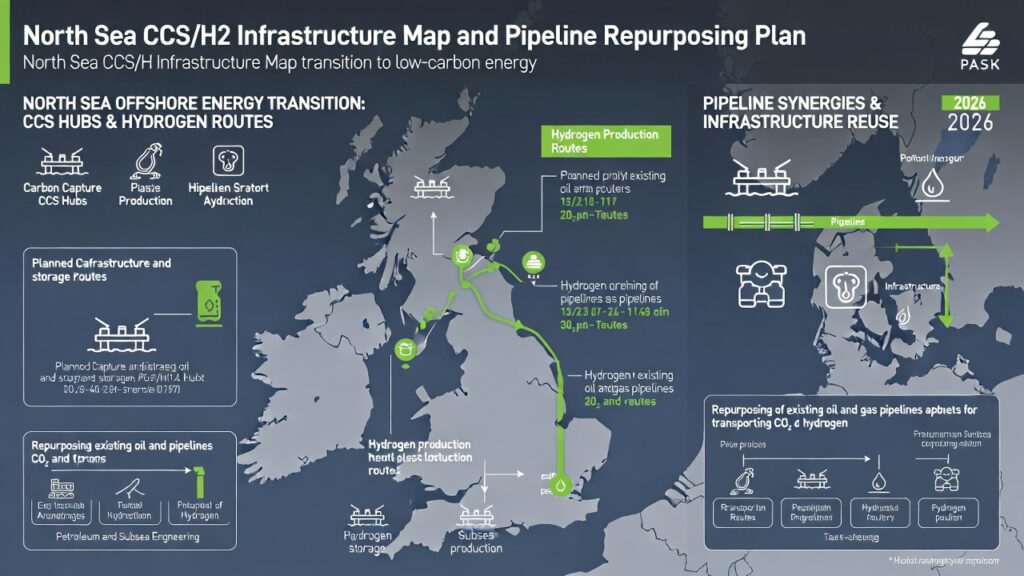
This map highlights the major North Sea CCS hubs, CO₂ transport routes, and storage sites (including Northern Lights, Porthos/Aramis, HyNet, East Coast Cluster)
Hydrogen Routes and Offshore Production
Hydrogen development focuses on blending (early), dedicated lines (mid-term), and offshore production (long-term).
- Germany Hydrogen Core Network 9,000+ km planned; 2026 sees significant conversions (e.g., Lubmin–Bobbau operational).
- AquaDuctus (North Sea) Offshore H₂ pipeline concept for GW-scale wind-to-hydrogen; early planning 2026.
- H2Morrow & H2Synergy : Offshore wind + electrolysis + pipeline export; feasibility advancing.
Pipeline synergies are key: repurposing existing gas lines for H₂ (with embrittlement mitigation) or CO₂ (dehydration/corrosion control) reduces costs and accelerates deployment.
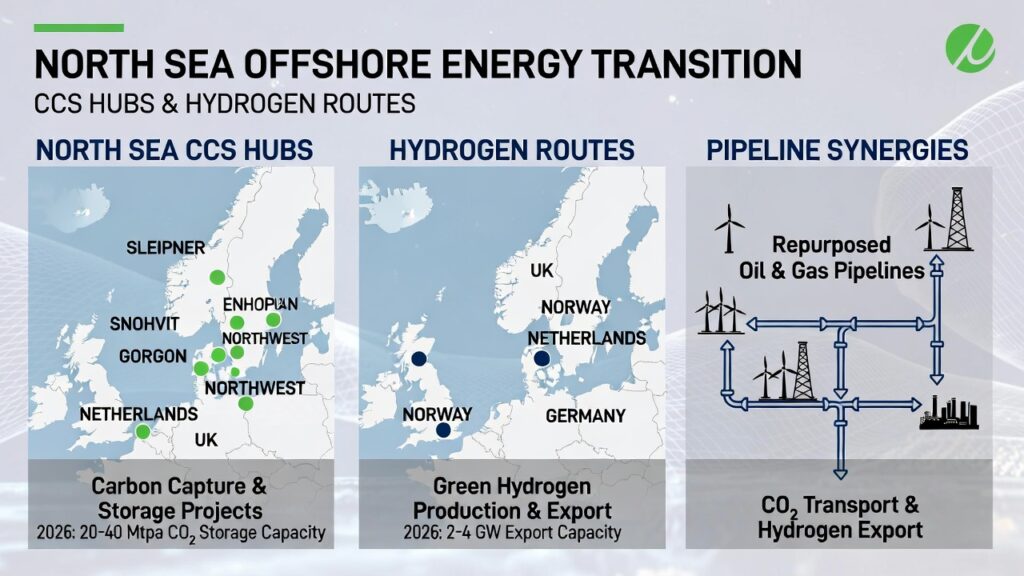
This infographic illustrates the pipeline repurposing process for CCS (CO₂) and hydrogen (H₂), highlighting feasibility steps, challenges, and integrity upgrades:
Pipeline Synergies and Integrity Implications
- Repurposing advantages : Cost savings (1–10% of new build), faster permitting, use of existing routes/rights-of-way.
- Technical challenges:
- CO₂: Wet corrosion, supercritical pressure maintenance, dense-phase fracture risk.
- H₂: Embrittlement (reduced toughness, fatigue crack growth), leakage, pressure cycling.
- Integrity strategies : Re-qualification (hydrostatic testing, FEM), lower-strength steels, coatings/inhibitors, fiber-optic monitoring, digital twins for predictive fatigue.
- 2026 outlook : North Sea projects generate operational data; JIPs (DNV, CO2SafePipe) refine standards.
Closing Thoughts
The North Sea in 2026 exemplifies the energy transition at scale: CCS hubs storing millions of tonnes of CO₂ annually, hydrogen routes emerging from repurposed assets, and pipelines bridging hydrocarbon legacy to low-carbon future.For pipeline/subsea engineers, this creates rich opportunities in integrity management, repurposing assessments, and hybrid systems.
The region is proving that existing infrastructure can be a powerful enabler of net-zero goals.
What North Sea projects or repurposing challenges are you following?
Share in the comments!
Oko Immanuel
Petroleum / Subsea Engineer
Founder, Offshore Pipeline Insight
Texas A&M Alumnus
March 07, 2026
Author’s Contact : oko@offshorepipelineinsight.com