Oko Immanuel
Petroleum / Subsea Engineer
Founder, Offshore Pipeline Insight
Texas A&M
March 09, 2026
Drilling and completion integrity challenges are universal across environments, yet onshore land rigs (primarily horizontal shale wells) and offshore platforms (deepwater/HPHT) face distinctly different loading regimes, operational constraints, and risk profiles. In 2026, with land rig electrification accelerating and deepwater tiebacks remaining the dominant offshore activity, cross-learning between the two domains has become essential for engineers and operators.This technical blog compares key integrity challenges in land rigs vs. offshore platforms, highlights shared root causes, and outlines transferable technologies and lessons being applied today.
1. Primary Integrity Challenges: Onshore vs Offshore
| Challenge Area | Onshore Land Rigs (Shale Horizontal) | Offshore Platforms (Deepwater/HPHT) | Shared Root Causes & Transferable Lessons |
|---|---|---|---|
| Drill Pipe Fatigue | High-frequency bending/torsion in long laterals (10,000–15,000 ft) | Axial tension + vessel motion-induced bending in risers/BHA | Cyclic loading → fatigue crack initiation at tool joints/upsets. Use S-N curves + real-time torque/drag monitoring on both. |
| BOP Reliability | Surface stack: ram packer wear, annular extrusion during frac | Subsea stack: connector leaks, shuttle valve failures, acoustic pod loss | Seal/elastomer degradation, pressure cycling. API RP 53/16A testing protocols apply equally. |
| Casing Deformation | Shear from fault slip/frac hits, collapse from depletion | Thermal cycling, burst/collapse from HPHT, bending from riser motion | Geomechanical stress + cyclic pressure. Premium connections + centralization reduce risk. |
| Cement Sheath Integrity | Micro-annulus from frac pressure surges, SCP from gas migration | Thermal gradients cause debonding, SCP from reservoir communication | Cement shrinkage + cyclic stress. Flexible/expansive cements + DAS/DTS monitoring work in both. |
| Well Control & Kick Detection | High-pressure frac returns, influx during trips | Narrow mud windows, gas kicks in HPHT reservoirs | Real-time pressure monitoring + early kick detection algorithms (onshore adopting offshore MPD tech). |
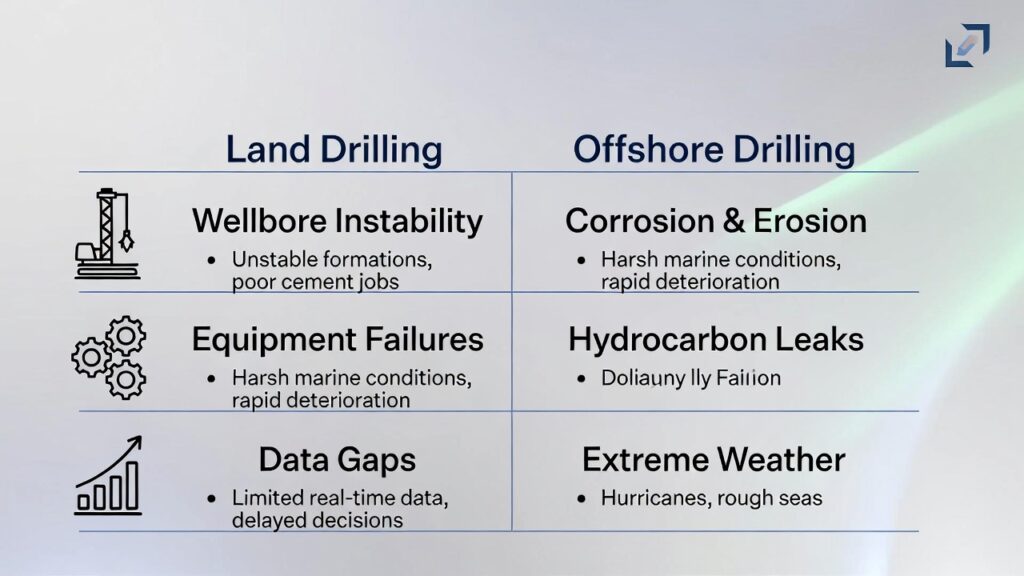
This side-by-side comparison table summarizes the dominant integrity challenges and transferable lessons in 2026:
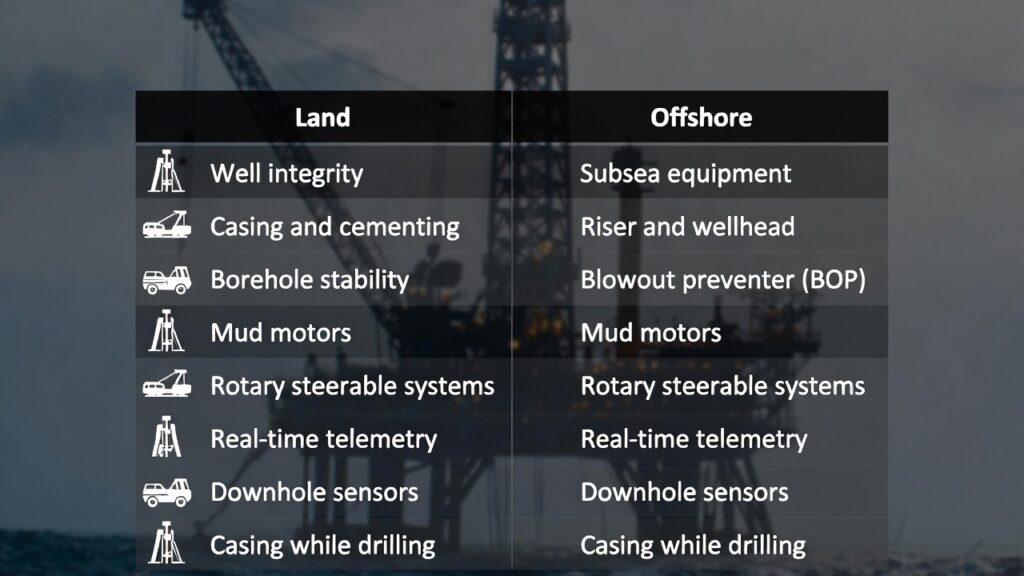
2. Shared Technologies Driving Cross-Domain ImprovementsSeveral technologies proven offshore are now migrating onshore (and vice versa):
- Mud motors & rotary steerable systems (RSS) Offshore RSS (high dog-leg capability) now used in onshore extended-reach laterals for precise placement and reduced fatigue.
- Real-time telemetry Offshore wired drill pipe telemetry (high-speed data) inspires onshore wired systems for real-time torque/drag, vibration, and pressure monitoring.
- Digital twins & AI anomaly detection Offshore digital twins for riser fatigue now applied onshore for casing stress and BOP health prediction.
- Fiber-optic sensing Offshore DAS/DTS for leak/strain detection being piloted in onshore gathering lines and shale wellbores for SCP and frac hit monitoring.
This infographic shows shared technology icons and their applications across onshore and offshore drilling:
Closing Thoughts
Onshore shale wells face intense shear, frac-induced stress, and depletion challenges, while offshore deepwater/HPHT wells contend with extreme pressures, temperatures, and dynamic loading. Yet the core integrity principles fatigue modeling, seal reliability, real-time monitoring, and risk-based design—are highly transferable.
In 2026, the convergence is accelerating: onshore rigs adopt offshore-grade digital twins and telemetry; offshore projects borrow onshore frac sequencing and cost discipline.
The result is safer, more efficient wells across both domains.
What drilling integrity lessons have you seen transfer between onshore and offshore?
Share in the comments!
Oko Immanuel
Petroleum / Subsea Engineer
Founder, Offshore Pipeline Insight
Texas A&M Alumnus
March 09, 2026