By Oko Immanuel, M.Eng – Founder, Offshore Pipeline Insight
March 18, 2026
On March 14, 2026, the U.S. Department of the Interior under the Trump administration granted final approval to BP’s Kaskida project a $5 billion ultra-deepwater oil development in the Gulf of Mexico. This decision marks BP’s first new standalone oilfield sanction in the GoM since the 2010 Deepwater Horizon disaster, signaling renewed confidence in deepwater exploration and production in the region after more than 15 years of caution.
Kaskida is located in Keathley Canyon Block 249 in approximately 6,000 feet of water, targeting Paleogene reservoirs at depths exceeding 30,000 feet subsea. The project is expected to produce up to 80,000 barrels of oil per day at peak, with first oil targeted for 2029–2030.Why Kaskida Matters – A Strategic & Technical MilestoneAfter the Macondo blowout in 2010, BP faced intense regulatory scrutiny, massive financial penalties, and a prolonged pause on major new greenfield developments in the GoM. While the company continued operations and participated in tiebacks (e.g., Argos platform, Mad Dog 2), Kaskida represents BP’s most significant new standalone investment in the region since then.Key project highlights:
- Estimated recoverable resources: ~300–500 million barrels of oil equivalent (P50 range, per industry analogs and BP disclosures).
- Development concept: Subsea tieback to a new floating production unit (FPU) or potentially shared host infrastructure, with 6–8 subsea wells.
- Water depth & reservoir conditions: ~6,000 ft water depth, reservoir pressures approaching 20,000 psi, temperatures >300°F — classifying it as a 20K HPHT development.
- CAPEX: ~$5 billion (early estimate), reflecting the high cost of 20K-rated equipment, long tiebacks, and robust safety systems.
- Production start: Late 2029 or early 2030, aligning with BP’s broader GoM strategy to maintain ~300,000–400,000 net boe/d net production through the 2030s.
The approval comes amid a pro-energy policy shift, streamlined permitting under the current administration, and record-high oil prices that make ultra-deepwater economics more attractive.
Technical Enablers: 20K HPHT Subsea Technology Maturity Kaskida would not have been possible without the industry’s hard-won progress in 20,000 psi-rated subsea equipment, proven at Chevron’s Anchor (first oil 2024) and Beacon’s Shenandoah developments.Critical technologies enabling Kaskida include:
- 20K subsea production systems : Trees, manifolds, jumpers, and connectors qualified for 20,000 psi and 350°F+ (TechnipFMC, SLB, Baker Hughes).
- HPHT completion strings : High-collapse alloys, premium connections, and thermal barriers to manage extreme pressure/temperature cycling.
- Subsea boosting & flow assurance : Multiphase pumps and insulation to maintain flow from deep, tight Paleogene reservoirs.
- Advanced seismic imaging : High-resolution ocean-bottom node (OBN) data to map complex salt canopies and reservoir compartments.
- Digital twins & integrity monitoring : Real-time pressure/temperature modeling, annulus pressure management, and predictive maintenance.
These advancements reduce conservatism in design, lower intervention risks, and improve long-term well reliability all essential for a 30+ year field life in ultra-deepwater HPHT conditions.
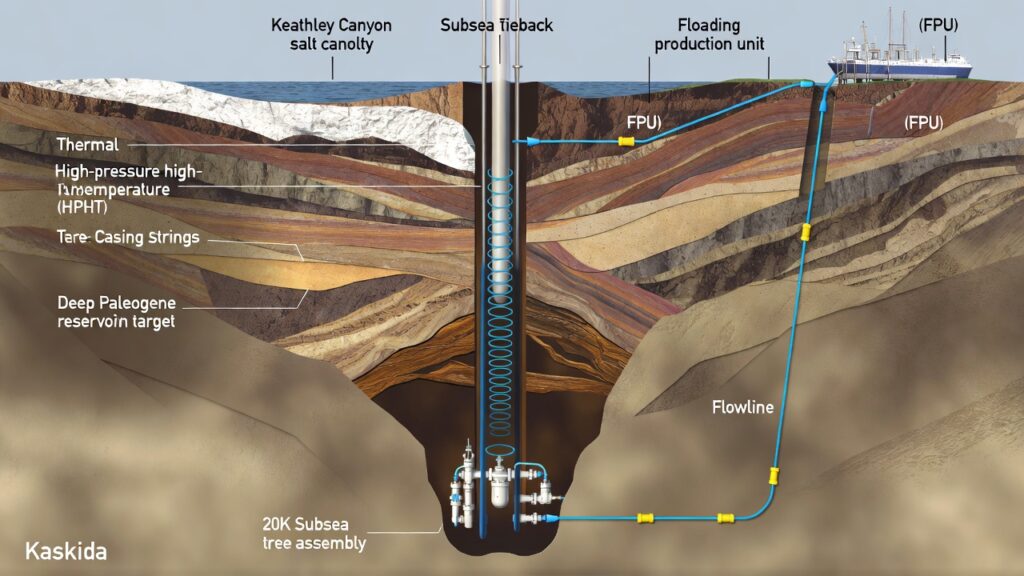
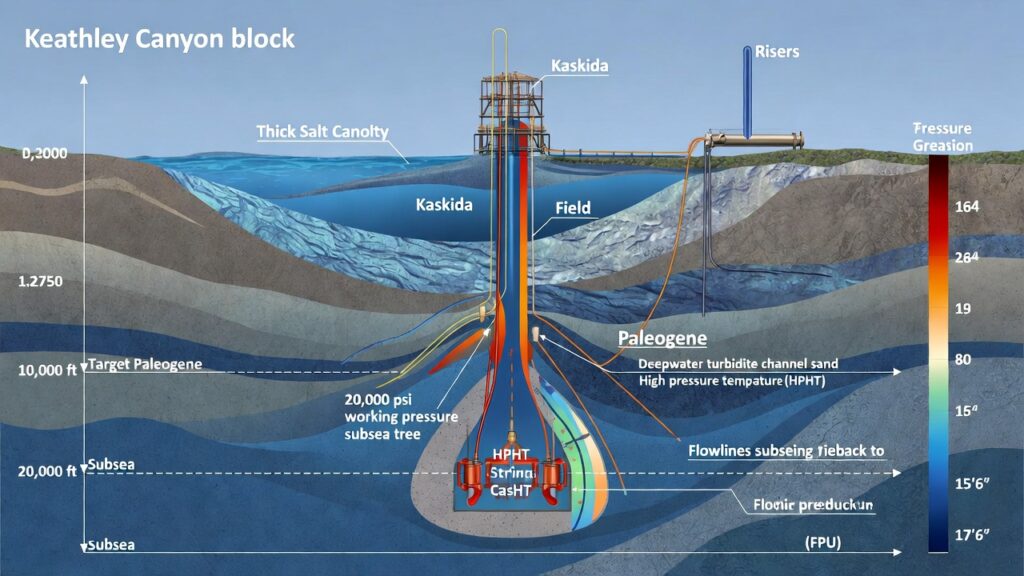
Figure 1: Conceptual cross-section of the Kaskida development
(Insert image: Geological cross-section showing Keathley Canyon salt canopy, deep Paleogene reservoir target, 20K subsea tree, HPHT casing strings, thermal/pressure gradients, and subsea tieback flowlines to FPU.)
Broader Implications for the Gulf of Mexico in 2026
- Industry signal: BP’s return to greenfield development encourages other operators (ExxonMobil, Chevron, Shell) to advance stalled Paleogene projects (e.g., Conifer-1, Shenandoah South expansions).
- Economic impact: Kaskida supports thousands of jobs during construction and operations, plus significant tax revenue for Louisiana and federal coffers.
- Energy security: Adds domestic oil supply at a time of geopolitical uncertainty and global demand growth.
- Safety & environmental standards: Post-2010 reforms (BSEE regulations, I3P verification) ensure Kaskida incorporates best-in-class blowout prevention, well control, and spill response planning.
The Bottom Line
The March 14, 2026 approval of BP’s Kaskida project is more than a single sanction it’s a vote of confidence in ultra-deepwater technology, regulatory stability, and the long-term future of the Gulf of Mexico. With 20K HPHT subsea systems now field-proven, the Paleogene’s deepest reservoirs are moving from “stranded” to “strategic.”Engineers and operators:
What do you see as the biggest remaining technical hurdle for 20K+ HPHT tiebacks materials, flow assurance, or integrity monitoring?
Drop a comment or connect on LinkedIn let’s discuss real-field lessons.Stay sharp out there, brothers.
The Gulf’s next chapter is being written in 20K psi.
Oko Immanuel
Subsea Engineering Specialist | Offshore Pipeline Insight