Oko Immanuel
Petroleum / Subsea Engineer
Founder, Offshore Pipeline Insight
Texas A&M Alumnus.
March 08, 2026
Offshore electrification replacing gas turbines on platforms with external power sources (shore power, offshore wind, or hybrid renewables) has matured from concept to commercial reality in 2026. Driven by net-zero targets, carbon taxes, and operational cost savings, several landmark projects demonstrate the feasibility, challenges, and CO₂ reduction impact of electrifying offshore oil and gas facilities.
This technical case study review focuses on key examples (primarily North Sea and Middle East), their engineering approaches, integrity considerations for power cables and subsea tie-ins, and transferable lessons for the broader industry.
1. Johan Sverdrup Field – Norway (Power from Shore, Phase 1 & 2)
- Operator: Equinor
- Location: North Sea, Norwegian Continental Shelf
- Electrification type: Full power from shore via HVDC subsea cable
- Timeline: Phase 1 operational 2019; Phase 2 full electrification completed 2022–2023; ongoing optimization in 2026
- Capacity: ~100 MW from shore (Kårstø onshore grid)
- CO₂ reduction: Eliminates ~500,000 tCO₂/year from platform turbines; cumulative savings >3 MtCO₂ since start
- Engineering highlights:
- 200 km HVDC subsea cable (525 kV)
- Onshore converter station + offshore transformer module
- Dynamic export cable fatigue management (lazy-wave configuration)
- Redundant power supply + backup diesel generators
- Integrity lessons: Cable fatigue monitoring (fiber-optic DAS), cathodic protection for long tie-backs, and real-time condition-based maintenance.
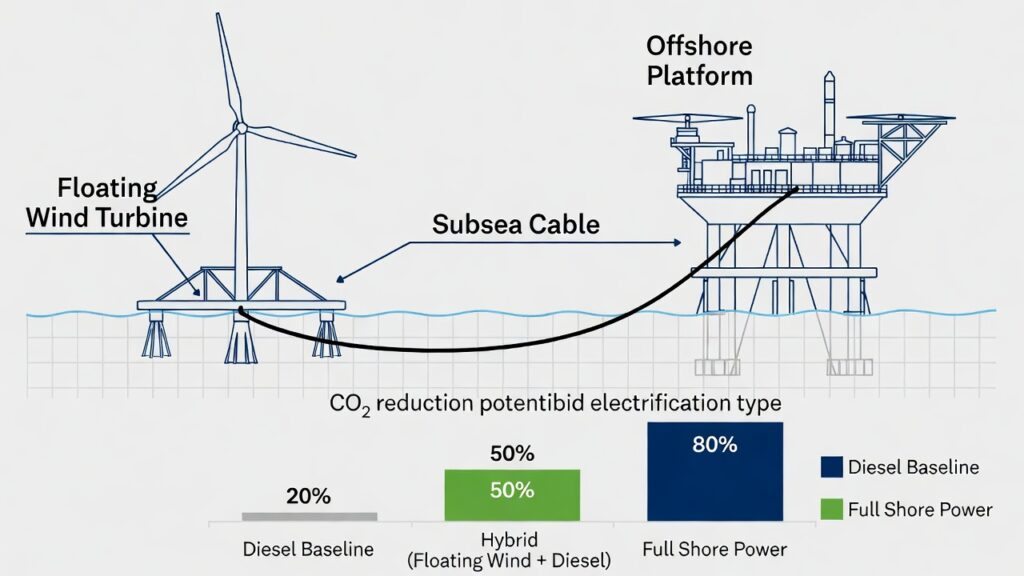
This diagram illustrates the Johan Sverdrup power-from-shore configuration (onshore grid → HVDC cable → offshore platform):
2. Hywind Tampen – Norway (Floating Offshore Wind Hybrid)
- Operator: Equinor
- Location: North Sea (Tampen area)
- Electrification type: Hybrid floating wind (11 × 8 MW turbines) powering 5 platforms
- Timeline: World’s largest floating wind farm; full operation 2023–2024; performance optimization ongoing in 2026
- Capacity: ~88 MW installed; ~35–40% capacity factor → ~300 GWh/year
- CO₂ reduction: ~200,000–250,000 tCO₂/year avoided
- Engineering highlights:
- Dynamic export cables from floating turbines to fixed platforms
- Hybrid control system (wind + backup gas turbines)
- Mooring and cable fatigue management in harsh North Sea conditions
- Integrity lessons: Dynamic cable fatigue parallels offshore oil/gas risers; real-time motion and strain monitoring critical.
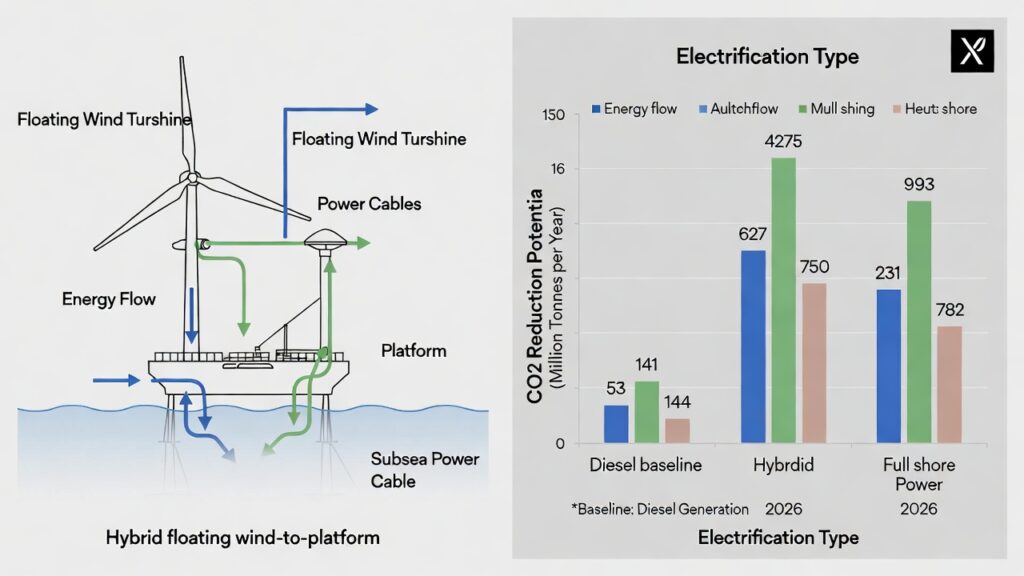
This schematic shows the hybrid floating wind-to-platform power system:
3. ADNOC Offshore Fields – UAE (Shore Power + Renewables)
- Operator: ADNOC
- Location: Arabian Gulf
- Electrification type: Shore power from nuclear/solar + hybrid renewables
- Timeline: Major fields (Upper Zakum, Lower Zakum) partially electrified 2023–2025; full program scaling in 2026
- Capacity: Targeting 50% emissions cut by connecting platforms to clean onshore power
- CO₂ reduction: Projected 5–10 MtCO₂/year avoided across fields
- Engineering highlights:
- HVDC subsea cables from shore
- Integration with solar/nuclear grid
- Subsea power distribution modules
- Integrity lessons: Long-distance subsea cable reliability, corrosion in warm Gulf waters, and hybrid power stability.
4. Key Integrity & Engineering Lessons for 2026
- Dynamic cable fatigue : Lazy-wave or steep-wave configurations common; fatigue from platform motion requires fiber-optic strain monitoring and predictive modeling.
- Power quality: Harmonics from VFDs and converters need active filters; voltage stability critical for sensitive subsea equipment.
- Redundancy & backup Hybrid systems retain diesel/gas turbines as spinning reserve; black-start capability essential.
- Subsea tie-ins: Power umbilicals and connectors must handle high voltage (66–132 kV) + harsh marine environment; integrity parallels CO₂/H₂ pipelines.
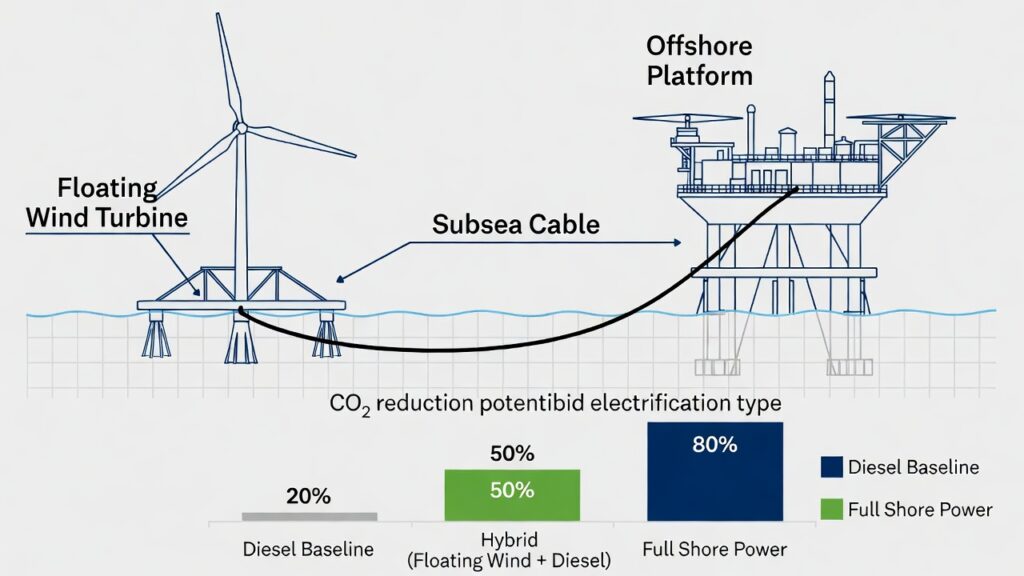
- CO₂ impact : 40–90% reduction depending on grid mix; full electrification in renewable-heavy grids (Norway, UK) achieves >80%.
This chart compares CO₂ reduction potential across electrification types (diesel baseline vs. hybrid vs. full shore power)
Closing Thoughts
Land rig electrification in 2026 is no longer optional it’s a competitive necessity. Hybrid systems deliver 40–70% CO₂ reduction today, while grid-tied rigs in renewable-rich areas (Texas, Oklahoma) achieve 80–90%. The transition brings engineering opportunities (power quality, cable fatigue, battery integration) and integrity synergies with offshore practices (dynamic cable monitoring, digital twins).
For drilling engineers and operators, 2026 is about balancing emissions goals with operational reliability and cost.
What electrification projects or challenges are you seeing in your operations?
Share in the comments!
Oko Immanuel
Petroleum / Subsea Engineer
Founder, Offshore Pipeline Insight
Texas A&M Alumnus
March 08, 2026
Author’s Contact: oko@offshorepipelineinsight.com