By Oko Immanuel, M.Eng – Founder, Offshore Pipeline Insight
March 20, 2026
Carbon Capture and Storage (CCS) is no longer a future concept in the LNG industry — it is now a core requirement for new and expanding projects. By 2026, operators are integrating CCS to reduce emissions intensity, meet regulatory mandates, and maintain social license to operate amid rising global demand for lower-carbon LNG.
This article focuses on how subsea technology enables CCS in LNG projects, drawing on real-world examples from Qatar’s North Field expansion and Mozambique LNG, where subsea infrastructure plays a pivotal role in CO₂ capture, transport, and sequestration.
Why CCS is Essential for LNG in 2026
LNG production involves removing CO₂ from raw natural gas to meet sales specifications (typically <50 ppm CO₂). Traditionally vented or flared, this CO₂ is now captured and stored — turning a waste stream into a decarbonization opportunity.Key drivers:
- Regulatory pressure : EU CBAM, U.S. methane fees, and buyer demands for low-carbon intensity LNG.
- Market advantage : Premium pricing for certified low-emission cargoes.
- Operational necessity : Qatar and U.S. Gulf Coast expansions must incorporate CCS to stay competitive.
Subsea Technology Enabling CCS in LNG Projects
CCS for LNG relies heavily on subsea systems for CO₂ transport and injection — especially in offshore or near-shore developments.
- Subsea CO₂ Pipelines & Flowlines
- Materials: Corrosion-resistant alloys (CRA) like duplex/super duplex or lined carbon steel to handle CO₂ corrosion and impurities.
- Design: Pipe-in-pipe (PIP) systems with insulation to maintain supercritical CO₂ state and prevent phase changes.
- Pressure management: Rated for 100–200 bar injection pressures, with fatigue-resistant welds for dynamic conditions.
- Subsea Injection Manifolds & Trees
- HPHT-rated injection trees and manifolds for high-rate CO₂ injection into depleted reservoirs or saline aquifers.
- Real-time monitoring: Fiber-optic DTS/DAS for leak detection and pressure integrity.
- Subsea Boosting & Compression
- Subsea pumps/compressors to boost CO₂ from onshore capture plants to injection sites (e.g., Northern Lights model).
- Power supply: Subsea cables and variable speed drives for energy efficiency.
- Digital Twins & Integrity Management
- Real-time subsea monitoring of CO₂ plume migration, well integrity, and seal performance.
- Predictive analytics to optimize injection rates and detect anomalies early.
Real-World Case Study 1: Qatar North Field Expansion (NFE + NFS)
QatarEnergy’s North Field East (NFE) and North Field South (NFS) expansions represent the world’s largest integrated CCS deployment in LNG production.
- Capacity: NFE adds 32–33 MTPA (first LNG 2026); NFS adds 16 MTPA (2027–2028). Total target: 142 MTPA by 2030.
- CCS scale: Up to 4–5 Mtpa CO₂ capture and sequestration (one of the largest globally).
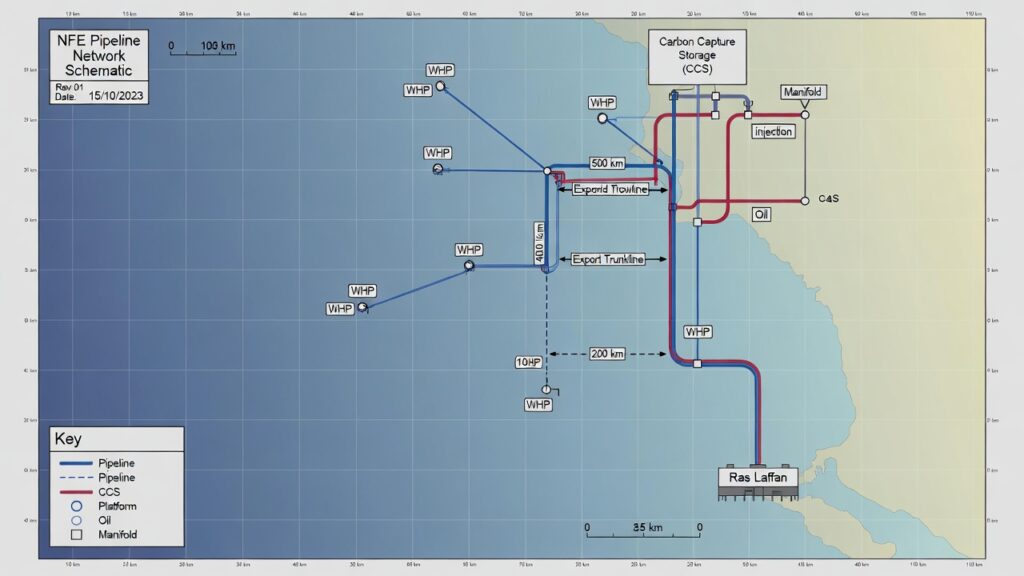
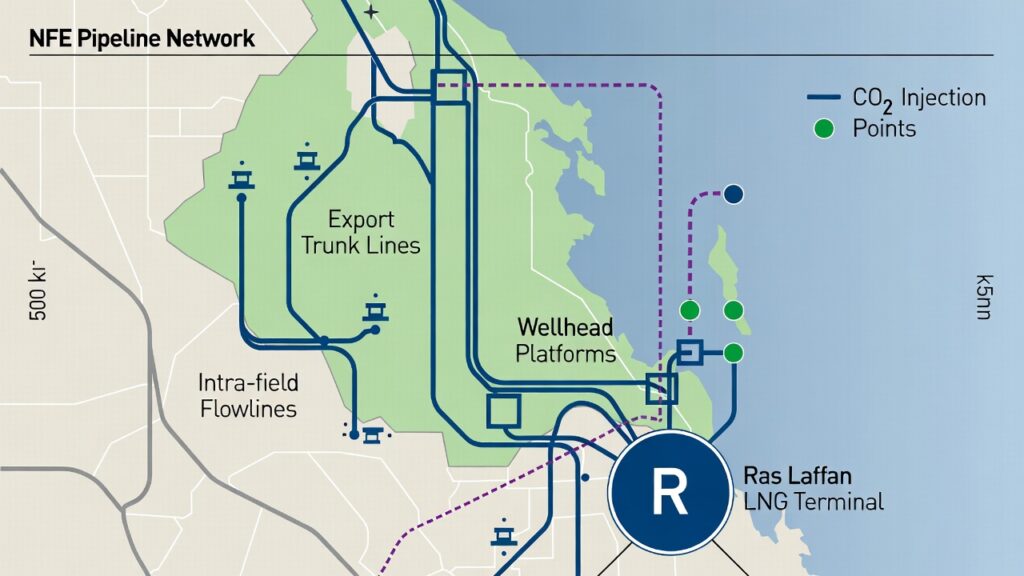
- Subsea role: ~500 km of new subsea pipelines (trunk + intra-field) transport gas to Ras Laffan. CCS includes subsea injection lines and manifolds to inject CO₂ into saline aquifers or depleted reservoirs offshore.
- Tech highlights: Pipe-in-pipe sections for thermal management, CRA materials for CO₂ corrosion, and digital twins for plume monitoring and well integrity.
- Impact: Reduces emissions intensity by ~25% vs. conventional LNG, securing premium markets in Europe and Asia.
Figure 1: Qatar North Field East Pipeline & CCS Network
( image: Schematic/map of ~500 km NFE pipelines with export trunk lines, intra-field flow lines, wellhead platforms, Ras Laffan terminal, and CCS injection lines/manifolds.)
Real-World Case Study 2:
Mozambique LNG – Restart & CCS Integration Path
TotalEnergies’ Mozambique LNG (Area 1, Rovuma Basin) restarted in early 2026 after a 2021 force majeure due to security issues. First LNG targeted for 2029.
- Capacity: 13.1 MTPA (Phase 1).
- CCS plans: Early integration discussions for CO₂ capture from gas processing, with subsea injection into depleted reservoirs or saline aquifers offshore.
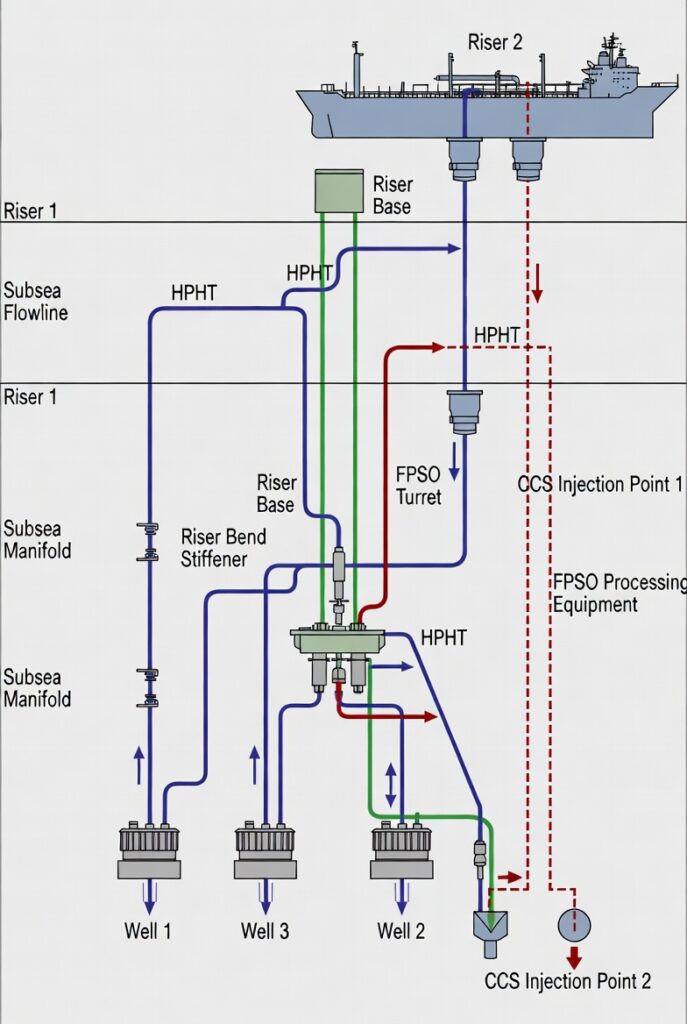
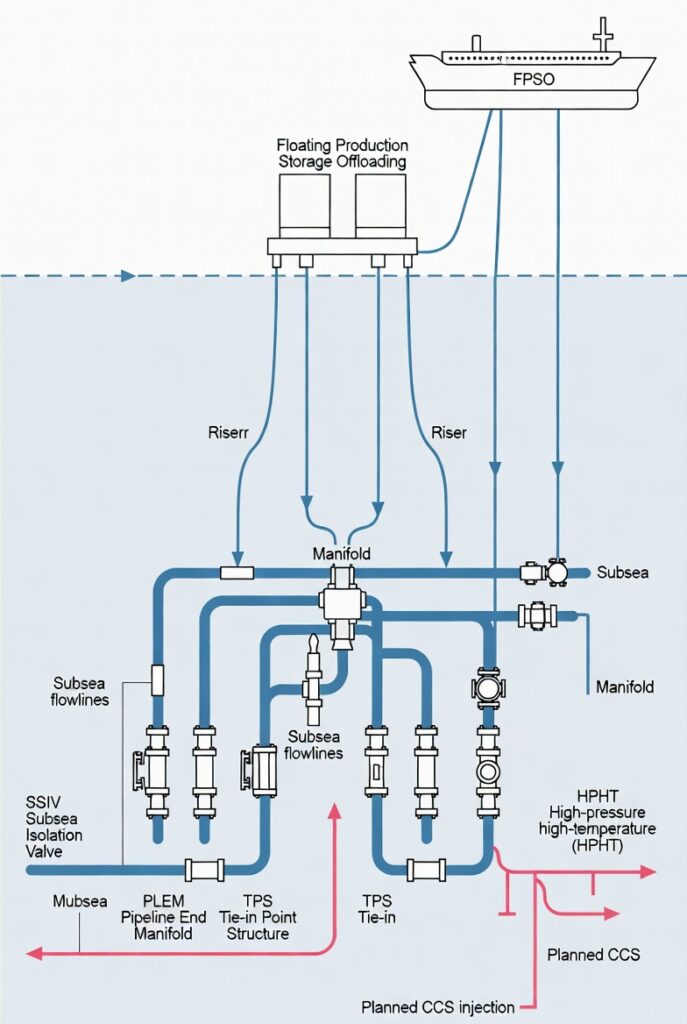
- Subsea focus: Extensive subsea infrastructure (flowlines, manifolds, risers) for gas production, with future CCS injection lines and subsea trees.
- Tech highlights: HPHT-rated subsea systems for high-CO₂ feed gas, dynamic risers for FPSO tieback, and potential subsea compression/boosting for CCS transport.
- Status: Construction ~40% complete; CCS is in planning phase to meet buyer demands for low-carbon LNG.
Figure 2: Mozambique LNG Subsea Infrastructure Overview
( image: Schematic showing subsea flow lines, manifolds, risers to FPSO, and planned CCS injection lines with labels for HPHT components.)
The Bottom Line for 2026
CCS integration is now a must-have for LNG projects. Subsea technology pipelines, injection trees, boosting, and digital twins is the key enabler for safe, efficient CO₂ transport and sequestration. Qatar NFE and Mozambique LNG show how offshore infrastructure is evolving to support both LNG production and decarbonization.Engineers:
How do you see subsea tech evolving for CCS in LNG more PIP systems, subsea compression, or advanced monitoring?
Drop a comment or connect on LinkedIn.Stay sharp out there, brothers. The future of LNG is low-carbon and subsea is leading the way.
Oko Immanuel
Subsea Engineering Specialist | Offshore Pipeline Insight