By Oko Immanuel, M.Eng in Subsea Engineering (Texas A&M University)
Published: February 24, 2026
H2: Floating offshore wind farms are scaling fast in 2026, unlocking massive wind resources in deepwater areas where fixed-bottom turbines are no longer practical (water depths >60 m). Floating platforms semi-submersible, spar, or tension-leg depend entirely on mooring systems to stay in position against extreme wind, wave, and current forces.
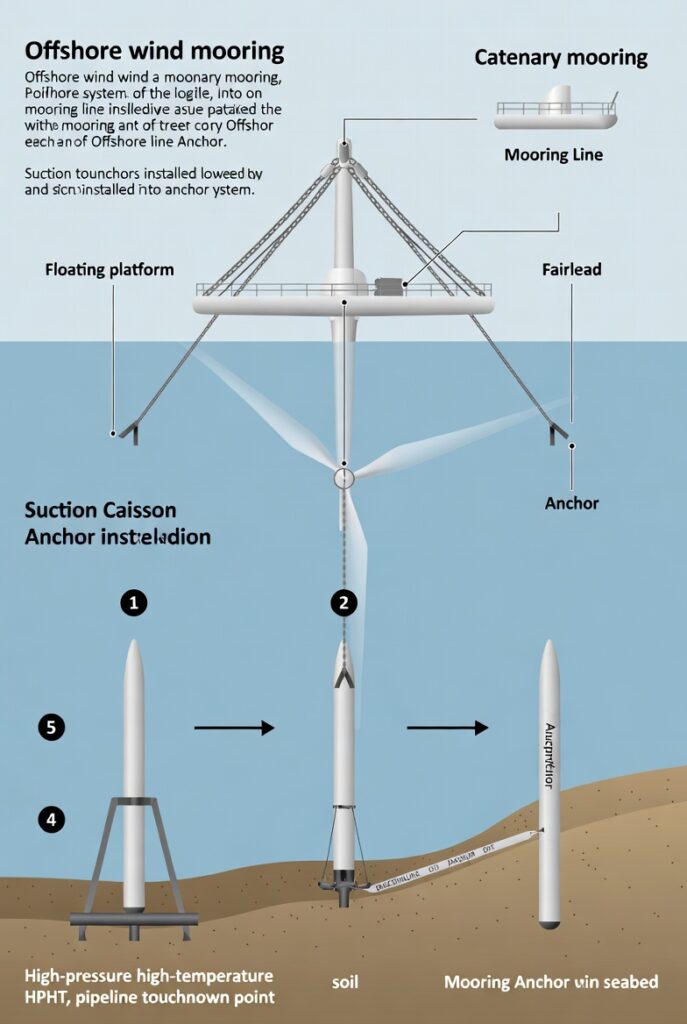
These moorings (chains, synthetic ropes, suction caissons, drag embeds, fairleads, and connectors) face integrity threats almost identical to those in HPHT subsea pipelines: high-cycle fatigue, corrosion, seabed interaction, and the need for reliable remote monitoring in remote, harsh marine conditions.Oil & gas HPHT pipeline experience is already proving invaluable the same engineering principles and tools that keep pipelines safe for decades are being applied to make floating wind moorings more reliable and cost-effective.
Shared Integrity Challenges
Floating wind moorings and HPHT pipelines encounter the same core degradation mechanisms:
- High-Cycle Fatigue
HPHT pipelines endure thermal and pressure cycles during operations. Mooring lines face continuous dynamic tension cycles from waves and wind — often 10⁶ to 10⁸ cycles over a 25-year life — leading to fatigue cracks in chains, wire ropes, and connectors. - Corrosion & Material Degradation
Pipelines suffer internal sour corrosion and external seabed attack. Moorings face marine corrosion (pitting in splash zones, crevice corrosion at connectors), biofouling, and hydrogen embrittlement in high-strength steels under constant tension. - Seabed & Anchor Interaction
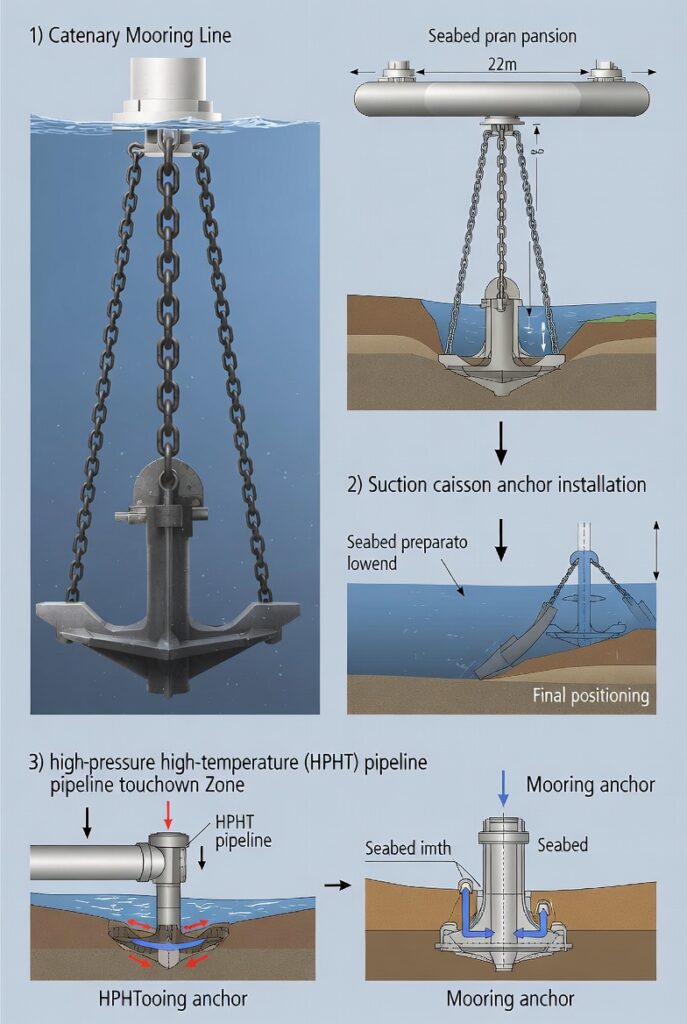
Pipeline touchdown points risk scour, free spans, and upheaval buckling. Mooring anchors (suction caissons, drag embeds) face pull-out, dragging, and scour around the foundation — the same soil-structure interaction and stability risks.
These mooring systems experience integrity challenges strikingly similar to HPHT subsea pipelines...
4. Monitoring in Deepwater
Both require low-intervention, remote sensing where physical access is expensive and weather-dependent.
These mooring systems experience integrity challenges strikingly similar to HPHT subsea pipelines...
Integrity Lessons from HPHT Pipelines Applied to MooringsThe oil & gas industry has decades of proven tools for these exact problems — floating wind is adopting them quickly.
- Digital Twins for Predictive Monitoring
HPHT pipelines use digital twins to forecast buckling, corrosion, and fatigue from live sensor data. Floating wind twins monitor mooring line tension, platform motion, anchor holding capacity, and cumulative fatigue — reducing physical inspections by 30–50% (e.g., Equinor Hywind Tampen twin). - Risk-Based Inspection (RBI)
Probabilistic RBI in pipelines prioritizes high-risk segments (welds, risers). Moorings apply RBI to focus ROV/AUV inspections on critical chains, connectors, and high-tension areas minimizing unnecessary interventions. - Fiber-Optic Distributed Sensing
HPHT pipelines use DAS/DTS fiber for continuous leak/buckling detection. Moorings integrate fiber along lines for real-time strain, tension, and vibration monitoring detecting early fatigue or chafing without diver intervention. - Cathodic Protection (CP)
Sacrificial anodes and impressed current CP protect HPHT pipelines externally. Moorings use identical systems on anchors and chains to combat marine corrosion with remote potential monitoring to track anode depletion. - Material & Fatigue Testing
HPHT pipelines qualify materials via full-scale cyclic testing. Moorings use similar protocols for synthetic ropes (polyester, HMPE) and high-strength connectors with hydrogen embrittlement testing for future blends.
Practical 2026 Engineer Tips
- Apply HPHT fatigue models (DNV-RP-C203) to mooring lines under site-specific wave spectra and platform motion.
- Deploy digital twins early integrate SCADA, motion sensors, and metocean data for predictive O&M.
- Use RBI to prioritize mooring inspections focus on fairleads, connectors, and touchdown zones.
- Design scour protection around anchors graded rock aprons or frond mats, similar to pipeline touchdown rock dumps.
- Monitor biofouling and corrosion pipeline CP lessons apply directly to mooring components.
Floating wind moorings are dynamic subsea tension members under continuous loading the same integrity principles that keep HPHT pipelines safe apply here. Oil & gas subsea expertise is playing a key role in scaling floating wind safely and cost-effectively.
What mooring integrity challenge do you see in floating offshore wind?
Share in the comments!
Share on LinkedIn for offshore wind & subsea pros.
Subscribe for HPHT series updates, offshore wind insights, and energy transition news.