By Oko Immanuel, M.Eng in Subsea Engineering
Published: February 20, 2026
High-Pressure High-Temperature (HPHT) pipelines operating above 10,000 psi and 150°C have long been engineered for hydrocarbon service in deepwater and ultra-deep environments. In 2026, the energy transition is forcing operators to repurpose or design new HPHT lines for CO₂ (carbon capture, utilization, and storage – CCUS) and hydrogen transport. These alternative fluids introduce unique challenges: phase behavior, corrosion, embrittlement, and flow assurance risks that traditional oil/gas designs may not handle.
Drawing from recent OTC, SPE, and SPT Congress discussions, this article explores how HPHT pipeline systems are evolving to support net-zero goals while maintaining safety and reliability.
Key Challenges for CO₂ and Hydrogen in HPHT Pipelines
- Material Compatibility & Degradation
- CO₂: Dense-phase CO₂ is highly corrosive in the presence of water (forming carbonic acid), leading to pitting and stress corrosion cracking (SCC). HPHT conditions accelerate degradation in carbon steels.
- Hydrogen: Atomic hydrogen causes embrittlement, blistering, and cracking in susceptible steels—especially under high pressure and cyclic loading typical of HPHT lines.
- Impact: Traditional carbon steel often fails qualification; retrofitting existing lines requires extensive testing.
- Flow Assurance & Phase Behavior
- CO₂: Supercritical phase behavior (critical point ~31°C / 73 bar) causes rapid density changes, leading to slugging, hydrate-like solids, or Joule-Thomson cooling during depressurization.
- Hydrogen: Lower density and higher compressibility increase slugging risks in multiphase systems; low viscosity can cause erosion in bends and valves.
- HPHT overlap: High temperatures exacerbate phase instability; rapid cooldowns in shutdowns promote blockages.
3 . Integrity & Fatigue Risks
Cyclic pressure/temperature changes in CCUS or hydrogen blending cause fatigue at welds, risers, and tie-ins.
External threats (seabed mobility, corrosion under insulation) remain, but internal fluid changes demand new monitoring approaches.
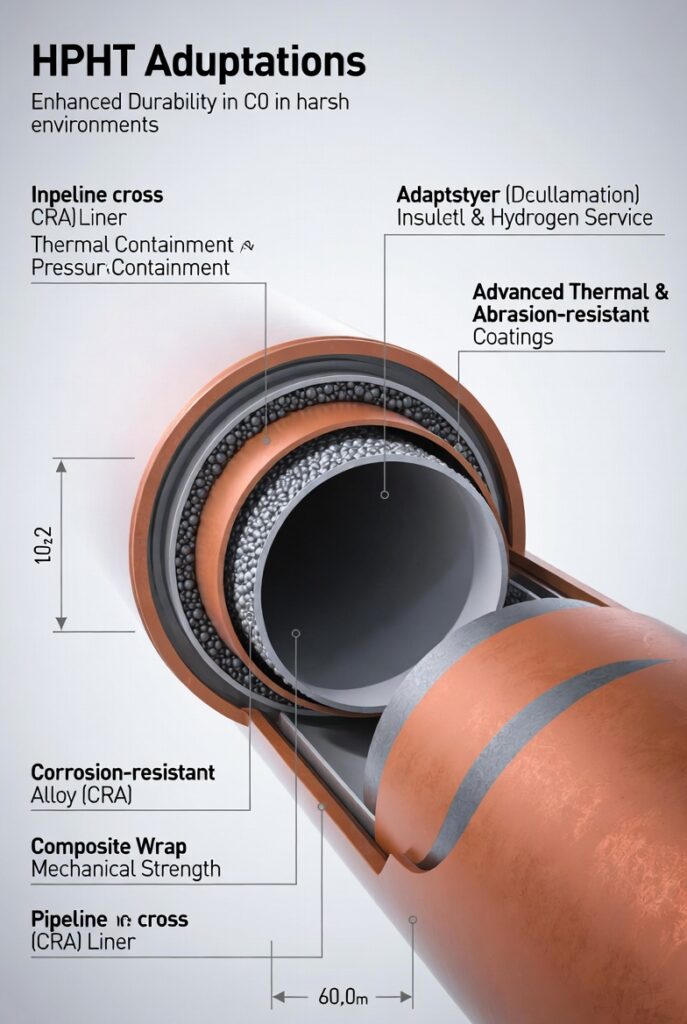
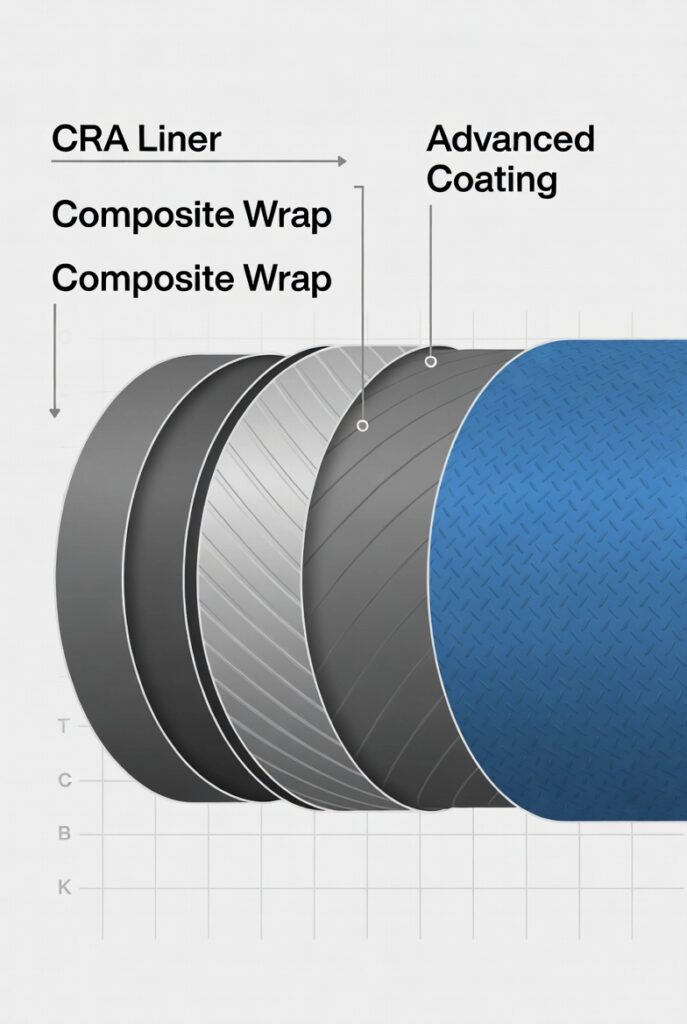
(Diagram illustrating HPHT pipeline cross-section adaptations for CO₂ and hydrogen: CRA liners, composite wraps, and advanced coatings.)
Emerging Adaptations & Solutions in 2026
- Materials Upgrades
- Use corrosion-resistant alloys (CRAs like Inconel 625, duplex) or mechanically lined pipe (MLP) for internal protection.
- Hydrogen-specific steels (e.g., low-sulfur, controlled microstructure) or non-metallic liners (composites, polymers) for embrittlement resistance.
- Full-scale qualification testing (per DNV-RP-F108, API) is now standard for repurposed lines.
- Flow Assurance Strategies
- Insulation (pipe-in-pipe with syntactic foam) and active heating (direct electrical heating – DEH or trace heating) to prevent phase issues and blockages.
- Chemical inhibitors tailored for CO₂ (corrosion) and hydrogen (minimal needed but compatibility checks).
- Advanced modeling (OLGA, PIPESIM with updated PVT data) for transient CO₂/hydrogen behavior.
- Integrity & Monitoring Enhancements
- Digital twins integrated with fiber-optic distributed sensing for real-time strain, temperature, and corrosion tracking.
- Probabilistic risk-based inspection (RBI) to prioritize high-risk segments.
- Cathodic protection optimization and external coatings for long-term seabed exposure.
Practical Tips for Engineers
- Assess existing HPHT lines early: Conduct material compatibility tests for CO₂/hydrogen before repurposing.
- Design new lines with dual-use in mind: Specify CRA-clad or composite options from the start.
- Use controlled buckling (sleepers, snake-lay) to accommodate thermal expansion differences.
- Stay updated: Track CCUS projects (e.g., Northern Lights in Norway, Porthos in Netherlands) and hydrogen pilots for lessons learned.
The energy transition isn’t replacing HPHT pipelines it’s evolving them. By adapting materials, flow assurance, and integrity strategies, these systems can bridge hydrocarbon reliability with low-carbon futures.
What challenges have you seen in adapting pipelines for CO₂ or hydrogen?
Share in the comments let’s discuss practical solutions for subsea integrity and flow assurance!
Share on LinkedIn or X for energy transition pros. Subscribe for HPHT series updates, flow assurance insights, integrity tips, and weekly news.
(Next: More on deepwater drilling fleet growth or Gulf leasing opportunities.)