March 2, 2026
By Oko Immanuel
Founder & Owner, Offshore Pipeline Insight
M.Eng in Subsea Engineering | Former Roughneck | Texas A&M Alumnus
In subsea HPHT pipelines, gas hydrates are one of the most common and costly flow assurance threats. Hydrates form when light hydrocarbons (methane, ethane) combine with water under high pressure (>500 psi) and low temperature (<77°F / 25°C) typical conditions on the deepwater seabed. Once formed, they create ice-like plugs that can completely block flow lines, requiring expensive remediation (often $10–50 million per incident) or even shutdowns.
Hydrate inhibitors : are chemicals injected into the production stream to prevent or delay hydrate formation. They are essential for safe, continuous operation in deepwater and long tieback systems.
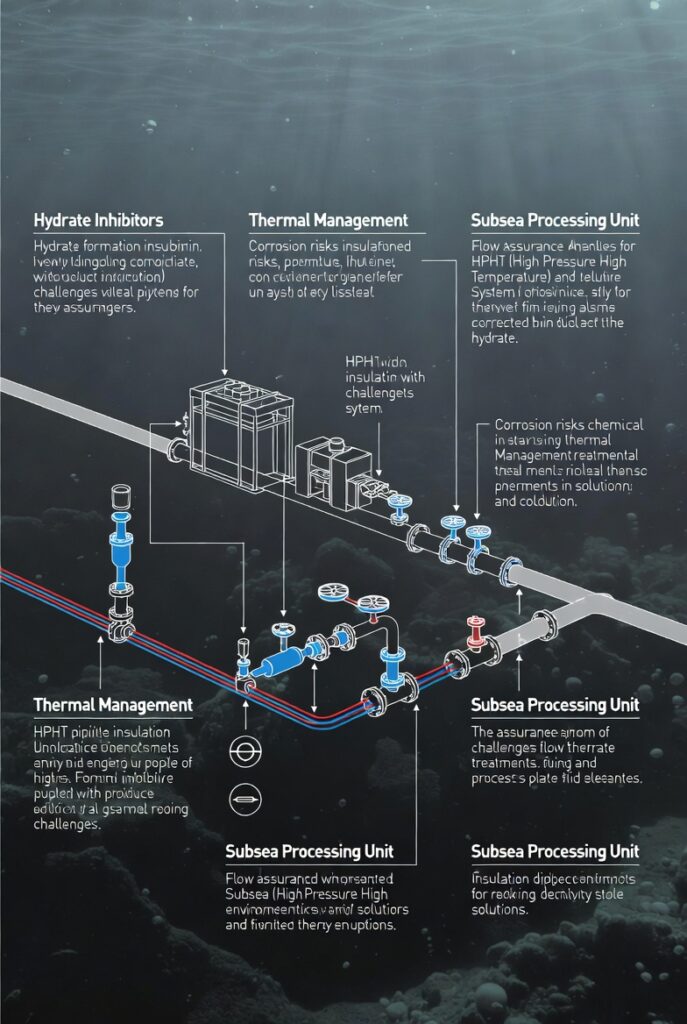
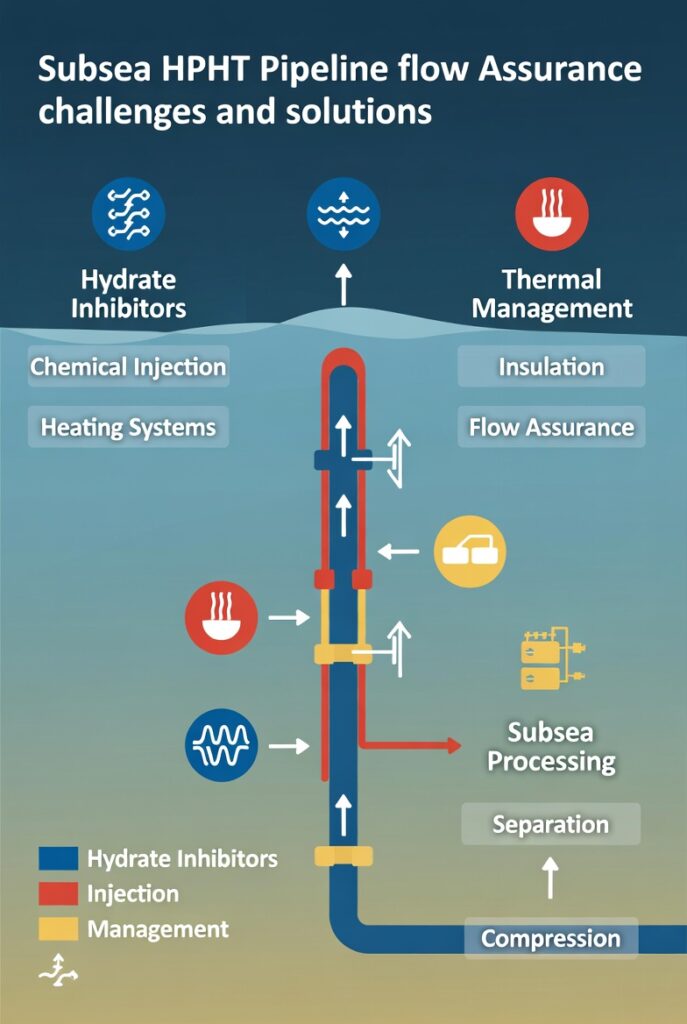
Two Main Types of Hydrate Inhibitors
- Thermodynamic Hydrate Inhibitors (THIs)
These shift the hydrate formation curve to lower temperatures/higher pressures, making hydrates less likely to form.- Methanol (MeOH) Most common and effective THI.
- Dosage: 10–60 wt% in water phase (typically 20–40%).
- Pros: Very effective, widely available, fast-acting.
- Cons: High volume required, recovery/regeneration needed, toxicity/environmental concerns.
- Monoethylene Glycol (MEG) Preferred for long-term use in closed-loop systems.
- Dosage: 30–80 wt%.
- Pros: Lower toxicity than methanol, regenerable (recovered onshore), suitable for export pipelines.
- Cons: Higher viscosity, more expensive.
- Diethylene Glycol (DEG) Less common, used in specific cases.
- Methanol (MeOH) Most common and effective THI.
- Low-Dosage Hydrate Inhibitors (LDHIs)
These are used at much lower concentrations (0.1–3 vol%) and do not shift the hydrate curve significantly. Instead, they interfere with hydrate crystal growth.
- Anti-Agglomerants (AAs)
- Allow hydrates to form but prevent them from sticking together into plugs.
- Best for high water-cut systems (>50% water).
- Dosage: 0.5–3%.
- Pros: Low volume, cost-effective in high-water flows.
- Kinetic Hydrate Inhibitors (KHIs)
- Delay hydrate nucleation and growth long enough for fluid to reach the platform.
- Dosage: 0.1–1%.
- Pros: Very low dosage, environmentally friendlier.
- Cons: Time-limited effectiveness (hours to days), less reliable in high subcooling.
How Inhibitors Are Deployed in Subsea Systems
- Subsea umbilical lines deliver chemicals from topside to wellhead/manifold.
- Chemical injection valves (downhole or manifold) dose precisely.
- MEG is often used in closed-loop systems (recovered and regenerated onshore).
- Methanol is common for short-term or high-risk scenarios.
- LDHIs reduce umbilical size and topside storage needs.
2026 Trends & Innovations
- Hybrid inhibition: Combining THIs with LDHIs for cost/environmental optimization.
- Green inhibitors: Bio-based or low-toxicity alternatives gaining traction.
- Real-time monitoring: Fiber-optic sensing detects early hydrate formation.
- AI dosing optimization: Predictive models adjust injection rates based on pressure/temperature/flow data.
Key Takeaway
Hydrate inhibition is a cornerstone of HPHT subsea flow assurance. Choosing the right inhibitor (THI vs. LDHI, methanol vs. MEG) depends on water cut, subcooling, tieback length, and environmental regulations. Proper design and monitoring prevent costly blockages.
What hydrate challenges have you faced in HPHT pipelines? Comment below share this post!
Stay tuned for more HPHT, subsea integrity, and flow assurance insights. Gig ’em!#HPHT #FlowAssurance #HydrateInhibitors #SubseaPipelines #OffshoreEnergy #GigEm #AggieEngineers