By Oko Immanuel, MSc in Subsea Engineering
Published: February 25, 2026
In HPHT subsea tiebacks (high-pressure >10,000 psi, high-temperature >150 °C, long distances >50 km), hydrate formation remains the most severe flow assurance risk during transient operations especially shut-down, cool-down, start-up and depressurisation.Hydrates are ice-like solids formed when water + gas molecules (methane, CO₂) combine at high pressure and low temperature. In deepwater HPHT systems, shut-in cool-down can drop temperatures below the hydrate formation curve within hours, forming plugs that can take weeks/months to remediate.In 2026, operators choose between chemical inhibition and thermal management (or hybrid approaches) based on tie-back length, water cut, environmental regulations, OPEX tolerance, and transition fluid compatibility (CO₂, H₂ blends).
Hydrate Formation Risk in HPHT Tiebacks
Key factors driving risk:
- Long tie-back distance → long cool-down time during shut-in
- High water cut → more free water available
- Deepwater cold ambient temperature → rapid cooling
- High pressure → shifts hydrate curve to higher temperatures
- CO₂/H₂ presence → changes hydrate stability zone and dissociation behaviour
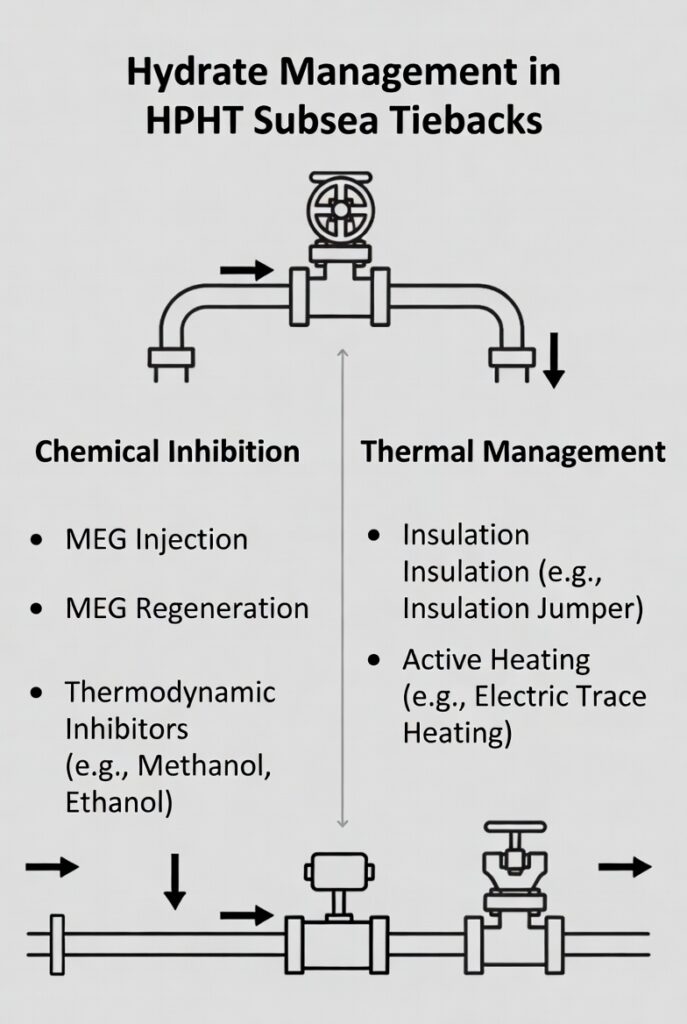
H2 Figure 1.Hydrate Management in HPHT Subsea Tiebacks
Chemical Inhibition Strategies (2026)
- Thermodynamic Inhibitors (THI)
- Methanol (MeOH) & Monoethylene Glycol (MEG) lowest cost, proven in many HPHT fields.
- 2026 trend: MEG preferred for environmental reasons (less toxic, recyclable) and lower injection volumes in long tie-backs.
- Dosage typically 20–60 wt% in water phase.
- Low Dosage Hydrate Inhibitors (LDHI)
- Anti-agglomerants (AA) — allow hydrates to form but prevent agglomeration/blockage.
- Kinetic Hydrate Inhibitors (KHI) delay hydrate nucleation/growth.
- 2026 advancement: Hybrid KHI + AA formulations for high water-cut HPHT wells; reduced chemical volume vs THI.
- Advantages of chemical inhibition
- Proven technology with long track record
- Lower capex (no additional hardware)
- Flexible dosage adjustment
- Disadvantages
- High OPEX (chemical cost + logistics)
- Environmental impact (MeOH toxicity, MEG regeneration energy)
- Limited effectiveness in ultra-long tie-backs (>100 km)
Thermal Management Strategies (2026)
- Passive Insulation
- Pipe-in-pipe (PIP), wet insulation (polyurethane foam, syntactic foam), pipe-in-pipe with vacuum or aerogel.
- Goal: Keep fluid temperature above hydrate formation curve during shut-in (typically 8–24 hours cool-down window).
- Active Heating
- Direct Electrical Heating (DEH) — current passed through pipe wall or trace heating cables.
- Trace-heated pipe-in-pipe (THPIP) — integrated heating cables inside annulus.
- 2026 trend: DEH systems now rated for HPHT pressures/temperatures; hybrid DEH + insulation for extended cool-down protection.
- Advantages of thermal management
- No chemical injection → lower OPEX and environmental impact
- Better for ultra-long tie-backs and high water-cut systems
- Enables longer shut-in times without risk
- Disadvantages
- Higher capex (insulation + heating hardware)
- Power supply requirements (umbilical or topsides power)
- Installation complexity (especially in deepwater)
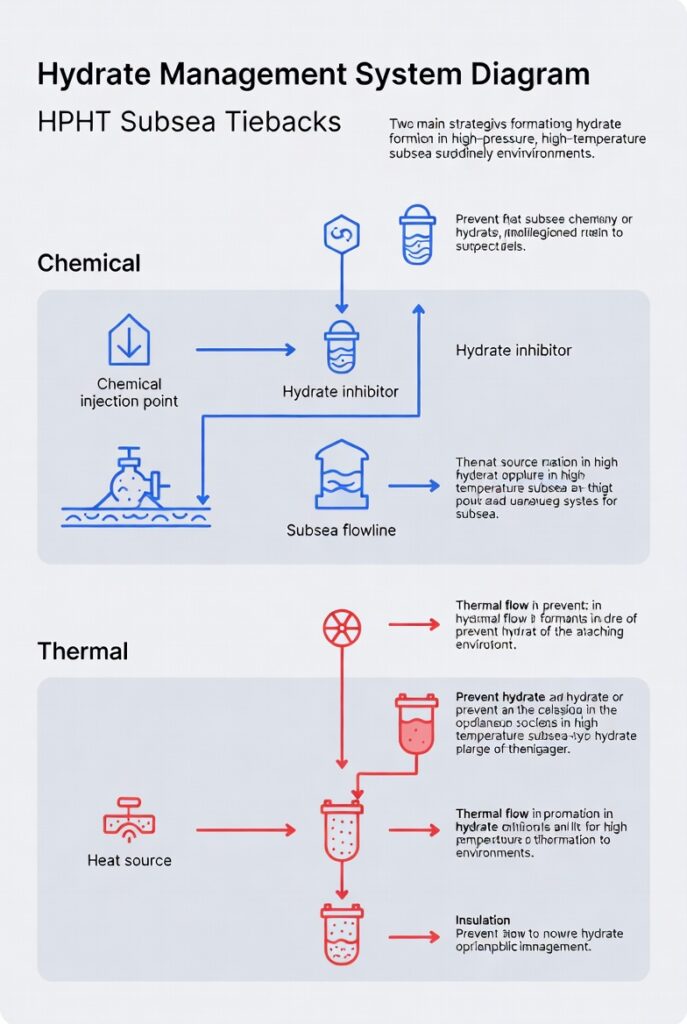
Hybrid & Emerging Approaches in 2026
- Chemical + Thermal Use insulation + low-dose LDHI for cost/opex balance.
- Cold Flow : Allow hydrates to form as slurry still experimental but gaining interest for ultra-long tie-backs.
- Digital Twins — Real-time simulation of cool-down, hydrate risk, and chemical/thermal performance — integrates temperature/pressure sensors and flow models.
Practical 2026 Engineer Tips
- Model shut-in cool-down early (OLGA/PIPESIM with updated hydrate curves).
- For short tie-backs (<50 km): MEG or MeOH + insulation often sufficient.
- For long tie-backs (>80 km): Evaluate DEH or hybrid LDHI + PIP.
- Always qualify materials/chemicals for HPHT conditions high temperature degrades many inhibitors.
- Use fiber-optic distributed temperature sensing (DTS) for real-time hydrate risk monitoring.
Hydrate management in HPHT subsea tiebacks remains a balance of cost, reliability, and environmental impact chemical inhibition is proven, thermal is future-proof, and hybrids are increasingly common.
What hydrate management strategy are you using in your HPHT tiebacks?
Share in the comments!
Share on LinkedIn for subsea & flow assurance pros.
Subscribe for HPHT series updates, offshore wind insights, and energy transition news.