Oko Immanuel
Petroleum / Subsea Engineer
Founder, Offshore Pipeline Insight
Texas A&M Alumnus.
March 07, 2026
2026 marks a pivotal “year of reckoning” for hydrogen infrastructure. After years of ambitious announcements and pilot-scale hype, the sector is shifting toward pragmatic execution amid policy adjustments, project cancellations, and the push for viable, large-scale networks. While global clean hydrogen project announcements exceed 1,500, actual build-out remains limited many developers are adjusting timelines, scaling back, or canceling amid funding gaps and off take uncertainty.
This technical blog examines the current state of hydrogen pipeline development in 2026 (Europe and US focus), highlights key projects moving from ambition to reality, and dives into integrity lessons particularly hydrogen embrittlement and repurposing challenges for pipeline engineers.
Current State: Ambition Meets Reality
Europe and the US lead hydrogen pipeline ambitions, but progress in 2026 is uneven:
- Europe: Early movers like Germany (Hydrogen Core Network) and the Netherlands (Porthos/Aramis) are operational or in late construction; broader European Hydrogen Backbone timelines are slipping (many commissioning dates pushed to 2027–2030).
- US: Hubs in Gulf Coast and Midwest advance slowly; focus on blue hydrogen (SMR + CCUS) with limited dedicated H₂ pipelines.
- Global trends: Wood Mackenzie calls 2026 a “year of reckoning policy retreats (e.g., EU softening RED III quotas), cancellations in Middle East/Australia, but progress in RFNBO supply chains and ammonia cracking.
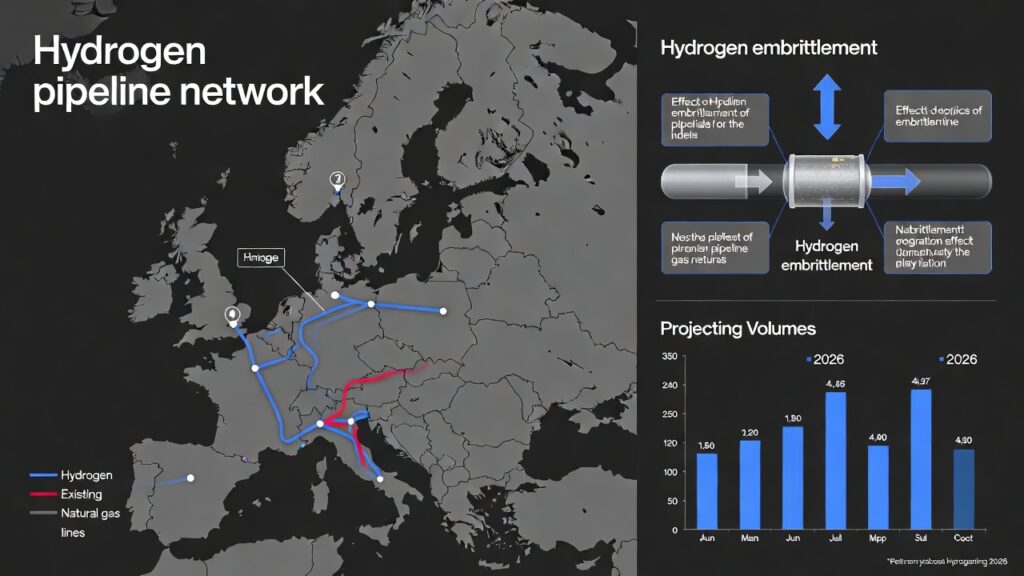
This map illustrates the emerging hydrogen pipeline network in Europe (blue lines) alongside existing natural gas infrastructure (red), showing repurposing opportunities:
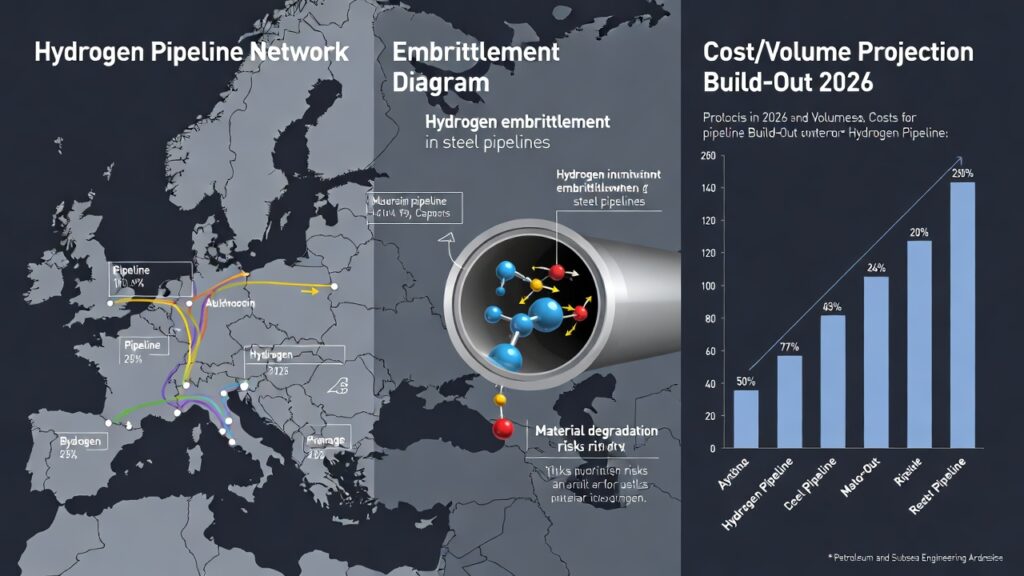
A cost/volume projection chart highlights the gap between ambition and projected build-out through the late 2020s (blue hydrogen dominant early, green scaling later):
Key Projects Advancing in 2026
Several flagship initiatives are crossing from planning to operation or FID:
- Germany – Hydrogen Core Network (H2 Core): Approved October 2024; major conversions (e.g., Lubmin–Bobbau 400 km line operational 2025–2026; Bad Lauchstädt–Leuna 25 km in service). 2026 sees testing/commissioning of additional segments.
- Netherlands – Porthos/Aramis: Offshore CO₂/H₂ tie-ins; Porthos operational 2026 (~2.5 Mt CO₂/year to North Sea); Aramis advancing for H₂ import/export.
- UK – HyNet & East Coast Cluster: Offshore storage hubs; pipeline repurposing for H₂/CO₂ advancing with £21.7B UK CCUS funding.
- US Gulf Coast: Bayou Bend/River Bend CCS hubs target CO₂ transport (repurposing potential); blue H₂ projects (e.g., ExxonMobil networks) move forward with 45Q credits.
- Other notables: Thyssengas Dutch-German corridor (52 km conversion FID 2025, operation 2027); AquaDuctus offshore H₂ pipeline (GW-scale North Sea).
Integrity Lessons: Hydrogen Embrittlement & Pipeline Challenges
Hydrogen’s unique properties pose significant integrity risks, especially in repurposed natural gas lines.
- Hydrogen Embrittlement (HE): H₂ diffuses into steel, reducing ductility/fracture toughness and accelerating fatigue crack growth (particularly in high-strength grades X70+ under cyclic pressure). Post-operated steels show higher susceptibility.
- Leakage & Permeation: Small H₂ molecules increase escape risk through welds, seals, and gaskets.
- Pressure Cycling: Variable renewable-linked supply causes fatigue; reduced linepack capacity (H₂ ~1/3 energy density of NG) impacts security.
- Mitigation Strategies:
- Lower operating pressures (50–80 bar) to limit HE.
- Use lower-strength steels (X52/X60); internal coatings/inhibitors.
- Enhanced inspection (AUV/ROV, ILI for defects).
- Digital twins for predictive fatigue modeling.
This diagram illustrates hydrogen embrittlement mechanisms in steel pipelines (diffusion, crack propagation at defects):
Closing Thoughts
2026 separates viable hydrogen markets from policy driven ambition. Pipeline build-out is progressing in clusters (Germany, Netherlands, Gulf), but integrity remains the critical path embrittlement, leakage, and repurposing risks demand rigorous re-qualification and monitoring.For subsea/pipeline engineers, this creates opportunities in inspection tech, material upgrades, and hybrid (H₂/CO₂) systems. The transition is real, but measured.
What integrity challenges or projects are you tracking in 2026? Share in the comments!
Oko Immanuel
Petroleum / Subsea Engineer
Founder, Offshore Pipeline Insight
Texas A&M Alumnus.
March 07, 2026
Author’s Contact: oko@offshorepipelineinsght.com