Oko Immanuel
Petroleum / Subsea Engineer
Founder, Offshore Pipeline Insight
Texas A&M Alumnus.
March 06, 2026
Hydrogen production integrated with Carbon Capture, Utilization, and Storage (CCUS) commonly known as blue hydrogen—is a critical bridge technology in the energy transition. It leverages established fossil fuel-based processes (primarily natural gas) while capturing and sequestering the resulting CO₂ emissions, achieving low-carbon or near-zero emissions hydrogen at scale. In 2026, blue hydrogen remains the most mature, cost-competitive low-emission pathway compared to green (electrolysis) alternatives in many regions, especially where natural gas is abundant and CCUS infrastructure is emerging.
This post covers the core process, key technologies, integrity/transport considerations for CO₂ pipelines (tying into our earlier discussions), and the latest 2026 trends and projects driving deployment.
The Blue Hydrogen Production Process with CCUS
Blue hydrogen is produced via steam methane reforming (SMR) or autothermal reforming (ATR) of natural gas, followed by water-gas shift and pressure swing adsorption to isolate high-purity H₂. CCUS captures ~85–99% of the CO₂ (mostly from process streams) to prevent atmospheric release.Key steps:
- Feedstock reforming: Natural gas (CH₄) + steam → syngas (H₂ + CO) in SMR, or partial oxidation in ATR for higher efficiency.
- Water-gas shift: CO + H₂O → CO₂ + H₂ (increases H₂ yield).
- CO₂ capture: Pre-combustion (high-concentration streams from shift reactor) or post-combustion (flue gas from reformers). Technologies include amine solvents (e.g., Shell CANSOLV, ADIP ULTRA), membranes, or advanced sorbents.
- Compression & transport: Captured CO₂ compressed to supercritical state (>1,070 psig) and piped to storage (saline aquifers, depleted reservoirs) or utilization (EOR, chemicals).
- Storage/Utilization: Permanent geological sequestration or reuse (e.g., synthetic fuels, urea).
Pre-combustion capture dominates blue hydrogen due to concentrated CO₂ streams, enabling >90% capture rates with lower energy penalties than post-combustion.
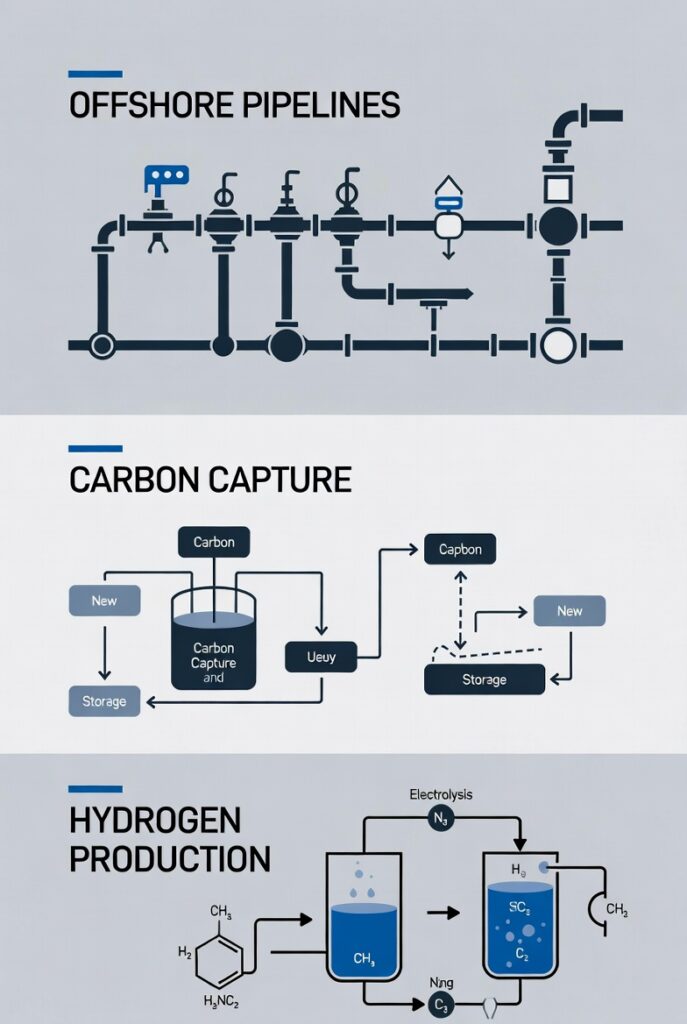
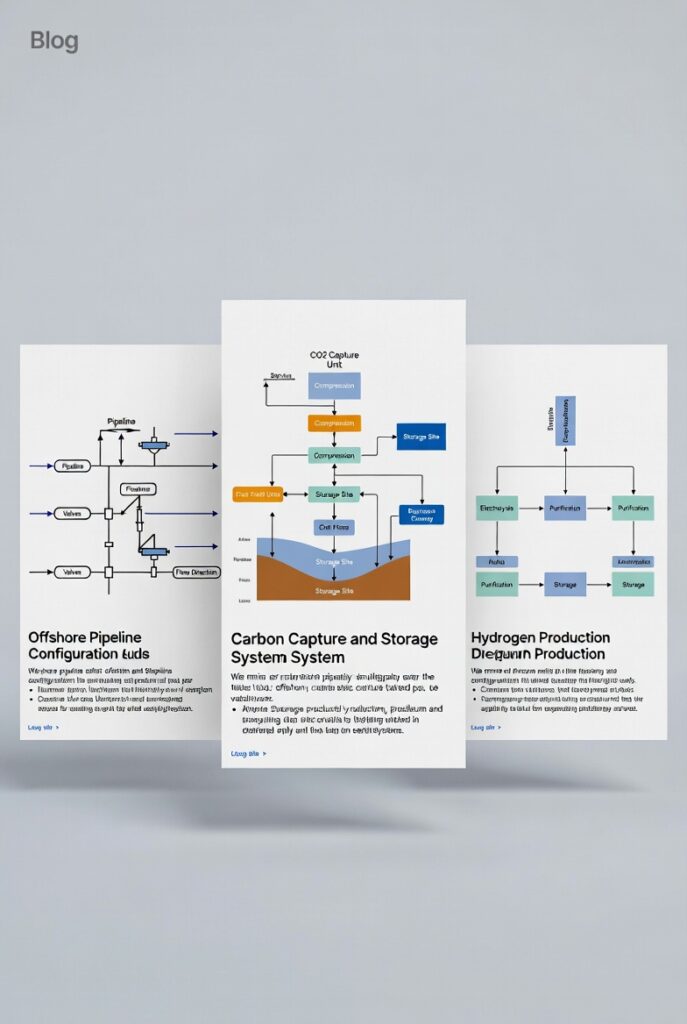
This diagram illustrates the integrated blue hydrogen process with CCUS:A schematic of SMR + CCUS flow, showing capture points and CO₂ pipeline export:
Integrity & Pipeline Considerations for CO₂ TransportCO₂ pipelines face unique challenges vs. hydrocarbons:
- Corrosion risk: Wet CO₂ forms carbonic acid—dehydration to <50 ppm water essential.
- Phase behavior: Maintain supercritical pressure to avoid two-phase flow and running ductile fractures.
- Repurposing: Existing natural gas lines viable (with upgrades for toughness, seals), but new dedicated CO₂ lines preferred for high-purity streams.
- Monitoring: Fiber-optic sensing for leaks/strain; digital twins for predictive integrity.
Synergies with offshore: Subsea CO₂ lines (e.g., Northern Lights) parallel dynamic cable fatigue lessons—fatigue from motions, pressure management.
2026 Developments: Momentum in Blue Hydrogen + CCUS
2026 sees blue hydrogen leading low-carbon H₂ due to cost advantages, policy support (e.g., US 45Q credits, EU/UK funding), and first operational clusters.
- US: Gulf Coast hubs (e.g., ExxonMobil networks >100 Mt/year potential reduction); DOE Hydrogen Hubs (7 regional, many blue-focused); Stratos DAC + blue integration.
- Europe: Northern Lights Phase 2 scaling; Porthos/Aramis operational; UK HyNet/Teesside advancing despite some deferrals.
- Middle East/Asia: Aramco Jubail CCS Hub (9 Mt/year target); Qatar/North Field blue pathways; China coal-to-H₂ with CCUS.
- Challenges & shifts: Scale constraints (integration over ambition); EGR (Enhanced Gas Recovery) driving some CCUS (e.g., Tangguh UCC FID Jan 2026, unlocking gas via CO₂ injection); pilots to shared infrastructure.
- Events: American Hydrogen & CCUS Forum (Houston, April); World Hydrogen Summit (expanded CCUS focus).
Blue hydrogen LCOH remains competitive (~$1.5–3/kg with CCUS), bridging to green while enabling CCS learning curves.
Closing Thoughts
Hydrogen via CCUS (blue) offers a pragmatic, scalable path to decarbonize hard-to-abate sectors refineries, ammonia, steel while building CO₂ infrastructure for broader CCS. Pipeline/subsea expertise is pivotal: integrity tools, repurposing, offshore transport all transfer directly.As 2026 clusters generate real data, expect accelerated adoption.
What’s your take on blue vs. green pathways, or CO₂ pipeline challenges in your region?
Comment below—let’s discuss!
Oko Immanuel
Petroleum / Subsea Engineer
Founder, Offshore Pipeline Insight
Texas A&M Alumnus.
March 06, 2026