By Oko Immanuel, M.Eng – Founder, Offshore Pipeline Insight
March 17, 2026
High-Pressure High-Temperature (HPHT) subsea wells push equipment to extremes: reservoir temperatures often exceed 150–200°C, pressures hit 15,000+ psi, and cold seawater (~4°C) creates massive thermal gradients. One of the biggest integrity risks? Thermal expansion—not just in pipelines, but right at the wellhead.Trapped fluids in annuli, metal-to-metal seals in connectors, and the wellhead housing itself expand differentially, leading to annular pressure buildup (APB), casing deformation, wellhead growth/movement, seal leakage, or even fatigue failure over cycles. Traditional methods (analytical correlations like API or simple 1D heat transfer) work for screening but fall short in complex geometries, transient flows, ocean currents, and multiphase production.
Enter Computational Fluid Dynamics (CFD) a game-changer for predicting these effects more accurately. CFD excels at modeling fluid flow, convection, and heat transfer in and around subsea equipment, feeding precise temperature fields into structural models for expansion/stress prediction.
Why CFD Shines for HPHT Wellhead Thermal Expansion Prediction
- Accurate Convective Heat Transfer Coefficients
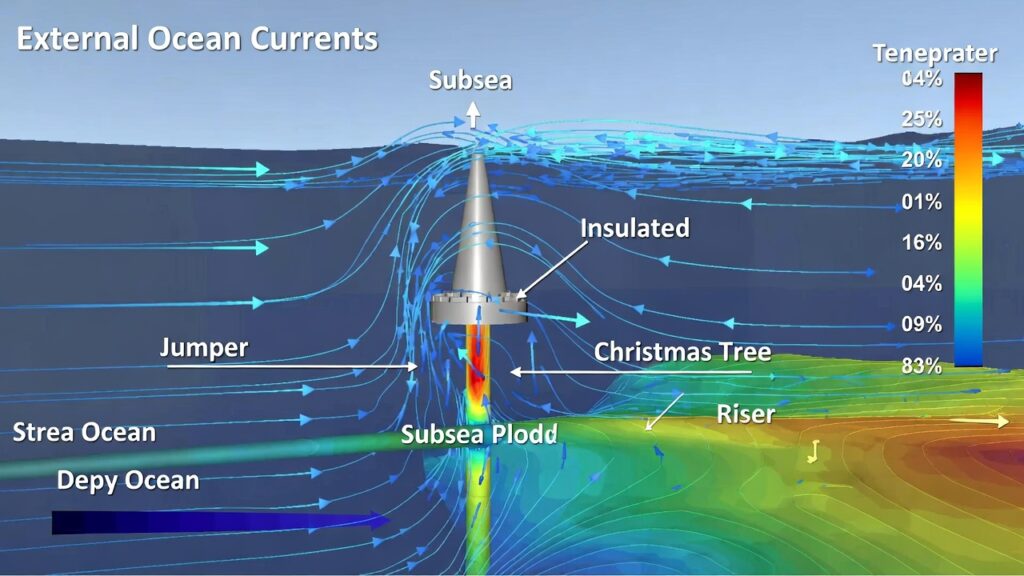
Seawater flows around the wellhead (currents, tides) create forced convection that’s hard to estimate with empirical Nu numbers. CFD simulates external flow over the Christmas tree, connector, and housing to compute local h (heat transfer coeff.) values—often 100–500 W/m²K or higher with currents. This beats conservative assumptions that overpredict cooldown or underpredict heating.Recent studies (e.g., Lu et al., 2011; referenced in multiple Ocean Engineering papers) validate CFD for seabed equipment thermal performance, directly applicable to wellheads.
2. Transient Multi-Annuli Temperature Prediction
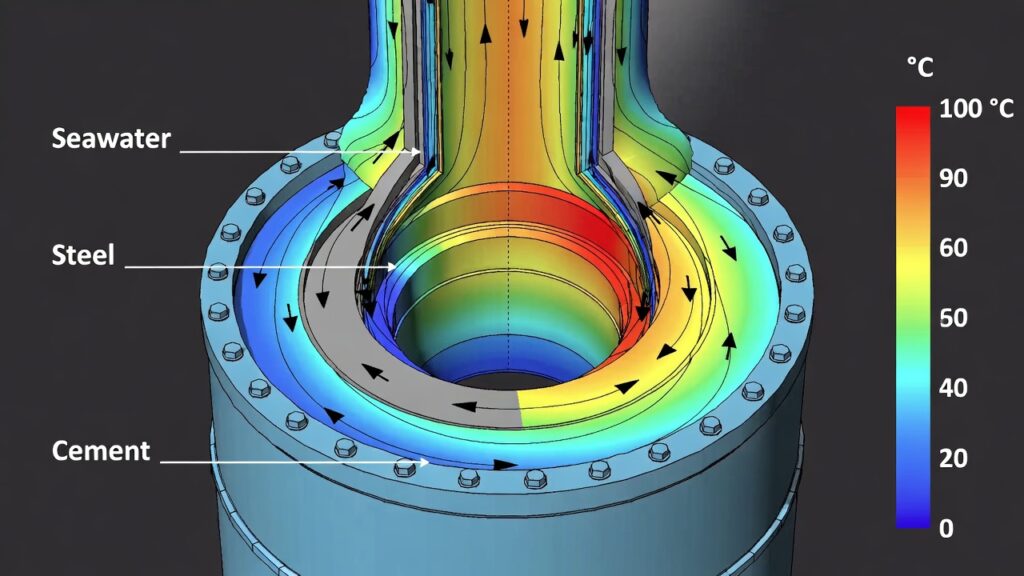
In subsea HPHT wells, heat from hot production fluid transfers through casing strings to trapped annuli fluids, causing expansion and APB. CFD captures transient radial/axial temperature profiles in multi-annuli systems, including natural convection inside sealed volumes and conduction through steel/cement.Coupled with PVT data for fluid expansion coefficients, CFD predicts pressure buildup more reliably than steady-state models—critical for avoiding burst/collapse in outer casings.
3. Internal Flow and Natural Convection in Equipment
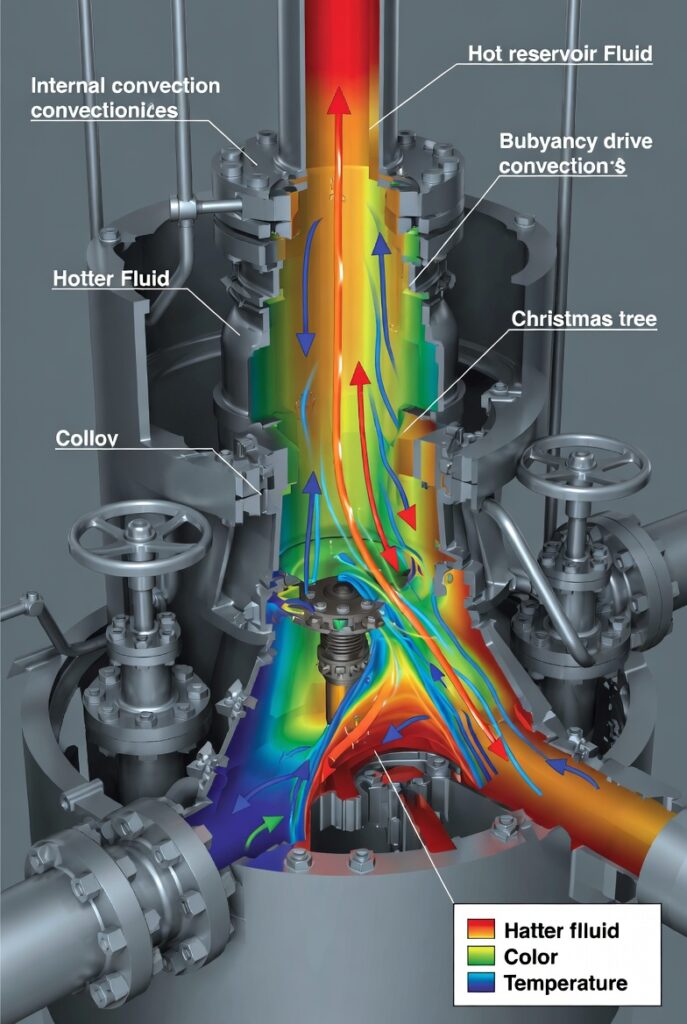
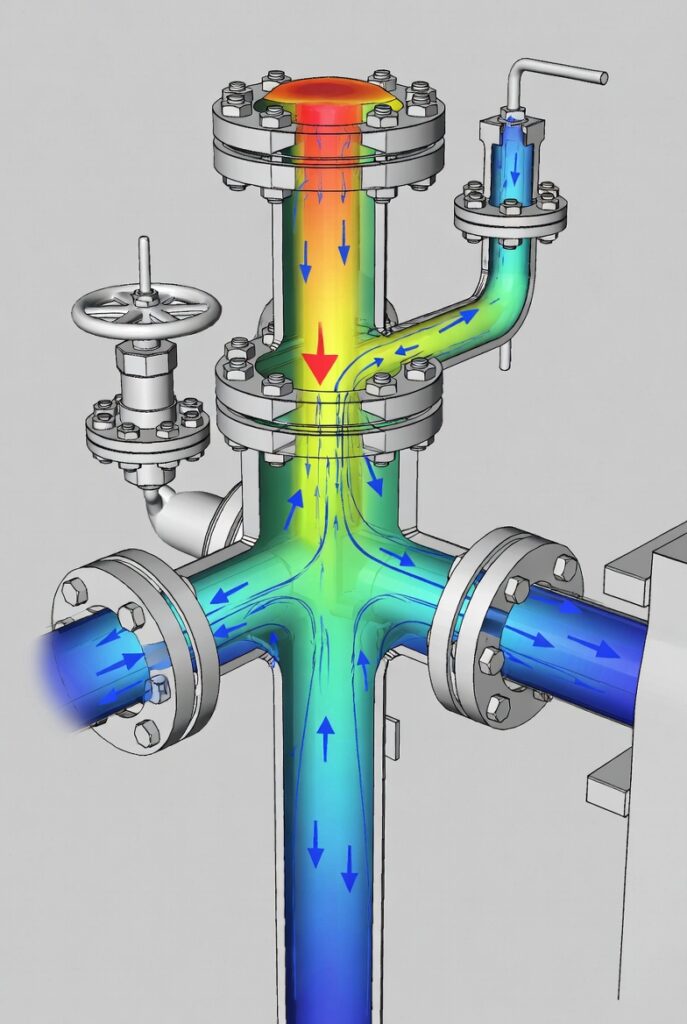
Inside the wellhead/Christmas tree, hot reservoir fluid drives buoyancy-driven flows. CFD models this internal convection (e.g., Marotta et al., 2014 FEM-CFD hybrid approaches) to predict local hotspots and cooling rates during shut-in/production cycles.
4. Coupled Thermal-Structural Insights
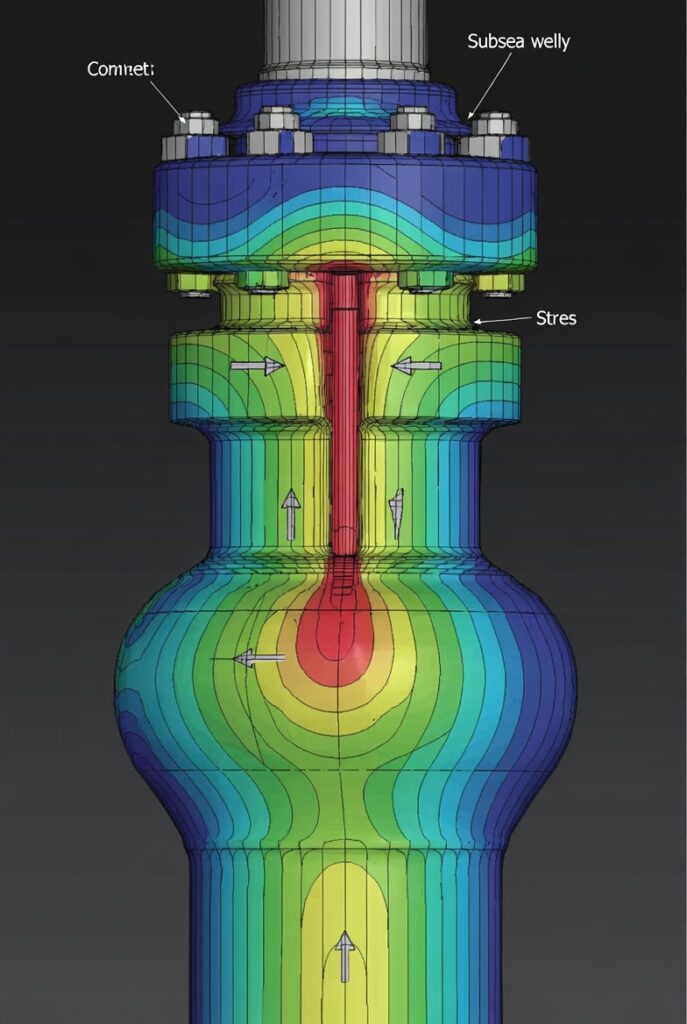
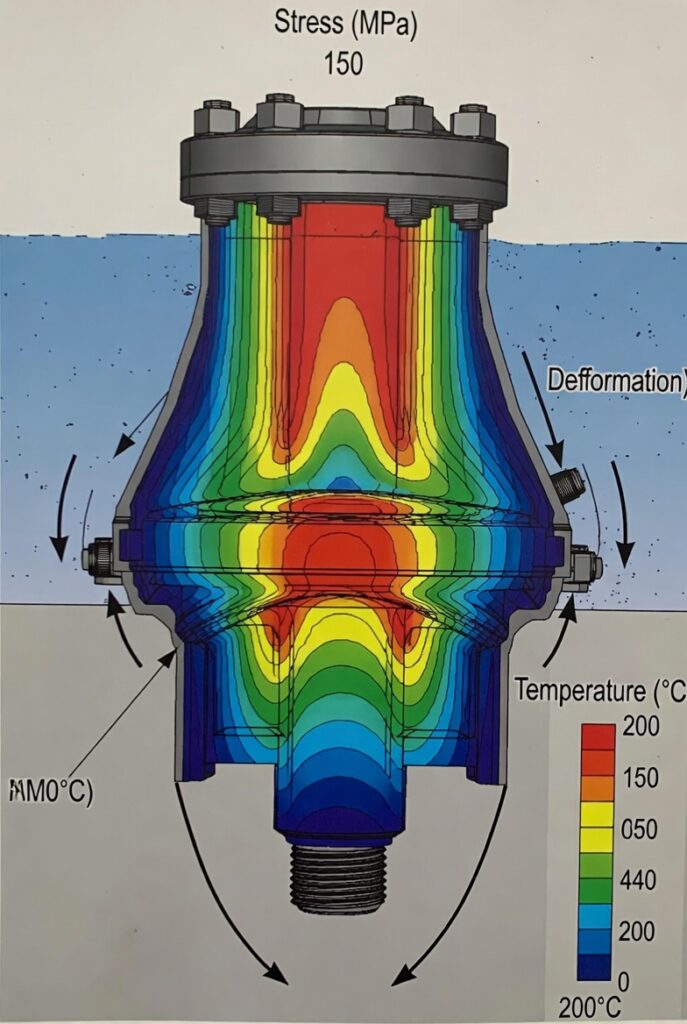
While pure CFD handles fluids/heat transfer, couple it with FEA (e.g., ANSYS Fluent + Mechanical, COMSOL Multiphysics) for full thermo-mechanical response: import CFD-derived temperature fields to calculate differential expansion, stresses in seals/housings, and wellhead movement.This reveals risks like mismatched expansion causing fit variations in valve assemblies or connector deformation under HPHT loads.
5. Ocean Current and Insulation Effects
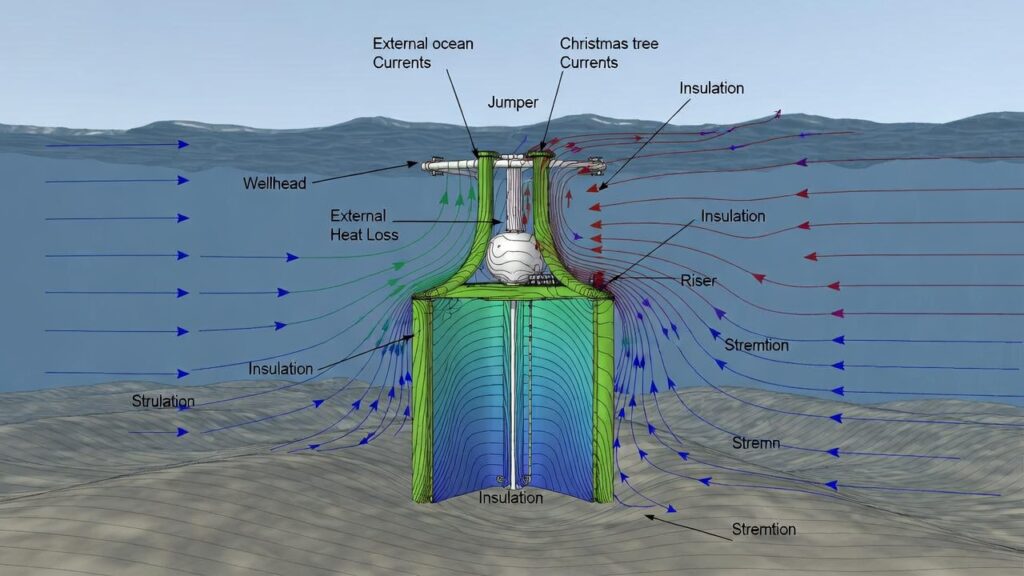
CFD incorporates external currents (e.g., 0.5–2 m/s) to assess insulation layer performance on jumpers/risers tied to wellheads. Poor insulation accelerates cooldown, increasing contraction risks; CFD quantifies it precisely.
Practical CFD Workflow Ideas for Engineers (2026 Best Practices)
- Geometry & Meshing
- Import CAD of wellhead assembly (high-pressure housing, connector, tree body).
- Use polyhedral/tetrahedral meshes refined near walls for boundary layers (y+ <5 for turbulence models).
- Include surrounding seawater domain (large enough to avoid boundary effects).
- Boundary Conditions
- Internal: Hot production fluid inlet (temperature, velocity from well models).
- External: Seawater at 4°C with velocity inlet for currents.
- Material properties: Temperature-dependent conductivity, expansion coeffs (API/ISO data).
- Models to Use
- Turbulence: k-ε or k-ω SST for external flow.
- Multiphase: If gas/liquid, VOF or Eulerian.
- Radiation: Minimal subsea, but include if high-temp surfaces.
- Transient solver for startup/shutdown cycles.
- Post-Processing & Coupling
- Export temperature contours → map to FEA for expansion/stress.
- Predict metrics: Max ΔT, annular pressure rise, connector contact pressure loss, wellhead growth (axial displacement).
- Validation & Calibration
- Compare with field thermocouples or lab tests.
- Adjust for real-world factors like marine growth fouling (reduces h).
Visuals to Include (Suggested Placements)
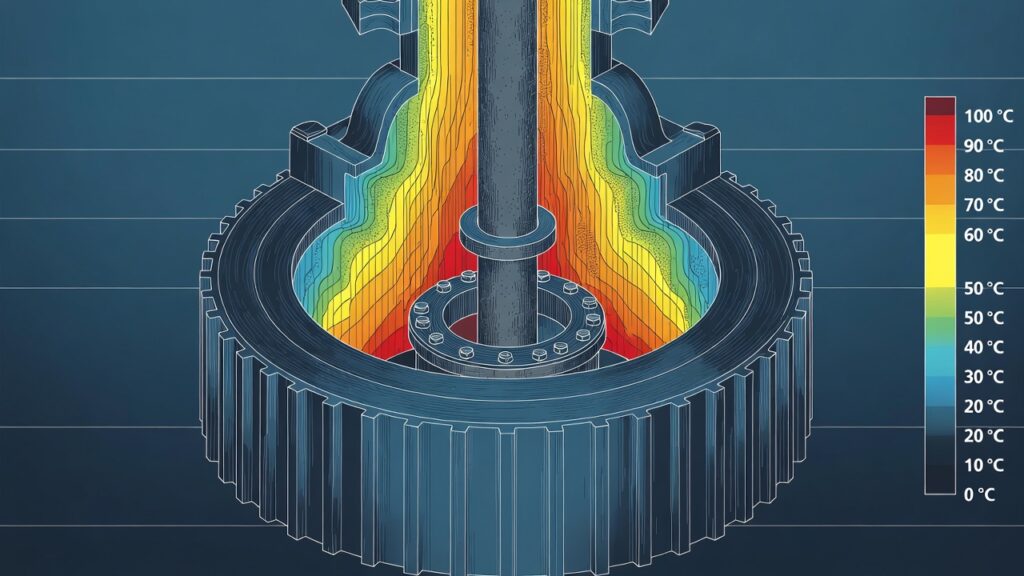
- Figure 1: CFD temperature contour plot on a subsea wellhead cross-section during production (hot internal fluid, cold external seawater gradient).
(Insert image: Color ramp from red (hot) to blue (cold), showing heat transfer paths.) - Figure 2: Velocity streamlines around the wellhead/Christmas tree under ocean current influence.
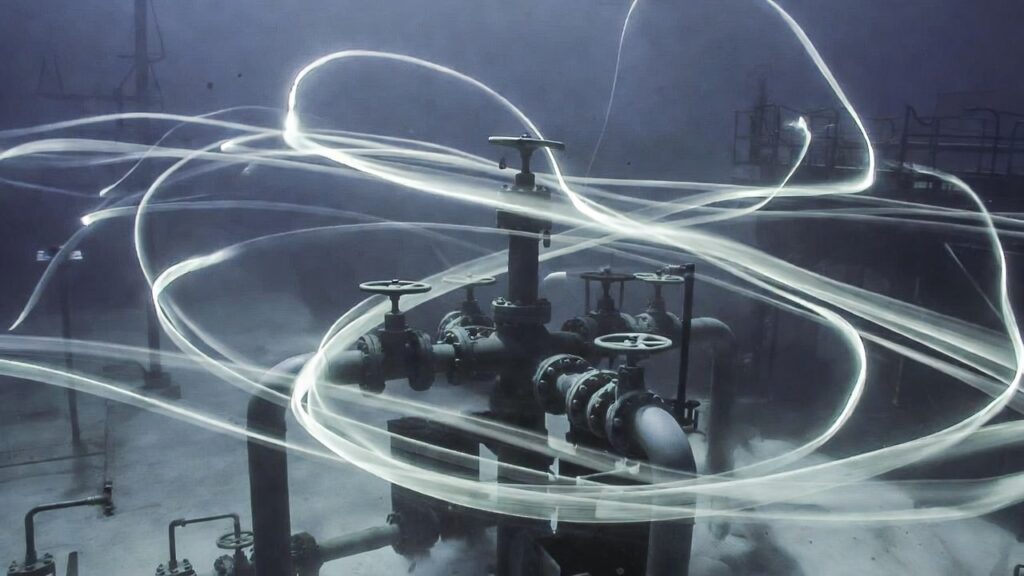
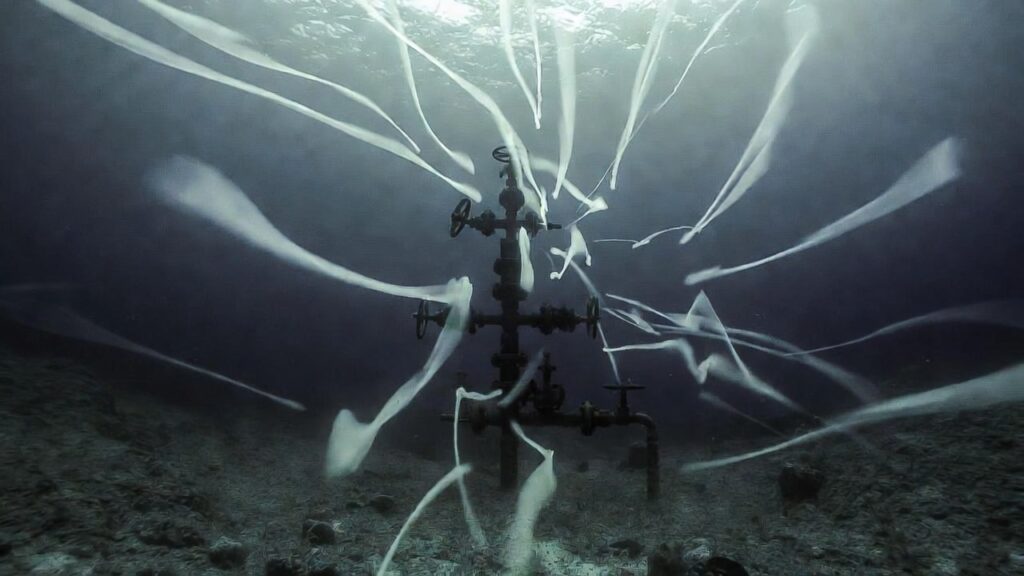
(Insert image: Streamlines colored by speed, demonstrating forced convection zones.) - Figure 3: Coupled result – Thermal stress/expansion deformation in wellhead connector (exaggerated scale).
(Insert image: FEA von Mises stress or displacement plot from CFD temps.) - Figure 4: Annular pressure buildup prediction curve vs. time (CFD vs. analytical).
(Insert chart: Line graph showing higher accuracy of CFD in transient phase.)
Challenges & Limitations
- Computational cost: Full transient multiphysics runs need HPC (days on clusters).
- Fluid properties: Accurate PVT/expansion data essential garbage in, garbage out.
- Validation: Limited public HPHT field data; rely on analogs or JIP results.
The Bottom Line for 2026 HPHT Projects
CFD isn’t just simulation it’s a predictive tool that reduces conservatism in design, optimizes material selection (e.g., higher-yield alloys for expansion), and mitigates risks like APB or seal failure. In deepwater HPHT (e.g., Gulf of Mexico, North Sea, Guyana ultra-deep), integrating CFD early in FEED saves millions in redesigns or interventions.As subsea tiebacks and CCS repurposing grow, expect more hybrid CFD-FEA workflows to become standard. Engineers: Start simple (external convection studies), then scale to full coupled models.
What HPHT wellhead challenges are you facing?
Drop a comment or connect on LinkedIn—let’s discuss real-field applications.
Stay sharp out there, brothers. Subsea integrity starts with understanding the heat.
Oko Immanuel
Subsea Engineering Specialist | Offshore Pipeline Insight.