By Oko Immanuel, M.Eng in Subsea Engineering
Published: February 23, 2026
H2 :HPHT subsea pipelines face extreme conditions high pressure (>10,000 psi), high temperature (>150°C), thermal cycling, sour service, and long tiebacks that accelerate degradation over time. Effective integrity management (IM)ensures these assets remain safe, reliable, and economical throughout their 20–30+ year design life, even as operators push for life extension and energy transition repurposing.In 2026, with rising focus on digitalization, probabilistic risk assessment, and CCUS/hydrogen compatibility, here are the key strategies, tools, and best practices for HPHT pipeline integrity.Major Threats in HPHT Pipelines
- Internal corrosion :Sour gas (H₂S/CO₂) causes pitting, cracking, and wall thinning.
- External corrosion : Cathodic protection failures or coating damage from seabed interaction.
- Fatigue & cracking : Thermal/mechanical cycling at welds, risers, and buckles.
- Buckling & walking :Uncontrolled lateral/axial movement from thermal expansion.
- Transition risks : CO₂ corrosion and hydrogen embrittlement in repurposed lines.
Risk-Based Integrity Management (RBI) Framework
Modern IM follows risk-based inspection (RBI) per DNV-RP-G101 or API 580:
- Identify threats (corrosion, fatigue, buckling).
- Assess probability and consequence (e.g., leak in high-consequence area = high risk).
- Prioritize inspection and mitigation.
- Review periodically (annual or after major events).
2026 trend Probabilistic models (Monte Carlo, Bayesian) now integrate real-time data for dynamic risk
Key Monitoring & Inspection Techniques
- In-Line Inspection (ILI / Smart Pigging)
Magnetic flux leakage (MFL), ultrasonic, or geometry tools detect metal loss, cracks, dents.
For HPHT tethered or bi-directional pigs for unpiggable sections. - External Monitoring
Close-interval potential survey (CIPS), direct current voltage gradient (DCVG), ROV visual inspections, acoustic emission for crack growth. - Non-Intrusive & Digital
Fiber-optic distributed sensing (strain, temperature, corrosion).
Digital twins real-time simulation of HPHT flowlines behavior using sensor data.
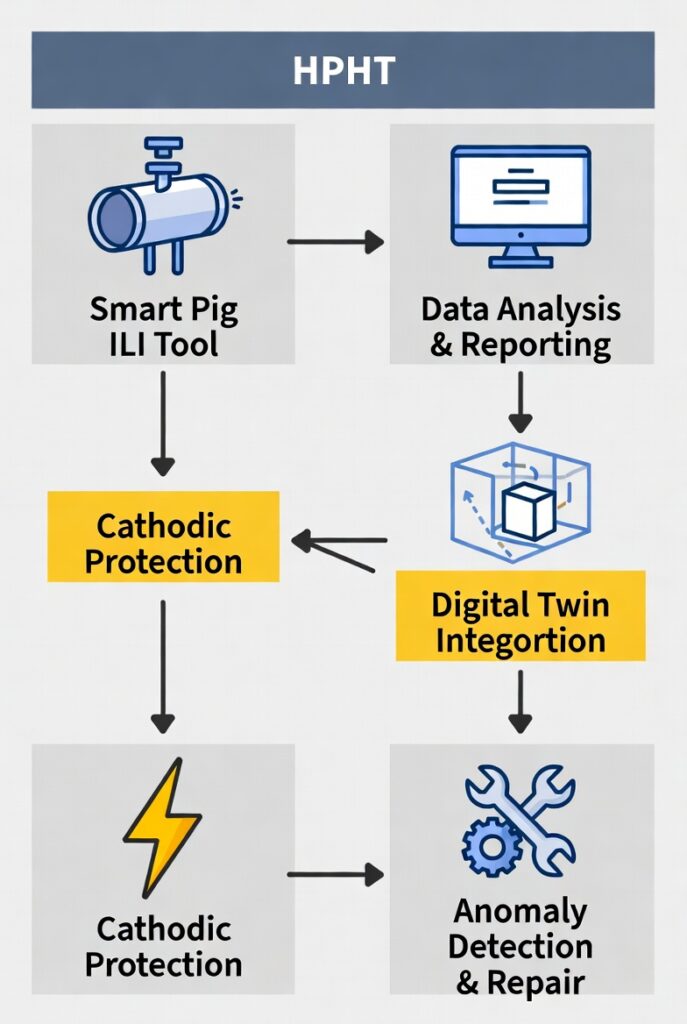
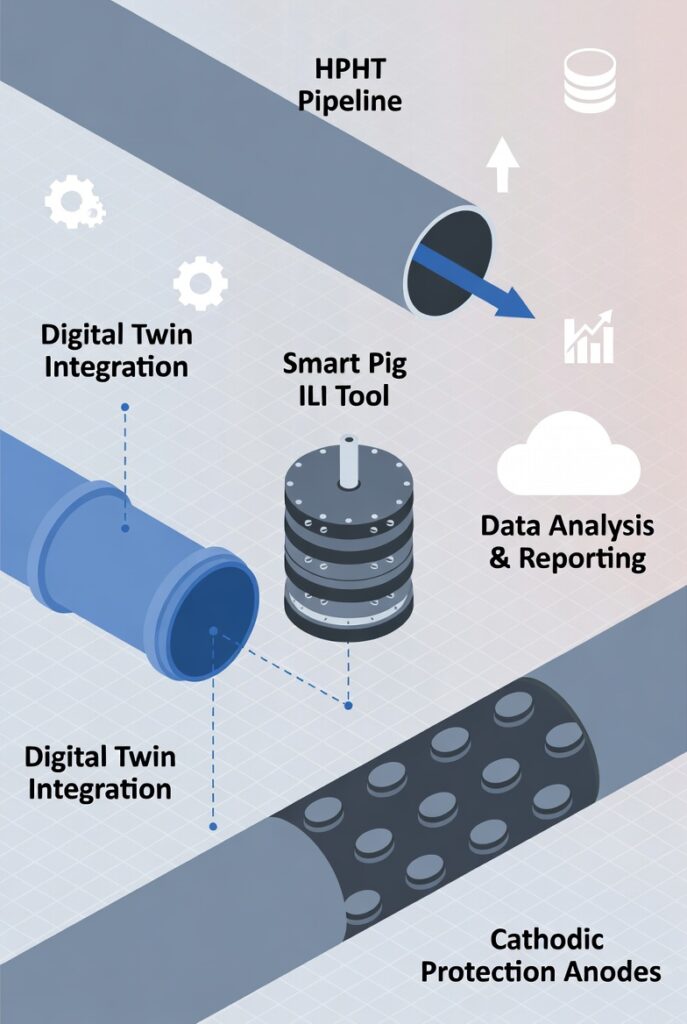
( H2: Diagram of HPHT pipeline integrity management showing smart pig ILI tool, digital twin integration, and cathodic protection anodes.)
Mitigation & Repair Strategies
- Cathodic protection :Sacrificial anodes or impressed current; monitor depletion.
- Chemical inhibition : Continuous dosing for internal corrosion.
- Repairs : Composite wraps, mechanical clamps, or cut-out/replacement for critical defects.
- Life extension : RBI + probabilistic assessment justifies operation beyond original design life.
2026 innovations AI-driven anomaly detection and robotic inspection reduce intervention costs.
Practical 2026 Engineer Tips
- Implement RBI early focus on high-risk segments (welds, buckles, risers).
- Integrate digital twins with fiber-optic sensing for predictive integrity.
- Schedule ILI based on risk scores prioritize HPHT lines with sour service.
- Qualify repairs for hydrogen/CO₂ compatibility if repurposing.
- Track PPIM 2026 and OTC for new tools (e.g., advanced NDE, autonomous crawlers).
Effective HPHT subsea pipeline integrity management in 2026 combines data-driven risk assessment with advanced monitoring to achieve zero incidents and cost-effective life extension. As assets age and transition demands grow, these strategies are essential.
What’s your biggest integrity challenge on HPHT or subsea pipelines right now?
Share in the comments let’s discuss monitoring, pigging, or digital twin applications!
Share for my subsea colleagues. Subscribe for HPHT series updates,
flow assurance tips, and integrity management checklists.