By Oko Immanuel, MSc in Subsea Engineering.
Published: February 25, 2026
A kick in offshore drilling occurs when formation fluids (gas, oil, or water) enter the well bore and the hydrostatic pressure of the drilling mud is no longer sufficient to balance formation pressure. If not detected and controlled quickly, a kick can escalate into a blowout one of the most dangerous and costly events in offshore operations.In deepwater and HPHT wells, kicks are particularly hazardous due to narrow mud windows, rapid gas expansion in the riser, cold seawater cooling, and limited surface volume. Understanding causes, early indicators, types, and response strategies is critical for safe drilling.
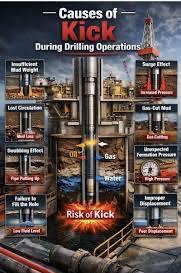
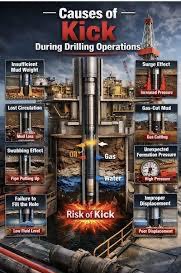
Causes of Kicks During Offshore Drilling
- Insufficient Mud Weight
Static mud weight (MW) or Equivalent Circulating Density (ECD) falls below pore pressure often due to barite sag, temperature effects, or intentional under balance. - Swabbing
Pulling pipe too fast reduces bottom-hole pressure (BHP) common during tripping out. - Lost Circulation
Mud losses into fractures or weak formations drop hydrostatic pressure. - Gas-Cut Mud
Gas from formation reduces mud density. - Improper Hole Cleaning
Cuttings or debris pack-off reduces annular flow area, increasing pressure losses. - Failure to Keep Hole Full
During connections or trips, not filling the hole properly causes pressure drop.
Early Indicators of a Kick (Before It Becomes Critical)
- Gain in Pit Volume :The most reliable early sign: any unexplained increase in mud volume at surface indicates influx (even 5–10 bbl can be serious in narrow-margin wells).
- Flow Rate Increase : Return flow exceeds pump rate.
- Pump Pressure Decrease : If pumps are on, standpipe pressure drops.
- Drilling Break : Sudden increase in ROP (rate of penetration) into high-pressure zone.
- String Weight Change : String becomes light (swabbing) or heavy (packing off).
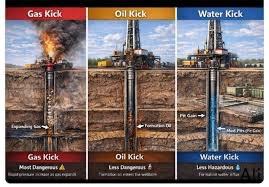
Types of Kicks
- Gas Kick : Most dangerous due to rapid expansion as gas rises up the annulus and riser (gas expands ~1000:1 from bottom to surface).
- Oil Kick : Less dangerous than gas (expansion is limited), but can still cause significant pressure surge.
- Water Kick : Least dangerous (incompressible), but indicates high formation pressure and can cause washouts or losses.
Well Control Response (Offshore Deepwater/HPHT)
- Shut-in immediately : Hard shut-in (close BOP rams) or soft shut-in (use choke first).
- Record Shut-In Drill Pipe Pressure (SIDPP) & Shut-In Casing Pressure (SICP) :Use to calculate kill mud weight.
- Use Driller’s Method or Wait & Weight Method : Circulate kick out while maintaining constant BHP.
- Riser Gas Handling : In deepwater, vent riser gas safely or use subsea choke for gas expansion control.
Practical 2026 Engineer Tips
- Monitor gain in pit volume obsessively even 5 bbl gain can be a kick in narrow-margin HPHT wells.
- Use real-time PWD (Pressure While Drilling) to track ECD and detect kicks early.
- Apply Managed Pressure Drilling (MPD) in narrow windows CBHP mode maintains constant BHP.
- Train crews on kick recognition gain is the first indicator before blowout.
- Use HPHT-style integrity tools (digital twins, fiber-optic sensing) for riser and BOP monitoring.
Kicks are preventable with proper mud weight management, early detection, and trained response but in deepwater HPHT, they remain a high-consequence risk.
What kick indicator has saved you in offshore drilling?
Share in the comments!
Share on LinkedIn for drilling & well control pros.
Subscribe for HPHT series updates, offshore wind insights, and energy transition news.