Oko Immanuel
Petroleum / Subsea Engineer
Founder, Offshore Pipeline Insight
Texas A&M Alumnus.
March 09, 2026
Managed Pressure Drilling (MPD) has become the standard technique for drilling narrow-pressure-window wells in 2026 particularly in high-pressure high-temperature (HPHT), deepwater, and depleted reservoirs. When combined with advanced subsea blowout preventer (BOP) stacks, real-time kick detection, and multiplexed control systems, MPD enables safer, faster, and more precise pressure management.
This technical article details the core MPD components, recent advancements in subsea BOP technology, kick detection methods, subsea BOP control architecture, and engineering considerations for HPHT and deepwater operations in 2026.
1. Core MPD Components in 2026
MPD maintains constant bottomhole pressure (BHP) by dynamically adjusting surface backpressure. The main components include:
- Rotating Control Device (RCD) Dynamic seal on the drill pipe; rated to 5,000–20,000 psi (active or passive). Primary barrier during drilling; allows rotation while containing annulus pressure.
- Automated Choke Manifold Real-time choke valve (electric or hydraulic) adjusts backpressure with ±25–50 psi accuracy. Includes redundant chokes, pressure sensors, and flow meters.
- Coriolis Flow Meters : Measure mass flow rate and density in return line → early kick/loss detection (influx/outflux imbalance <0.5–1 bbl).
- Backpressure Pump / Mud Gas Separator : Provides constant flow for pressure control during connections; separates gas from returns.
- Control System : PLC/SCADA-based with hydraulic model (real-time BHP calculation accounting for temperature, cuttings, compressibility).
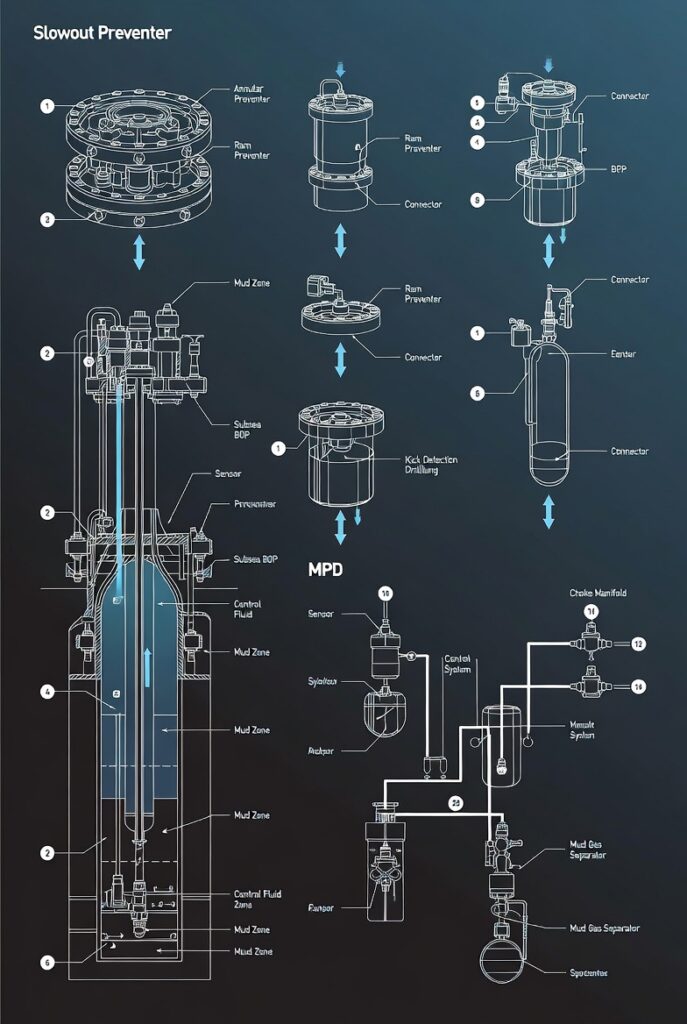
This schematic shows the full MPD system integrated with a subsea BOP stack and choke/kill manifold:
2. Advancements in Subsea BOP Technology (2026)
Subsea BOP stacks for MPD/HPHT wells are now designed for 15,000–20,000 psi service with enhanced reliability features:
- Dual blind/shear rams : Two independent shear rams (one pipe, one blind/shear) for 20,000 psi cut & seal capability on 6-5/8″ S-135 pipe.
- Rapid-response actuators : Electro-hydraulic or acoustic-triggered shear rams with <5-second closure time.
- Acoustic backup : Redundant acoustic control system for loss of hydraulic/umbilical communication.
- ROV intervention : Hot-stab ports and fly-by-wire controls for emergency operation.
- Real-time monitoring : Integrated pressure, temperature, position sensors, and battery-backed electronics for condition-based maintenance.
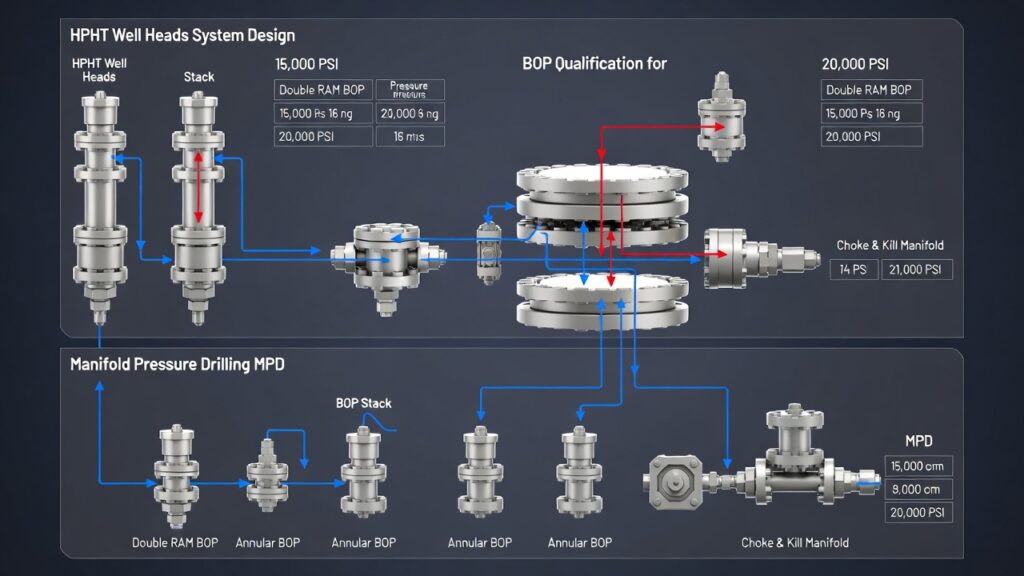
This diagram illustrates a typical 20,000 psi subsea BOP stack with MPD integration (annulars, rams, choke/kill lines, control pods, and acoustic backup):
3. Kick Detection in MPD with Subsea BOPs
Early kick detection is critical in narrow mud windows. MPD enhances traditional methods with:
- Flow-out vs. flow-in comparison : Coriolis meter & paddle flow sensor detect <0.5 bbl influx.
- Pressure signature analysis : Standpipe pressure drop or choke pressure increase indicates influx.
- Acoustic / vibration monitoring : DAS (distributed acoustic sensing) detects gas expansion or fluid movement in the annulus.
- Subsea sensor integration : Annulus pressure/temperature sensors below the BOP transmit real-time data to surface via multiplexed umbilical.
Typical kick indicators:
- Flow-out increase & standpipe pressure drop
- Choke pressure rise to maintain BHP
- Acoustic anomaly & temperature anomaly (DTS)
4. Subsea BOP Control Systems in 2026
Modern subsea BOPs use multiplexed electro-hydraulic control systems:
- Control pods : Dual redundant pods (yellow & blue) on the LMRP (Lower Marine Riser Package).
- Multiplexed umbilical : Single electrical/hydraulic line carries signals for all functions (open/close rams, annulars, connectors).
- Acoustic backup : Independent acoustic modem for emergency shear/close if umbilical is severed.
- ROV hot-stabs : Manual override ports for critical functions.
- Real-time diagnostics : Pod health monitoring (battery voltage, solenoid status, hydraulic pressure) transmitted to surface.
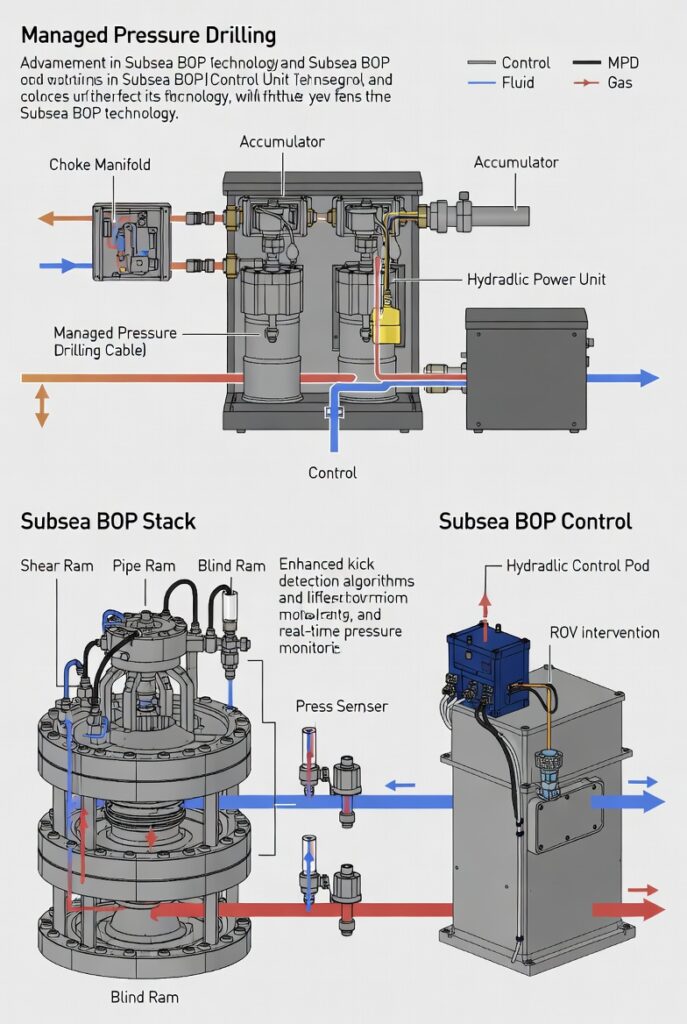
This schematic shows the subsea BOP control architecture (multiplexed pods, umbilical, acoustic backup, ROV intervention)
Closing Thoughts
In 2026, MPD combined with 20,000 psi-rated subsea BOPs represents the state-of-the-art for HPHT and narrow-margin drilling. Early kick detection via Coriolis, pressure signatures, and fiber-optic sensing, paired with redundant electro-hydraulic/acoustic control systems, dramatically improves safety and efficiency.
The engineering focus is on system integration, real-time data fusion, and condition-based maintenance skills directly transferable to subsea pipeline integrity monitoring.
What MPD or subsea BOP challenges are you facing in 2026?
Share in the comments let’s discuss real-world solutions!
Oko Immanuel
Petroleum / Subsea Engineer
Founder, Offshore Pipeline Insight
Texas A&M Alumnus.
March 09, 2026