By Oko Immanuel, M.Eng – Founder, Offshore Pipeline Insight
March 20, 2026
In 2026, natural gas has firmly re-established itself as the transitional fuel of choice. After a volatile few years marked by price spikes, supply disruptions, and decarbonization debates, the industry has entered a phase of structural growth driven by rising Asian demand, European industrial recovery, and the need for reliable, lower-carbon dispatchable energy.
Significant new LNG export capacity is coming online, led by the U.S. Gulf Coast and Qatar, positioning natural gas as the bridge between coal/oil and full renewables. This expansion is reshaping global energy flows, offshore infrastructure, and subsea pipeline networks.
1. Why Natural Gas is Back in Structural Growth ModeSeveral converging factors have restored confidence in natural gas as a long-term fuel:
- Asian demand surge : China, India, Japan, and Southeast Asia are seeing strong industrial and power-sector growth. Natural gas is displacing coal in many markets due to lower emissions and better air quality.
- European industrial recovery : Post-energy-crisis rebuilding requires reliable, affordable power. Gas-fired plants provide flexibility to balance intermittent renewables.
- Lower-carbon credentials : When paired with methane abatement and CCS, natural gas offers a credible bridge fuel with 50–60% lower CO₂ intensity than coal.
- Energy security : Diversified LNG supply chains reduce reliance on single pipeline routes (e.g., Russian gas via Nord Stream).
Analysts (IEA, Wood Mackenzie, Rystad) now forecast global LNG demand growing 4–6% annually through 2030, with natural gas maintaining its role as a transitional fuel well into the 2040s.
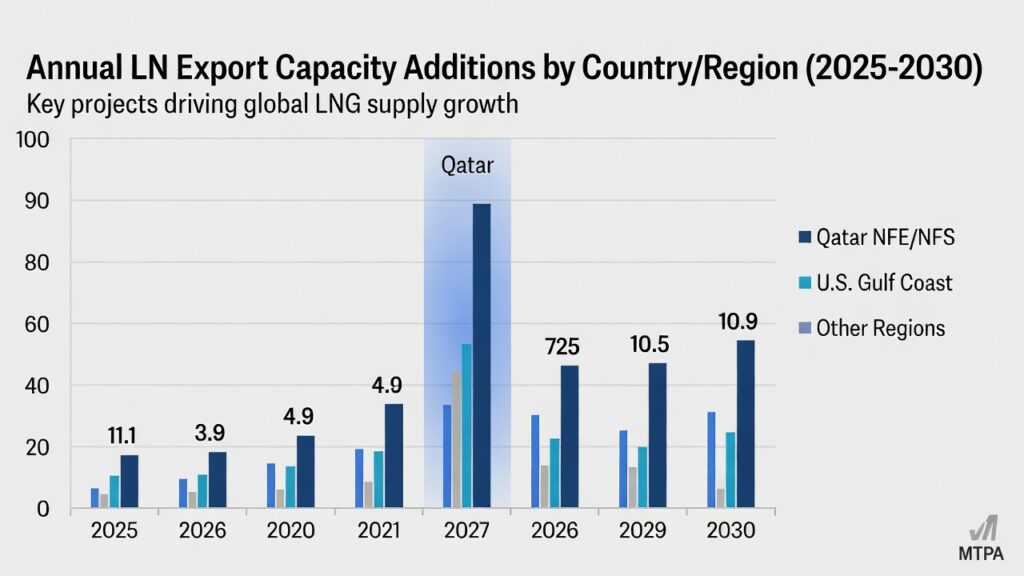
2. Major LNG Export Capacity Coming OnlineThe 2025–2027 window is one of the largest waves of new LNG capacity in history.
- Qatar North Field Expansion (NFE + NFS)
- NFE: 32–33 MTPA added (first trains 2026).
- NFS: Additional 16 MTPA (2027–2028).
- Total: Qatar moves from 77 MTPA to ~142 MTPA by 2030.
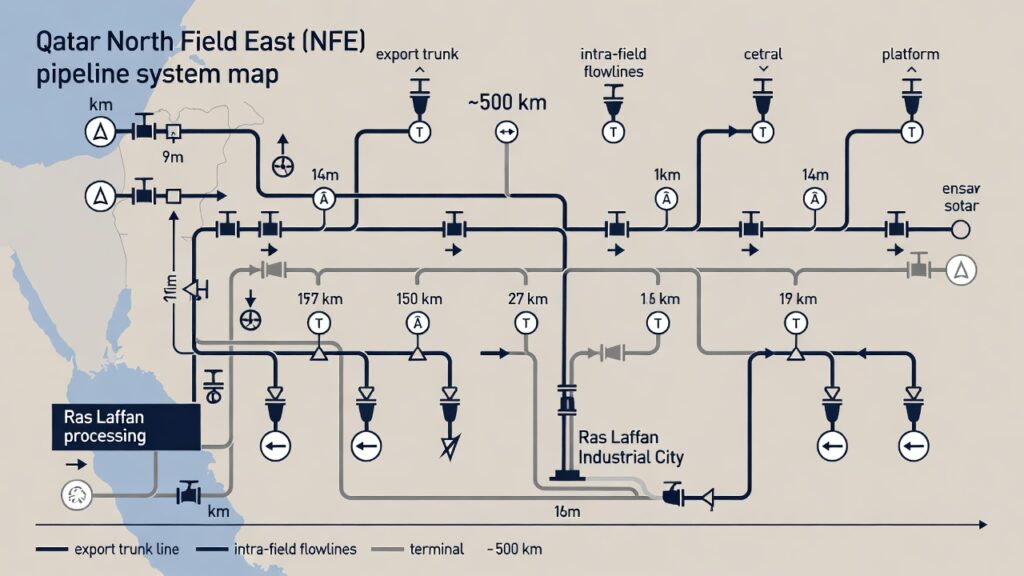
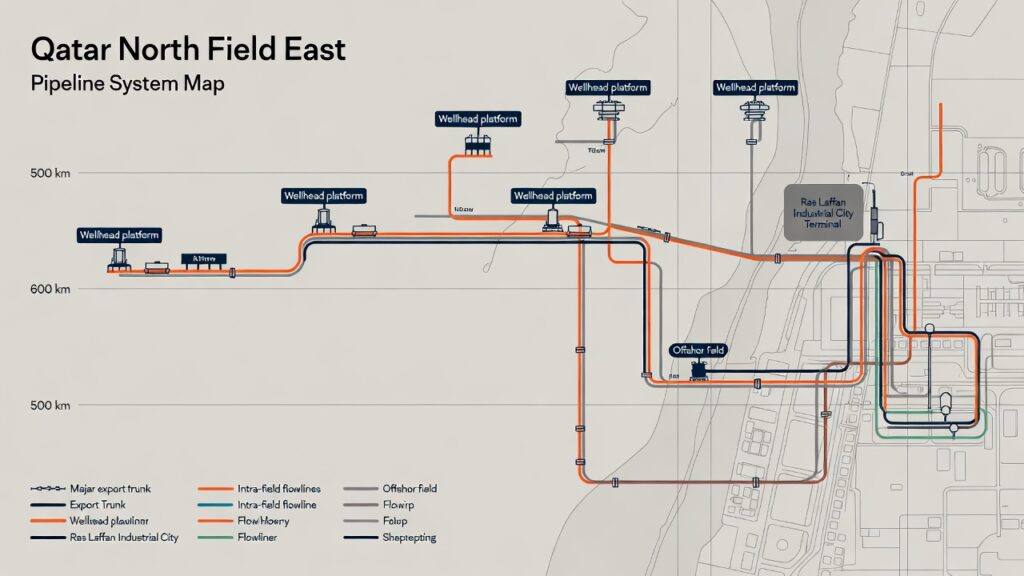
- Offshore: ~500 km of new subsea pipelines feeding Ras Laffan.
- U.S. Gulf Coast
- Golden Pass LNG (18 MTPA, 2026–2027).
- Plaquemines LNG (Phase 1: 13 MTPA, 2026).
- Corpus Christi Stage 3 (10 MTPA, 2026).
- Other projects (Rio Grande, Port Arthur, etc.) add further capacity.
- U.S. becomes the world’s largest LNG exporter by 2027–2028.
- Other contributors
- Australia (minor expansions).
- Mozambique (Area 1 & 4 projects restarting).
- Canada (LNG Canada Phase 1, 2028).
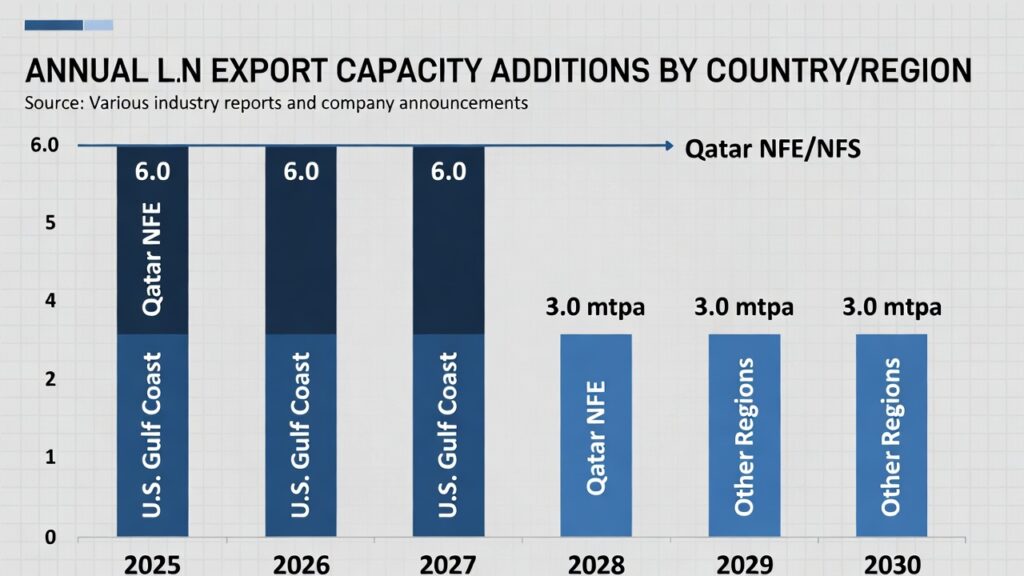
Figure 1: Global LNG Export Capacity Additions (2025–2030)
(image: Bar chart showing annual capacity additions by country/region: Qatar NFE/NFS, U.S. Gulf Coast projects, others. Highlight 2026–2027 as the peak wave.)
3. Offshore & Subsea Infrastructure Impact.
This expansion is driving massive offshore activity:
- Pipeline networks : Qatar’s NFE requires ~500 km of new trunk and intra-field lines. U.S. Gulf Coast projects tie into existing export pipelines and offshore gathering systems.
- Subsea systems : HPHT-rated trees, manifolds, and flowlines for high-pressure gas wells. Subsea boosting and compression for long-distance tiebacks.
- Floating LNG (FLNG) : Emerging in smaller fields (e.g., Mozambique, Argentina), requiring dynamic risers and mooring systems.
- Export terminals : New onshore/offshore LNG plants demand subsea intake/outfall lines and cooling water systems.
Figure 2: Qatar North Field East Pipeline Network
( image: Map/schematic of the ~500 km NFE pipeline system showing export trunk lines, intra-field flowlines, wellhead platforms, and Ras Laffan terminal.)
4. Strategic Implications for 2026
- Energy security : Diversified LNG supply reduces geopolitical risk (no single supplier dominance).
- Transition role : Gas enables renewable integration (fast-ramping power) and CCS-ready infrastructure.
- Offshore investment : High-margin HPHT gas projects fund the transition while meeting demand.
- Subsea opportunity : New pipelines, subsea compression, and integrity monitoring create demand for advanced tech.
The Bottom Line
Natural gas has returned to structural growth as the bridge fuel. Qatar and the U.S. Gulf Coast are leading the charge with massive export capacity additions in 2026–2027, supported by expanded offshore pipeline and subsea infrastructure.Engineers and energy professionals:
How is this LNG wave affecting your region more pipeline work, subsea electrification, or CCS tie-ins?
Share your insights in the comments or on LinkedIn.
Stay sharp out there, brothers. Gas is back — and it’s powering the transition.
Oko Immanuel
Subsea Engineering Specialist | Offshore Pipeline Insight