Oko Immanuel
Petroleum / Subsea Engineer
Founder, Offshore Pipeline Insight
Texas A&M Alumnus.
March 07, 2026
The offshore pipeline market continues its steady upward trajectory in 2026, driven by sustained demand for oil and gas transport infrastructure, deepwater and ultra-deepwater exploration, and the need for reliable export and tieback systems. Recent forecasts show the global market valued at approximately $16.98 billion in 2026, growing from $16.19 billion in 2025 at a CAGR of around 4.8–5.8% toward $21.27 billion by 2030 (The Business Research Company data). Other projections range from $16.37 billion in 2025 to $28.14 billion by 2035 at 5.57% CAGR (Consegic Business Intelligence), reflecting robust long-term expansion.
This update explores the primary growth drivers, emerging deepwater trends, and notable Subsea7 contract wins that underscore the sector’s dynamism in 2026.
Key Growth Drivers in 2026
Several factors are fueling offshore pipeline demand:
- Rising energy demand and offshore E&P: Continued global need for crude oil, natural gas, and LNG feedgas drives investments in subsea fields and export infrastructure. Deepwater and ultra-deepwater reserves in mature basins (Gulf of Mexico, Brazil) and emerging frontiers (Namibia, Guyana) require extensive pipeline networks.
- Technological advancements: Improvements in pipeline materials (corrosion-resistant alloys, HPHT-rated), installation techniques (S-lay, J-lay, reel-lay), and monitoring (fiber-optic sensing, digital twins) enhance safety, efficiency, and project economics.
- Gas-focused expansions: Surge in LNG projects (e.g., Qatar North Field, US Gulf exports) boosts demand for large-diameter gas lines (>24 inches) and gathering/export systems.
- Energy transition synergies: Repurposing for CO₂/H₂ transport and hybrid developments add new revenue streams.
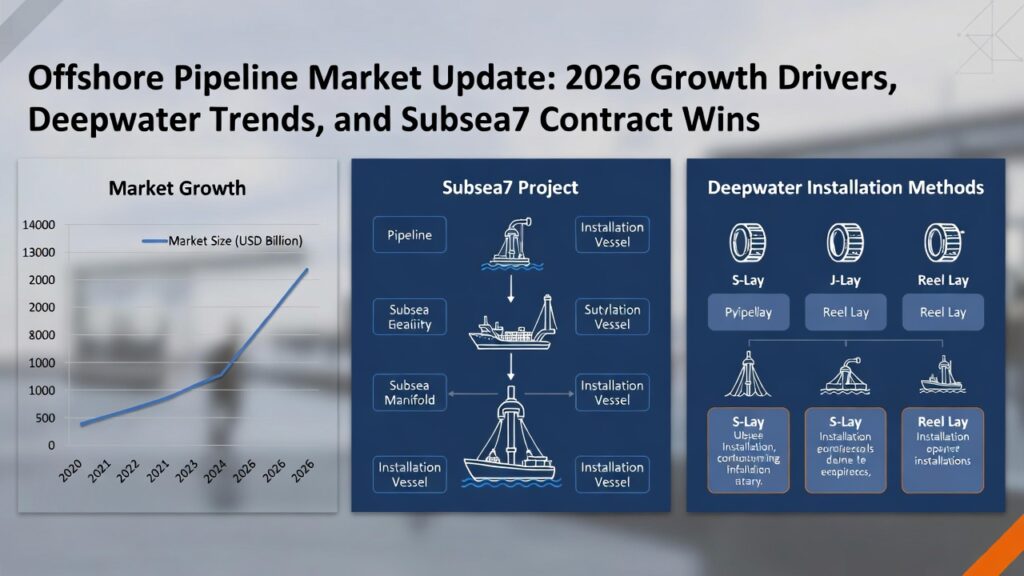
This line chart illustrates projected offshore pipeline market growth from 2020–2026 and beyond (based on aggregated forecasts):
Deepwater Trends in 2026
Deepwater (>1,000 m) and ultra-deepwater (>1,500–3,000 m) projects dominate new pipeline activity, with trends including:
- Tieback dominance: Operators favor subsea tiebacks to existing facilities over standalone platforms, reducing CAPEX by 30–50%. Examples: Shell Kaikias Waterflood, LLOG Buckskin South Expansion.
- Installation methods evolution: Reel-lay gains traction for rigid flowlines in deepwater (faster, fewer welds); J-lay for high-tension risers; S-lay remains standard for shallower segments.
- Integrity & monitoring focus: HPHT conditions demand advanced materials and real-time sensing to manage fatigue, corrosion, and thermal buckling.
- Regional hotspots: Gulf of Mexico (deepwater tiebacks), Brazil pre-salt, West Africa, and emerging plays (Namibia Venus).
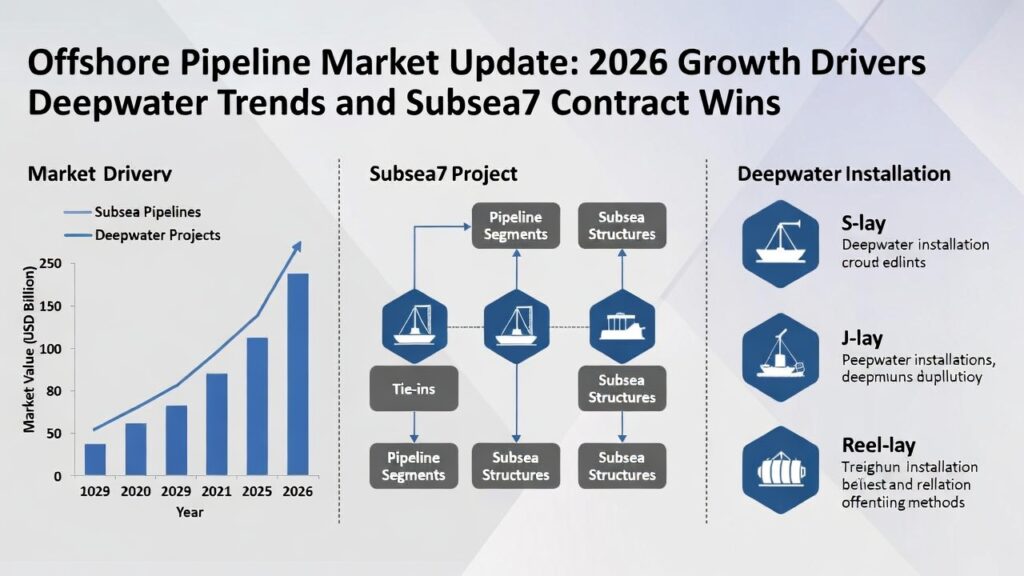
This diagram compares key deepwater installation methods (S-lay, J-lay, reel-lay) with their typical water depth ranges and applications:
Subsea7 Contract Wins in 2026
Subsea7 continues to secure major awards, reinforcing its leadership in deepwater pipeline EPCI:
- Kaikias Waterflood (US Gulf, Shell, Jan 2026): Sizeable contract for subsea umbilical, riser, and rigid flowline installation in up to 1,650 m water depth; offshore ops 2027.
- Sakarya/Goktepe extension (Black Sea, Türkiye, Mar 2026): Large variation order for 20 km flexibles, 120 km umbilicals, rigid riser in 2,200 m; ops 2027–2028.
- Eastern Mediterranean (Chevron, Feb 2026): Substantial contract for 17 km subsea flowlines and umbilicals; ops Q1 2028.
- Buckskin South Expansion (US Gulf, LLOG, Dec 2025–2026 carryover): Sizeable umbilical and rigid flowline in 2,100 m; ops 2026–2027.
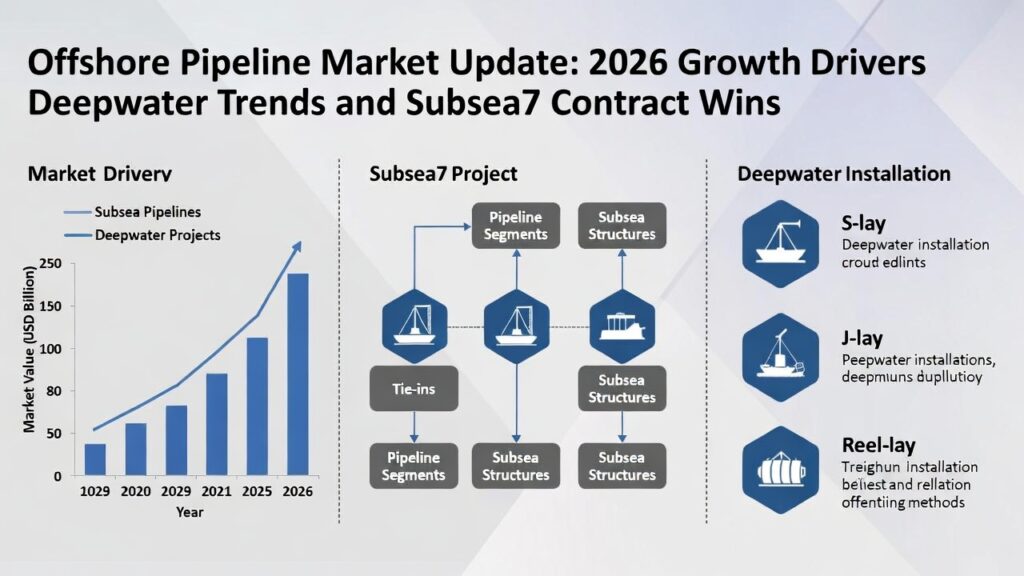
This schematic shows a typical Subsea7 deepwater project scope (pipeline segments, subsea structures, installation vessels, tie-ins):
Closing Thoughts
The offshore pipeline market in 2026 is robust, propelled by energy demand, deepwater tiebacks, and installation innovation. Subsea7’s contract wins highlight the sector’s strength in complex EPCI, while integrity remains key for long-term success.For pipeline/subsea engineers, 2026 offers opportunities in deepwater tech and transition projects.
What market drivers or contracts are you watching?
Share in the comments!
Oko Immanuel
Petroleum / Subsea Engineer
Founder, Offshore Pipeline Insight
Texas A&M Alumnus.
March 07, 2026
Author’s Contact : oko@offshorepipelineinsight.com