Oko Immanuel
Petroleum / Subsea Engineer
Founder, Offshore Pipeline Insight
Texas A&M Alumnus.
March 09, 2026
In 2026, onshore shale plays (Permian, Eagle Ford, Bakken, Haynesville, SCOOP/STACK) continue to drive the majority of U.S. oil and gas production. While drilling and completion receive most attention, the gathering pipeline network the low-pressure flow lines and tie-ins that connect multi-well pads to central batteries, separators, or trunk lines is frequently the weakest link in the production chain. Flow line corrosion, third-party damage, erosion, and tie-in leaks cause significant non-productive time (NPT), environmental incidents, and regulatory fines.
This technical article examines the main integrity threats to onshore gathering systems in shale operations, common failure modes, and practical mitigation strategies used in 2026.
1. Typical Onshore Gathering Pipeline Configuration
A standard Permian-style multi-well pad in 2026 features:
- 8–24 horizontal wells drilled from a single pad.
- Individual wellhead flowlines (2–4 inch diameter, 1,000–3,000 psi MAWP) connect each well to a central manifold or separator battery.
- Larger gathering lines (6–12 inch) transport multiphase production (oil, gas, produced water) to a central facility, compressor station, or sales pipeline.
- Tie-ins include welded or mechanical couplings, flanges, valves, pig launchers/receivers, and chemical injection points.
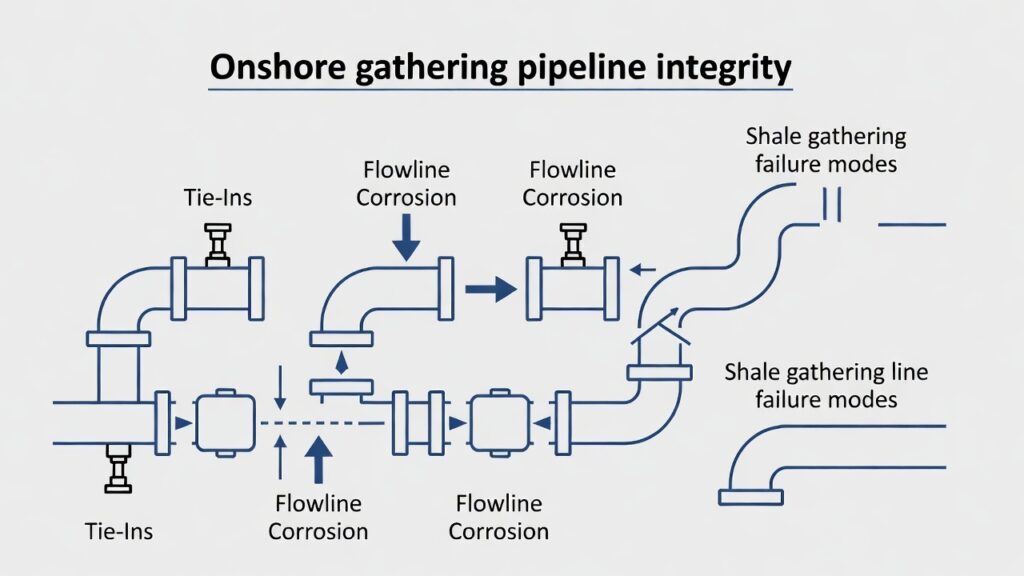
This schematic illustrates a typical land rig pad to gathering line configuration (multi-well pad → manifold → gathering flow line → central facility)
2. Primary Integrity Threats & Failure Modes
Shale gathering lines face a unique combination of corrosive fluids, high sand production, third-party activity, and operational cycling.
Top failure modes in 2026:
- Internal corrosion : Produced water with high chlorides, CO₂, H₂S, and bacteria (MIC) causes pitting and general wall loss. Wet gas lines see the highest rates.
- Erosion : High-velocity sand/proppant during initial flowback erodes elbows, tees, and valves.
- External corrosion : Soil corrosivity, coating disbondment, inadequate cathodic protection, or AC interference from nearby power lines.
- Third-party damage : Construction, farming, vehicles, or excavation hits (most common cause of leaks in populated shale areas).
- Tie-in failures : Weld defects, gasket leaks, flange misalignment, or mechanical coupling pull-out under thermal expansion/contraction.
- Fatigue cracking : Cyclic pressure from intermittent well production, plunger lift, or compressor cycling.
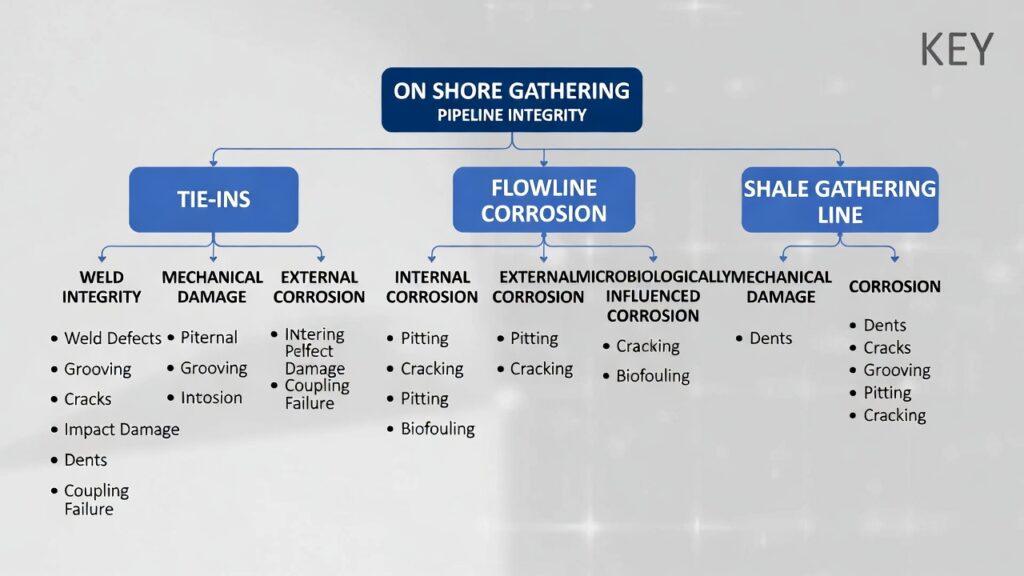
This heat map illustrates relative risk levels (probability by consequence) for onshore shale gathering line failure modes in 2026:
3. In-Line Inspection (ILI) Tool Comparison for Gathering Lines.
Gathering lines (typically 2–12 inch) are often unpiggable or difficult to inspect due to tight bends, diameter changes, and high sand content. Operators use a mix of ILI tools:
| ILI Tool Type | Diameter Range | Primary Detection | Strengths in Shale Gathering Lines | Limitations |
|---|---|---|---|---|
| Magnetic Flux Leakage (MFL) | 4–12 inch | Metal loss (pitting, corrosion) | High-resolution internal/external corrosion mapping | Poor for axial cracks; sensitive to debris |
| Ultrasonic (UT) | 4–12 inch | Wall thickness, cracks | Accurate for pitting and small defects | Requires clean pipe; slower run speed |
| Caliper (Geometry) | 4–12 inch | Dents, ovality, buckles | Essential for third-party damage and deformation | No corrosion info; must combine with MFL/UT |
| EMAT | 6–12 inch | Crack detection (no couplant) | Good for axial cracking in high-cycle lines | Higher cost; emerging in onshore use |
| Acoustic Resonance | 4–12 inch | Wall loss + cracks | Non-contact; works in multiphase flow | Limited resolution; newer technology |
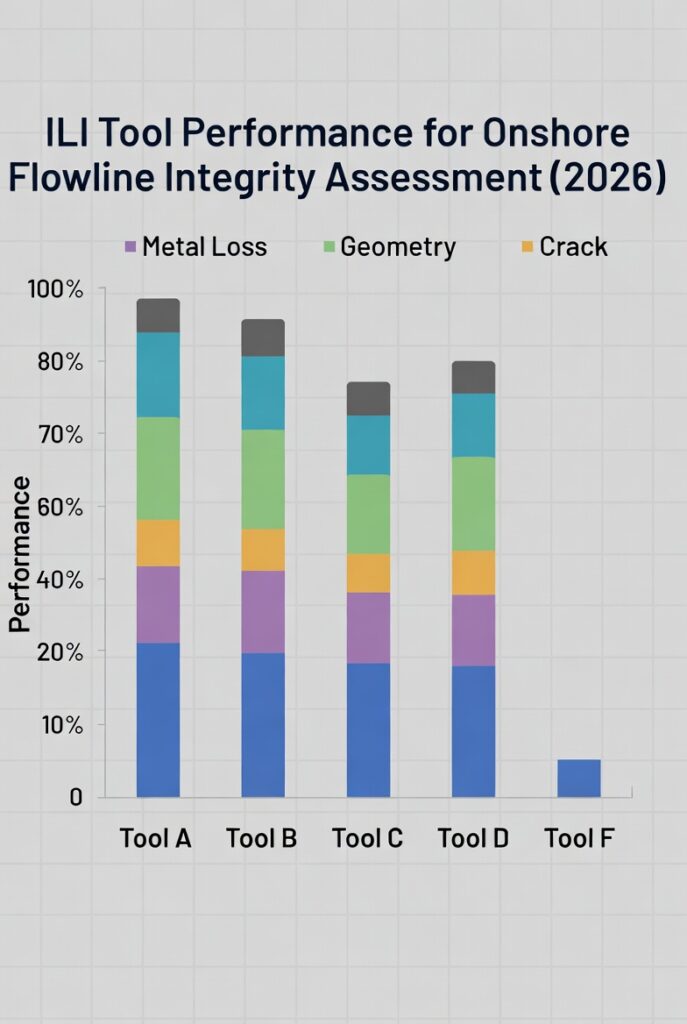
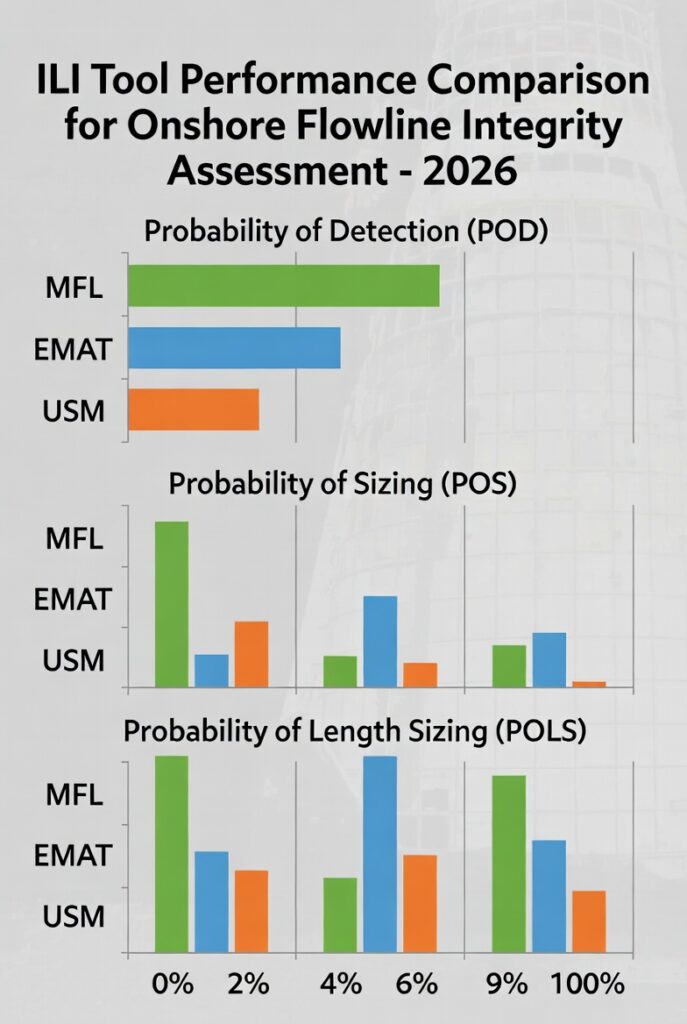
This chart compares ILI tool performance for onshore flowline integrity assessment in 2026.
4. Mitigation Strategies in 2026Operators are deploying layered defenses:
- Design : Corrosion allowance (0.125–0.250 inch), internal FBE/liquid epoxy coatings, CRA (corrosion-resistant alloy) in high-CO₂/H₂S areas, expansion loops for thermal growth.
- Chemical inhibition : Continuous corrosion inhibitor injection + scale inhibitors; biocide programs for MIC control.
- Cathodic protection : Impressed current or sacrificial anodes; regular surveys to detect shorts/shielding.
- Pigging : Routine cleaning pigs (foam, brush) + smart pigs (MFL/caliper combo) for baseline and periodic assessment.
- Monitoring : Fiber-optic DAS/DTS on critical lines for leak detection and third-party interference alerts; SCADA pressure/flow trending.
- Third-party protection : Bury deeper, marker tape/balls, line patrols, One-Call compliance.
Closing Thoughts
Onshore gathering pipelines in shale plays are high-risk assets short life expectancy, corrosive fluids, sand erosion, and frequent third-party exposure make integrity management a daily priority. The good news in 2026 is that proven tools (ILI, chemical inhibition, fiber monitoring) and design upgrades are dramatically reducing failure rates in Tier 1 acreage.
For pipeline and subsea engineers, onshore shale gathering systems are an excellent proving ground for technologies that later scale to offshore tiebacks and export lines.
What gathering line integrity issues are you seeing in your basin?
Share in the comments let’s exchange practical solutions!
Oko Immanuel
Petroleum / Subsea Engineer
Founder, Offshore Pipeline Insight
Texas A&M Alumnus.
March 09, 2026