Oko Immanuel
Petroleum / Subsea Engineer
Founder, Offshore Pipeline Insight
Texas A&M
March 07, 2026
While offshore and onshore drilling environments differ dramatically in water depth, wave loading, logistics, and regulatory scrutiny, many of the most critical integrity challenges particularly drill pipe fatigue and blowout preventer (BOP) reliability share remarkably similar root causes and failure mechanisms.
In 2026, with land rig utilization rebounding selectively in Tier 1 shale acreage and deepwater tiebacks continuing to dominate offshore activity, understanding these shared lessons is essential for engineers working across both domains.
This technical blog compares onshore (primarily horizontal shale wells) and offshore (deep/ultra-deepwater) drilling integrity risks, focusing on drill pipe fatigue and BOP reliability, and highlights transferable mitigation strategies being deployed in 2026.
Drill Pipe Fatigue: High-Cycle Loading in Horizontal & Deepwater WellsOnshore (Shale Plays)
- Primary loading mode: High-frequency bending/torsion cycles during long horizontal sections (10,000–15,000+ ft laterals) and aggressive sliding/rotating transitions.
- Critical locations: Tool joints (upset areas), hardbanding interfaces, and pipe body near connections.
- Failure mechanism: Fatigue crack initiation at stress concentrations → propagation under cyclic loading → washout or twist-off.
- 2026 trends: Longer laterals + higher dog-leg severity (DLS) in infill drilling increase fatigue risk; real-time torque/drag monitoring is now standard in Permian/Delaware.
Offshore (Deepwater)
- Primary loading mode: Axial tension from riser weight, bending from vessel motion (heave/pitch/roll), and torsional cycling during drilling.
- Critical locations: Upper drill pipe near surface, bottom-hole assembly (BHA), and riser connections.
- Failure mechanism: Combined axial + bending fatigue; cracks often initiate at slip marks or corrosion pits.
- 2026 trends: HPHT wells (e.g., Gulf of Mexico) see increased thermal fatigue; dynamic riser analysis and real-time fatigue tracking are mandatory.
Shared Lessons & Transferable Practices
- Fatigue life prediction using S-N curves and Miner’s rule applies equally.
- Inspection intervals (EMI, UT, MPI) and hardbanding renewal are critical on both.
- Real-time monitoring (torque/drag, standpipe pressure, vibration) reduces failure probability.
- Digital twins for fatigue modeling are being adopted onshore (shale pads) after proving value offshore.
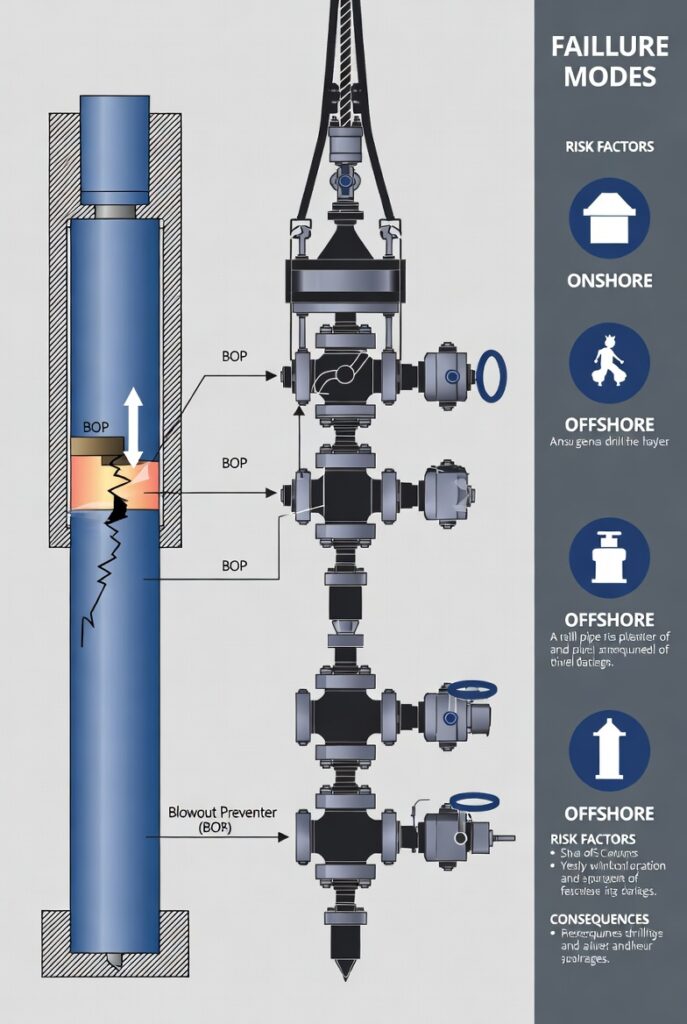
This diagram illustrates typical fatigue crack initiation and propagation in drill pipe (tool joint upset area, hardbanding interface, and pipe body)
Blowout Preventer (BOP) Reliability: Annular & Ram IntegrityOnshore
- Configuration: Surface BOP stacks (usually 4–5 rams + annular) for high-pressure fracking and well control.
- Common failure modes: Ram packer wear from frequent pressure testing, annular element extrusion, hydraulic control line leaks.
- 2026 trends: Increased use of shear rams for plug-and-abandon operations; real-time pressure/temperature monitoring on control pods.
Offshore (Subsea BOPs)
- Configuration: Subsea stacks (5–6 rams + dual annulars) in 5,000–12,000 ft water depth; multiplexed electro-hydraulic controls.
- Common failure modes: Connector gasket leaks, shuttle valve failures, acoustic pod communication loss, ram packer extrusion under high-pressure testing.
- 2026 trends: Increased focus on rapid-response shear rams (blind/shear) and acoustic backup systems post-Macondo lessons.
Shared Lessons & Transferable Practices
- Pressure testing protocols (API RP 53/API 16A) are nearly identical.
- Seal/elastomer degradation from temperature, pressure, and fluid exposure is a common root cause.
- Redundancy (dual PODs onshore/offshore) and regular function testing reduce risk.
- Digital logging of BOP test data + AI anomaly detection is emerging onshore after offshore adoption.
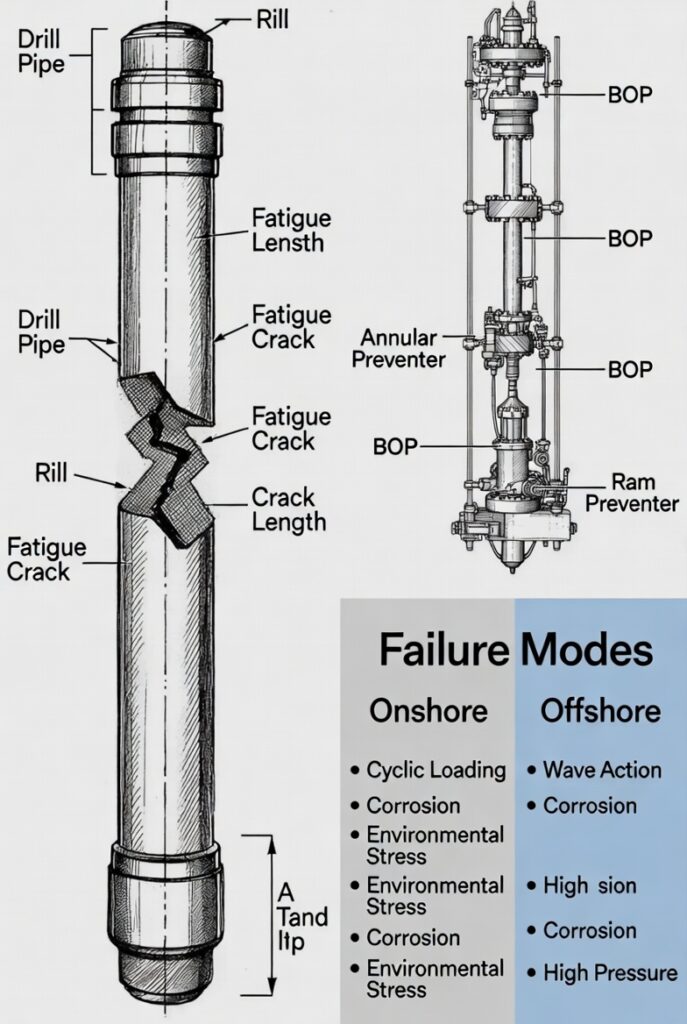
This BOP stack schematic shows a typical subsea configuration (left) versus onshore surface stack (right), with key failure-prone components highlighted:Side-by-Side Failure Modes ComparisonThis infographic compares the most frequent onshore and offshore drilling integrity failure modes related to drill pipe and BOP systems:
Key Takeaways for 2026
- Shared root causes : Cyclic loading, material fatigue, seal degradation, and human factors drive most failures in both environments.
- Transferable tools : Real-time monitoring, digital twins, AI anomaly detection, and rigorous inspection programs developed offshore are now migrating onshore (and vice versa).
- 2026 focus : Shale operators adopting offshore-grade fatigue modeling; deepwater projects emphasizing BOP reliability after recent high-profile incidents.
Whether you’re drilling horizontal shale wells or deepwater exploration, the integrity principles are universal: predict, monitor, mitigate.
What onshore or offshore integrity challenges are you facing in 2026?
Drop a comment let’s discuss practical solutions!
Oko Immanuel
Petroleum / Subsea Engineer
Founder, Offshore Pipeline Insight
Texas A&M Alumus
March 07, 2026