Oko Immanuel
Petroleum / Subsea Engineer
Founder, Offshore Pipeline Insight
Texas A&M
March 07, 2026
As the energy transition accelerates in 2026, repurposing existing offshore pipelines originally designed for oil and natural gas is emerging as a cost-effective strategy to transport low-carbon energy carriers like hydrogen (H₂) and carbon dioxide (CO₂). With thousands of kilometers of aging infrastructure approaching end-of-life in regions like the North Sea, Gulf of Mexico, and Dutch Continental Shelf, repurposing can extend asset life, reduce decommissioning costs, and accelerate CCS (carbon capture and storage) and hydrogen networks.
This technical blog examines the feasibility, key challenges (including hydrogen embrittlement and CO₂ corrosion), and real-world 2026 case studies driving this trend.
Feasibility: Why Repurposing Makes Sense Repurposing leverages billions in sunk capital new dedicated H₂ or CO₂ pipelines can cost 2–10× more than adapting existing ones. Key enablers include:
- Existing infrastructure Platforms, export pipelines, and subsea tie-backs already in place.
- Technical maturity Oil/gas pipeline materials (API 5L X52–X70 grades) can often be re-qualified with modifications.
- Economic advantages Reduced CAPEX (1–10% of new build), faster deployment, and alignment with net-zero policies (e.g., EU funding, US 45Q credits).
- Regional potential North Sea and Gulf of Mexico offer dense networks; studies show 23–42 GW electrolysis capacity on repurposed platforms (Dutch Continental Shelf example).
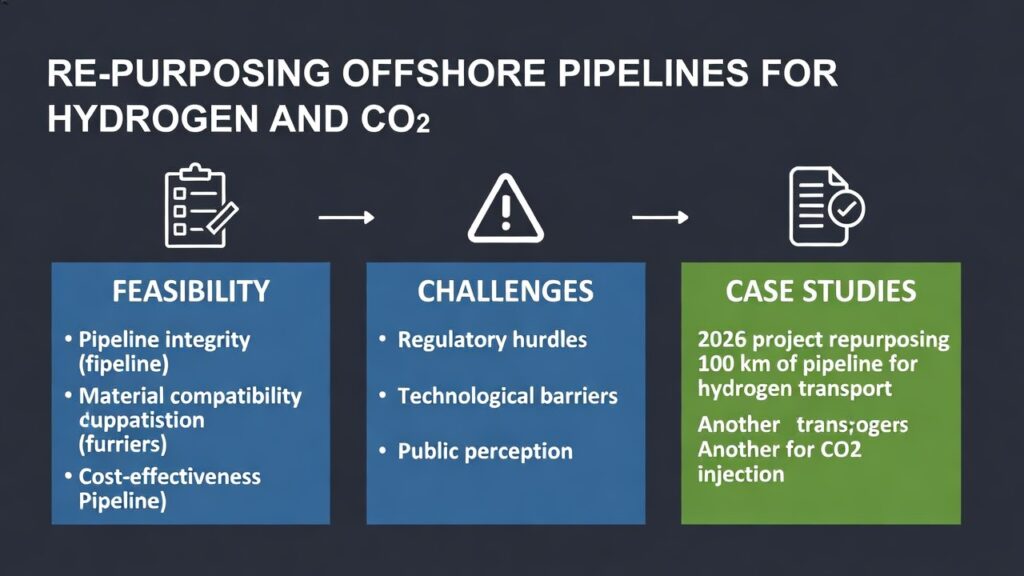
This infographic summarizes the repurposing pathway, feasibility factors, challenges, and emerging case studies:
A high-level diagram illustrating the repurposing process from natural gas to H₂/CO₂ service, highlighting material upgrades, pressure management, and integrity monitoring:
Key Challenges
Repurposing is not plug-and-play new fluids introduce risks absent in hydrocarbon service.
For Hydrogen (H₂)
- Hydrogen embrittlement H₂ diffuses into steel, reducing ductility, fracture toughness, and accelerating fatigue crack growth (especially in high-strength grades X70+ and under cyclic pressure).
- Leakage risk H₂’s small molecule size increases permeation through seals/gaskets and potential escape from welds/joints.
- Pressure derating Many studies recommend reducing operating pressure (50–80 bar) to mitigate embrittlement; line pack capacity drops significantly.
- Variable flow Renewable-linked production causes pressure cycling, worsening fatigue.
- Mitigation Lower-strength steels (X52 and below), inhibitors, internal coatings, enhanced inspection (AUV/ROV), and case-by-case fitness-for-service assessments.
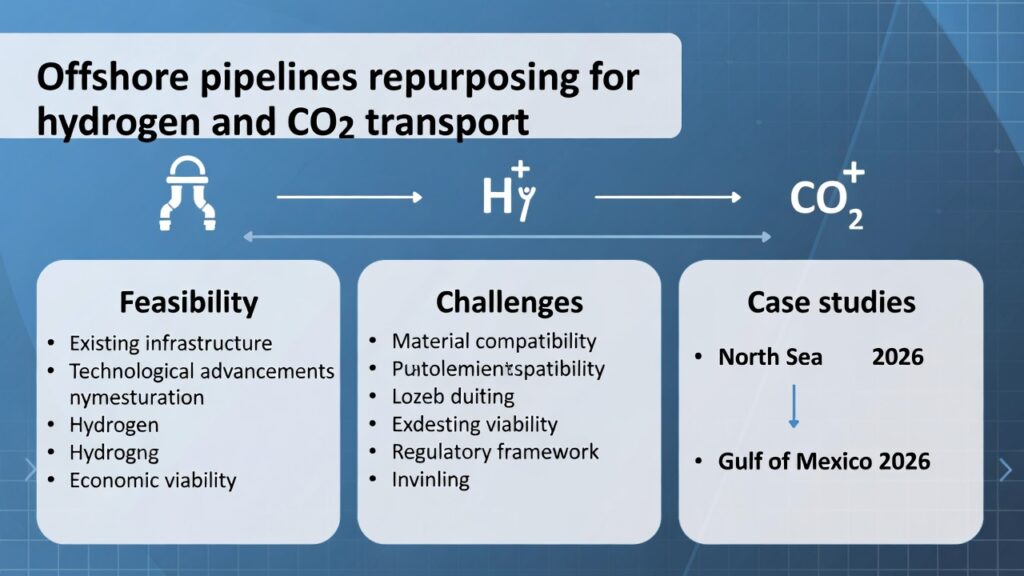
(“The diagram below summarizes the key elements of repurposing offshore pipelines for H₂ and CO₂,) illustrating the interplay between feasibility factors, technical challenges, and practical pathways.”
For CO₂
- Corrosion : Wet CO₂ forms carbonic acid → severe internal pitting/cracking; dehydration to <50 ppm water is critical.
- Phase behavior : Must maintain supercritical state (>1,070 psig) to avoid two-phase flow and running ductile fractures.
- Material compatibility : Elastomers/seals may degrade; existing lines often lack toughness for dense-phase service.
- Mitigation : Advanced coatings, corrosion inhibitors, re-qualification (hydrostatic testing, FEM for defects), and fiber-optic monitoring for leaks/strain.
Both require rigorous integrity reassessment: ILI (in-line inspection), direct assessment, digital twins, and regulatory approval.
2026 Case Studies Several projects are moving from feasibility to execution:
- North Sea (Northern Lights Phase 2 & Porthos/Aramis) Norway/Netherlands leading offshore CO₂ transport/storage; repurposing existing gas lines for dense-phase CO₂ to depleted fields. Northern Lights scaling to 5+ Mt/year by 2026–2028; challenges include pressure management and subsea fatigue.
- Dutch Continental Shelf : Studies show 84 platforms repurposable for 23–42 GW electrolysis + H₂ transport at 50–60 bar using existing pipelines; focus on material compatibility and economic viability.
- Gulf of Mexico : Emerging hubs (e.g., Bayou Bend, River Bend CCS) exploring repurposing for CO₂ (Class VI storage) and blue hydrogen; Talos Energy/Carbonvert projects target 20 Mt/year CO₂ injection by 2027, leveraging legacy infrastructure.
- Other highlights : Penspen’s European H₂ repurposing contracts (2025–2026), Germany’s AquaDuctus offshore H₂ pipeline (GW-scale), and global JIPs (DNV Skylark, CO2SafePipe) addressing embrittlement and corrosion.
Closing Thoughts
Repurposing offshore pipelines for H₂ and CO₂ is technically feasible and economically compelling, but success hinges on addressing embrittlement, corrosion, and pressure risks through rigorous integrity management and material upgrades. 2026 will be pivotal as North Sea and Gulf projects generate real operational data.For subsea/pipeline engineers, this presents direct opportunities: inspection tech transfer, digital twins for predictive modeling, and expertise in dynamic lines/mooring.
What repurposing challenges or projects are you tracking? Share in the comments!
Oko Immanuel
Petroleum / Subsea Engineer
Founder, Offshore Pipeline Insight
Texas A&M Alumnus.
March 07, 2026
Author’s Contact : oko@offshorepipelineinsight.com