Oko Immanuel
Petroleum / Subsea Engineer
Founder, Offshore Pipeline Insight
Texas A&M
March 09, 2026
Sable Offshore Corp., a Texas-based energy company, has been at the center of a contentious effort to restart oil production from the Santa Ynez Unit (SYU) off Santa Barbara County, California. The SYU comprising three offshore platforms (Heritage, Harmony, Hondo) and the Las Flores Pipeline System has been idle since the 2015 Refugio oil spill, which released over 100,000 gallons of crude into the Pacific. In 2026, Sable’s push to revive operations has sparked intense legal, environmental, and regulatory clashes, with federal interventions under the Trump administration clashing against state and local opposition.
This article examines the current status of Sable Offshore’s efforts, key developments in early 2026, the ongoing court battles, and implications for offshore pipeline integrity and energy production.
Background: The SYU and Las Flores Pipeline
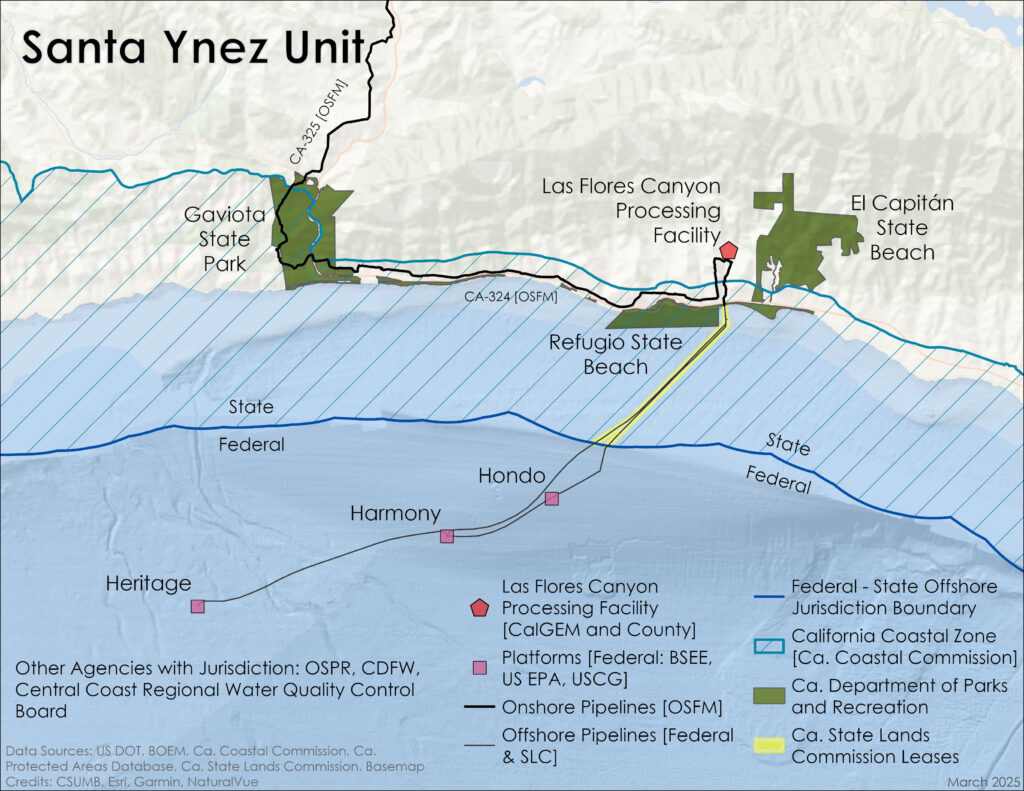
The Santa Ynez Unit, located in federal waters off Santa Barbara, was acquired by Sable from ExxonMobil in early 2024. The Las Flores Pipeline System consisting of Lines CA-324 and CA-325 transports crude from the platforms to onshore processing at Las Flores Canyon, then to refineries.The 2015 spill, caused by corrosion in the onshore segment, led to a shutdown and a federal consent decree requiring extensive repairs and state approvals for restart. Sable resumed limited offshore production in May 2025, storing oil onshore, but onshore pipelines remain blocked by state regulators.This map shows the Santa Ynez Unit platforms, pipelines, and Las Flores Canyon facility:
Recent Developments in 2026
Sable’s restart plans hit a major roadblock in early 2026. A Santa Barbara County Superior Court judge upheld a preliminary injunction on February 27, blocking pipeline operations without full state approvals. The ruling asserted that federal intervention by the Pipeline and Hazardous Materials Safety Administration (PHMSA) does not override the 2015 consent decree, which requires a waiver from California’s Office of the State Fire Marshal (OSFM).
PHMSA had approved Sable’s restart plan in December 2025 and issued an emergency waiver under President Trump’s “National Energy Emergency” executive order, claiming interstate jurisdiction to bypass state rules. However, California sued PHMSA in January 2026, arguing the pipelines remain intrastate.
Sable’s stock dipped after the injunction ruling, but the company is pursuing an “Offshore Storage and Treating” (OS&T) alternative: acquiring a vessel for offshore processing and shipping, bypassing onshore lines. Vessel delivery is expected in Q3 2026, with full sales potentially resuming Q4 2026.
Legal Battles and Environmental Opposition
Environmental groups (Center for Biological Diversity, Wishtoyo Foundation) and state agencies (Coastal Commission, OSFM) have strongly opposed the restart, citing the 2015 spill’s legacy and risks of another rupture. The Coastal Commission fined Sable a record $18 million in 2025 for unauthorized repairs.
California’s lawsuit against PHMSA tests federal preemption under the Pipeline Safety Act. A Ninth Circuit hearing is scheduled for February 27, 2026, but an earlier appeals court denied a stay request in December 2025.
Sable has spent ~$211 million on repairs through November 2025 and plans $475 million for the OS&T strategy. The company denies wrongdoing and asserts compliance with federal requirements.
Implications for Offshore Pipeline Integrity
The Sable case highlights ongoing tensions between federal energy priorities and state environmental protections.
For pipeline engineers, key lessons include:
- Jurisdictional overlaps: Interstate vs. intrastate classification can delay restarts; thorough consent decree compliance is critical.
- Integrity assessments: Post-spill repair programs must address corrosion, anomaly digs, and hydrostatic testing per API RP 1175.
- Alternative strategies: OS&T vessels offer bypass options but introduce new subsea integrity risks (dynamic mooring, export risers).
As of early 2026, Sable’s onshore pipelines remain shut, with production limited to offshore storage. The outcome of the Ninth Circuit hearing could determine if full restart occurs or if OS&T becomes the path forward.
What do you think of Sable’s OS&T alternative, or the federal vs. state jurisdiction debate? Share in the comments!
Oko Immanuel
Petroleum / Subsea Engineer
Founder, Offshore Pipeline Insight
March 09, 2026