Oko Immanuel
Petroleum / Subsea Engineer
Founder, Offshore Pipeline Insight
Texas A&M Alumnus.
March 09, 2026.
In 2026, shale development continues to dominate U.S. onshore production, particularly in the Permian Basin, Eagle Ford, Bakken, and Haynesville. However, casing deformation and cement sheath failure remain among the most persistent and costly integrity issues in horizontal wells especially in high-density infill programs with tight well spacing and aggressive fracturing.Frac hits, stress shadowing, fault reactivation, and depletion-induced geo mechanical changes are driving higher-than-ever rates of casing failure and sustained casing pressure (SCP).
This technical article examines the dominant deformation modes, cement sheath failure mechanisms, diagnostic approaches, and the most effective mitigation strategies being deployed in 2026.
1. Dominant Casing Deformation Modes in Shale Wells
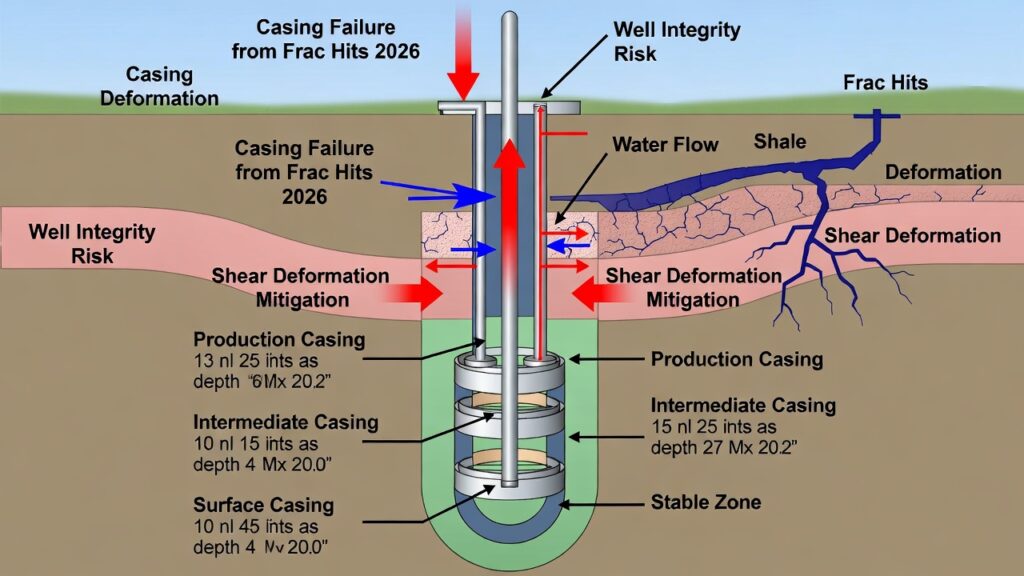
Casing deformation is now a well-documented geo mechanical and operational problem.
The most frequent modes in 2026 include:
- Shear deformation (most common)
Lateral displacement from fault slip or stress shadowing between adjacent frac stages. Displacement can reach 0.5–2 inches (or more in extreme cases), creating dog-legs or “S”-shaped distortions. - Collapse / ovalization
Localized external pressure from formation creep, depletion, or frac-hit-induced stress changes. - Connection failure
Thread jump-out, galling, or seal loss under combined compression, torque, and cyclic pressure during fracturing. - Erosion / wear
Tool joint hardbanding or high-velocity sand/proppant during extended production.
This diagram illustrates the primary casing deformation modes observed in shale wells.
2. Cement Sheath Failure Mechanisms
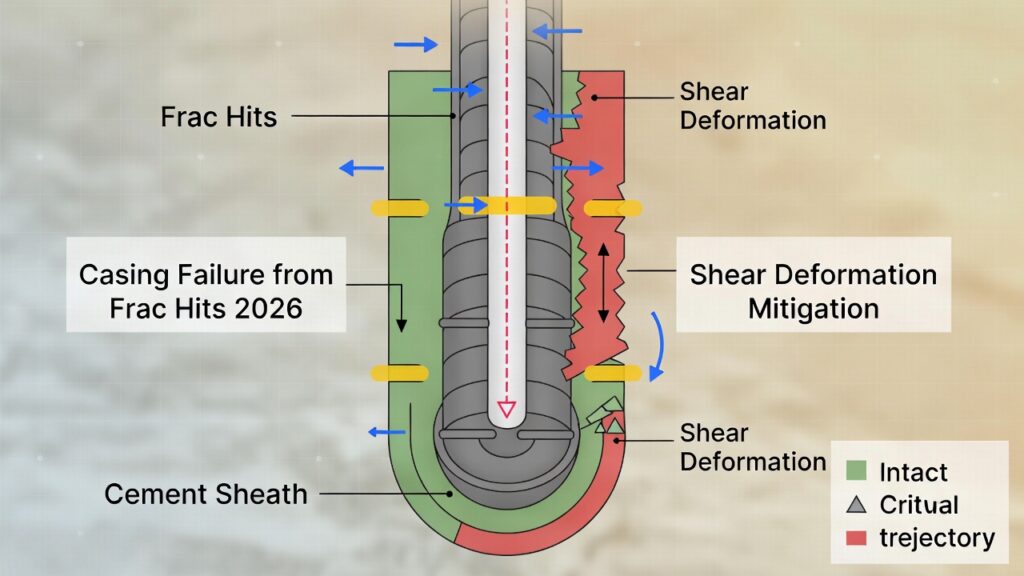
Even when casing remains structurally intact, the cement sheath frequently fails, creating pathways for gas migration, sustained casing pressure (SCP), and inter-zonal communication.
- Micro-annulus formation
Debonding at the casing-cement or cement-formation interface due to pressure/thermal cycling, shrinkage during cement setting, or poor mud removal. - Radial cracking
Shear failure from hoop stress changes during fracturing or depletion. - Channeling
Continuous vertical channels from poor displacement during primary cementing.
This diagram shows micro-annulus formation and radial cracking in the cement sheath:
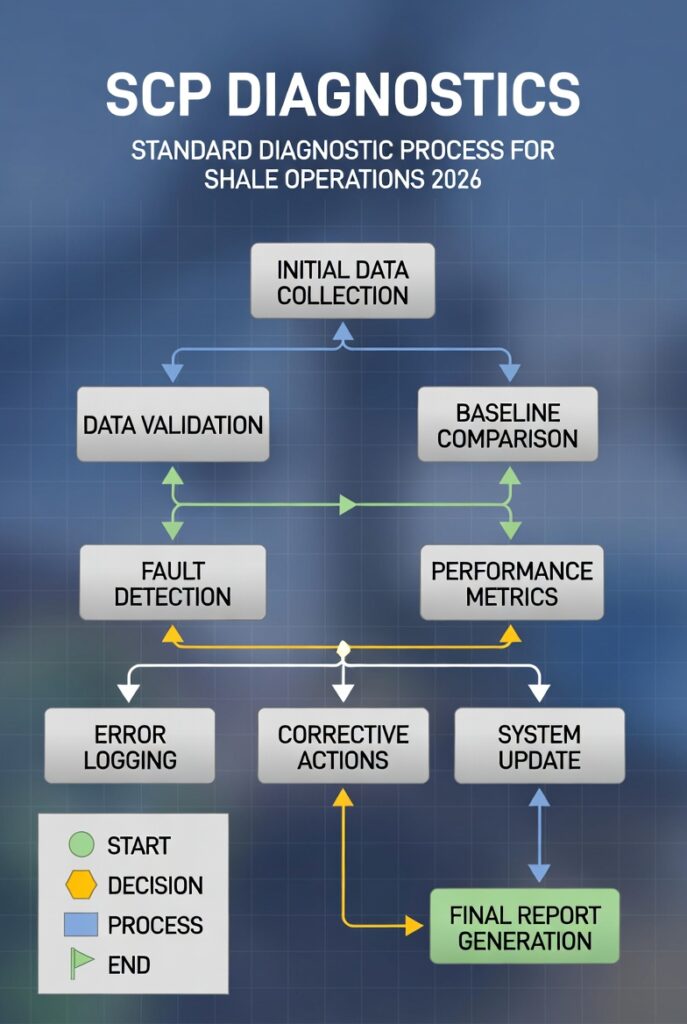
3. Sustained Casing Pressure (SCP) Diagnostic FlowchartSCP pressure in the annulus that rebuilds after bleed-down is a key indicator of barrier failure. Operators use structured diagnostic workflows to identify root causes and assess risk.
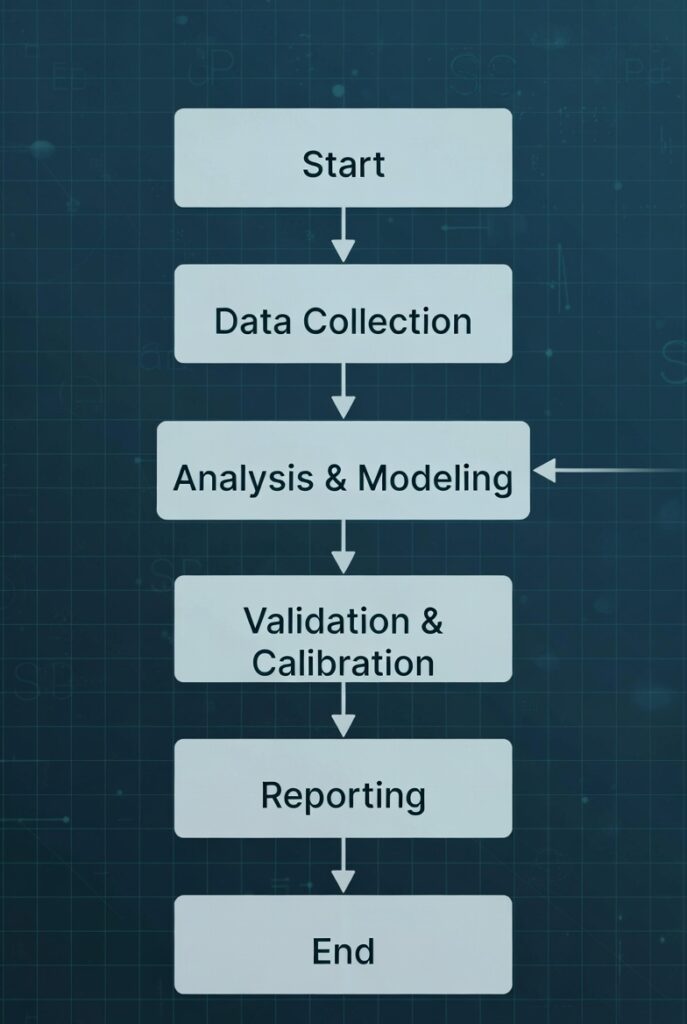
This flowchart outlines the standard SCP diagnostic process used in shale operations in 2026.
Key diagnostic steps:
- Bleed-down test : monitor rebuild rate and pressure behavior
- Pressure source identification: thermal, reservoir, tubing leak, casing leak, cement failure
- Logging suite: noise/temperature log, cement bond log (CBL), ultrasonic imaging tool (USIT)
- Risk assessment: compare observed pressure to MAASP (Maximum Allowable Annular Surface Pressure)
4. Mitigation Strategies in 2026Operators are implementing a multi-layered approach combining design, operational, and monitoring improvements:Casing design upgrades
- Higher collapse-rated grades (Q125, high-collapse proprietary) in fault-prone areas
- Premium connections with metal-to-metal seals and higher compression/torque ratings
- Larger OD strings (e.g., 5½” to 7″) in high-risk zones
Cementing best practices
- Flexible/expansive cements with latex, fiber, or resin additives to accommodate strain
- Optimized spacer/mud displacement; centralization (stand-off >70%)
- Lightweight/foam cement in low-fracture-gradient zones
Operational controls
- Optimized frac sequencing (zipper vs. simultaneous) to minimize stress shadowing
- Wider well spacing (400–600 ft) in geomechanically complex blocks
- Real-time microseismic + pressure monitoring during fracturing
Advanced monitoring
- Permanent or temporary fiber-optic DAS/DTS for SCP detection, frac-hit identification, and strain mapping
- Digital twins for casing stress simulation and SCP prediction
- AI anomaly detection on pressure/temperature data to flag early SCP buildup
Closing Thoughts
Shale well integrity in 2026 is no longer just a completion-stage issue it is a full life-cycle challenge driven by geo mechanics, frac intensity, well spacing, and depletion. Casing deformation and cement sheath failure remain the top risks, but advanced diagnostics (DAS/DTS, digital twins) and design upgrades are significantly reducing failure rates in Tier 1 acreage.
For drilling and completion engineers, the message is clear: integrate geo mechanical modeling, premium equipment, and predictive monitoring from the planning phase.
What casing or cement challenges are you facing in your shale operations?
Share your experiences in the comments!
Oko Immanuel
Petroleum / Subsea Engineer
Founder, Offshore Pipeline Insight
Texas A&M Alumnus.
March 09, 2026