By Oko Immanuel, M.Eng
Founder, Offshore Pipeline Insight
March 24, 2026
Subsea compression is transforming offshore gas developments by boosting pressure on the seabed. This enables longer tiebacks, higher recovery, reduced topside infrastructure, and lower emissions — critical advantages in maturing basins and frontier areas like the Guyana-Suriname basin.
Key Benefits Recap
- Extended tieback distances (100+ km)
- 5–10%+ increase in ultimate recovery
- Lower CAPEX/OPEX and smaller platforms
- Improved flow assurance and reduced hydrate risk
- Synergies with low-carbon initiatives (e.g., power from shore or floating wind)
Subsea Compression Case Studies (Proven Track Record in 2026)
1. Åsgard Subsea Compression (Norwegian Sea) – The World’s First Full-Scale System
Equinor’s Åsgard project pioneered subsea gas compression in 2015. Two compressor stations (dry-gas design with separation) were installed in ~270–300 m water depth to tie back the Midgard and Mikkel satellite fields.
Key results (as of 2026):
- Near 99–100% uptime over 10+ years
- Phase 2 (additional modules installed 2023–2025) boosts recovery from Mikkel and Midgard to 90%, adding ~306 million barrels of oil equivalent
- Generated significant extra revenue (estimated NOK 175 billion cumulative value) while cutting energy use and CO₂ emissions
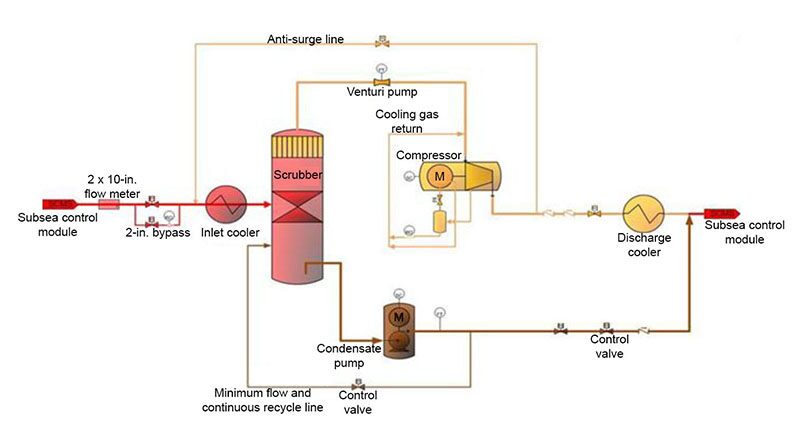
Simplified process flow schematic of a dry-gas subsea compression train, similar to the Åsgard system. Key elements include inlet cooler, scrubber, motor-compressor, condensate pump, discharge cooler, and anti-surge/recirculation lines.
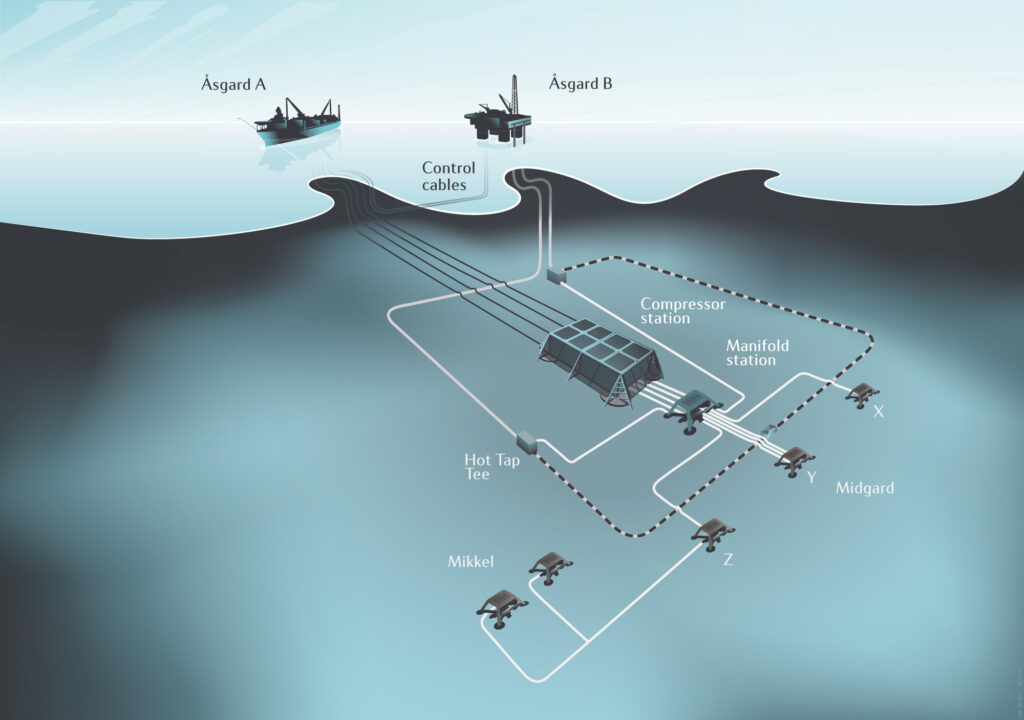
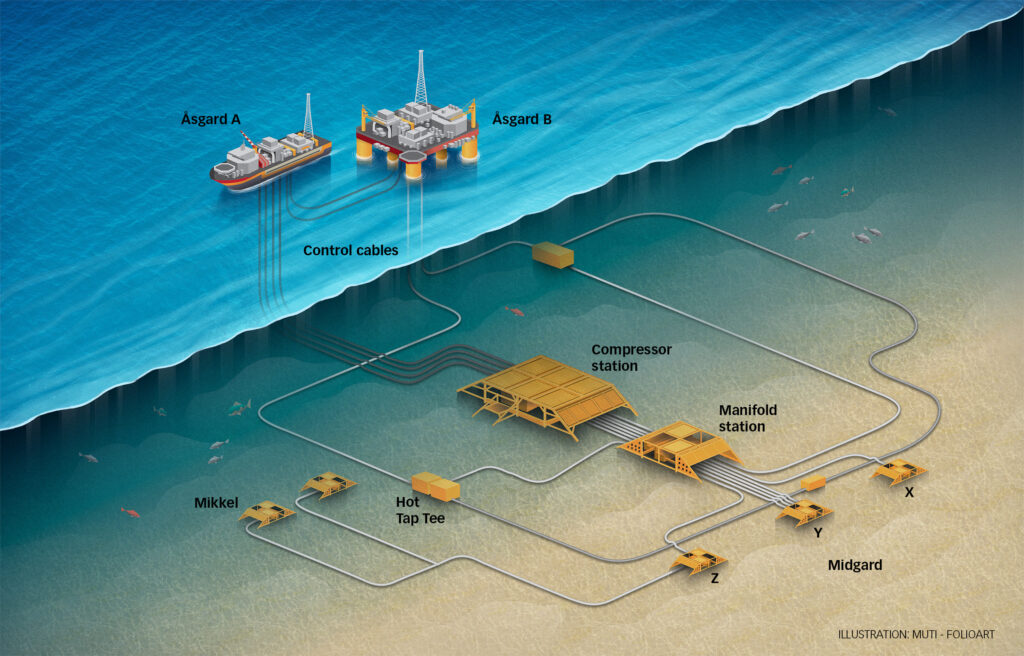
3D seabed overview of the Åsgard installation, illustrating compressor station, manifold, hot-tap tee, and flow line connections.
2. Gullfaks Subsea Compression (North Sea) – World’s First Wet-Gas/Multiphase System
Installed in 2015 at ~135 m depth, this multiphase compression system (no full separation) handles wet gas directly. In 2026, Equinor awarded OneSubsea an upgrade contract for next-generation modules with higher differential pressure and flow capacity to extend field life further.
Benefits demonstrated: Enhanced recovery from declining reservoirs and reliable operation in a mature field environment.
3. Ormen Lange Phase 3 (Norwegian Sea) – World’s Deepest and Longest Step-Out
Inaugurated in 2025, this project features subsea compression at 800–1,100 m depth with ~120 km power transmission from shore. It builds on lessons from Åsgard and Gullfaks to increase recovery and extend field life in one of Norway’s most challenging environments. Early 2026 saw temporary curtailments for maintenance, underscoring the need for robust long-term reliability.
These case studies prove subsea compression’s reliability, with high uptime, significant recovery gains, and successful scaling from pilot to full commercial deployment.
Guyana Offshore Projects in 2026: Growing Relevance for Subsea Compression
Guyana’s Stabroek Block (operated by ExxonMobil) continues its rapid expansion, with six sanctioned projects (Liza 1 & 2, Payara, Yellowtail, Uaru, Whiptail) and more in planning (Hammerhead, Longtail). Current production exceeds 900,000 bbl/day, targeting ~1.3 million bbl/day by 2027.
While the developments are primarily oil-focused with associated gas, several factors make subsea compression increasingly relevant:
- Gas handling and re -injection Large associated gas volumes require substantial compression (Whiptail alone plans ~1.2 Bcf/day gas compression capacity, matching the total of the first four projects).
- Long tiebacks and satellite developments Future phases and marginal accumulations will benefit from seabed boosting to minimize new FPSO topsides.
- Gas-to-Energy and monetization Associated gas is piped onshore for power generation; subsea compression could optimize transport and support future non-associated gas developments.
- Pre-commissioning and SURF activity Ongoing contracts (e.g., EnerMech with Saipem for Whiptail) highlight heavy subsea infrastructure investment, creating a natural pathway for compression tie-ins as fields mature.
The neighboring Guyana-Suriname basin (including Suriname’s GranMorgu project in Block 58) shares similar geology. GranMorgu (TotalEnergies/APA, first oil 2028, 220,000 bbl/day FPSO) will feature extensive subsea architecture ideal for future compression modules as reservoir pressure declines.Subsea compression offers Guyana operators a proven tool to maximize recovery, reduce flaring, lower costs, and prepare for greater gas monetization in the late 2020s and beyond.
Pipeline & Subsea Implications for 2026+
- Reduced liquid hold-up and hydrate risk in long export or injection lines
- Modular, phased installation (add compression when needed)
- Easier integration with all-electric FPSOs and low-carbon power sources
As the Guyana-Suriname basin matures, subsea compression will likely play a growing role in sustaining production and unlocking gas value.
Stay tuned to Offshore Pipeline Insight for more on subsea technologies, emerging basins, and practical offshore pipeline solutions.
Oko Immanuel, M.Eng
Founder & Lead Analyst
Offshore Pipeline Insight
https://offshorepipelineinsight.com
r