By Oko Immanuel, M.Eng
Founder, Offshore Pipeline Insight
March 25, 2026
Subsea compression continues to gain momentum as one of the most transformative technologies in offshore gas developments. By moving compression from topside platforms to the seabed, operators can significantly extend tieback distances, boost recovery rates, reduce CAPEX and OPEX, lower emissions, and unlock stranded or marginal fields.
What Is Subsea Compression and How Does It Work?
Subsea compression systems boost the pressure of produced gas directly on the seabed, eliminating or reducing the need for large topside compression facilities. This is especially valuable for long-distance tiebacks where reservoir pressure naturally declines over time.
Key Technical Components (Typical System Layout):
- Inlet cooler / scrubber Removes liquids and cools the gas stream.
- Gas-liquid separator (in dry-gas systems) or direct wet-gas handling.
- Motor-compressor (often centrifugal, with integrated electric motor).
- Liquid pump (for separated condensate/water).
- Cooling and recirculation loops.
- Power supply via long-step-out umbilicals or subsea power distribution.
- Control and monitoring modules with real-time sensors.
Simplified schematic of a subsea compression system (similar to the Åsgard installation).Field diagram of the pioneering Åsgard Subsea Compression project (Equinor, Norway).
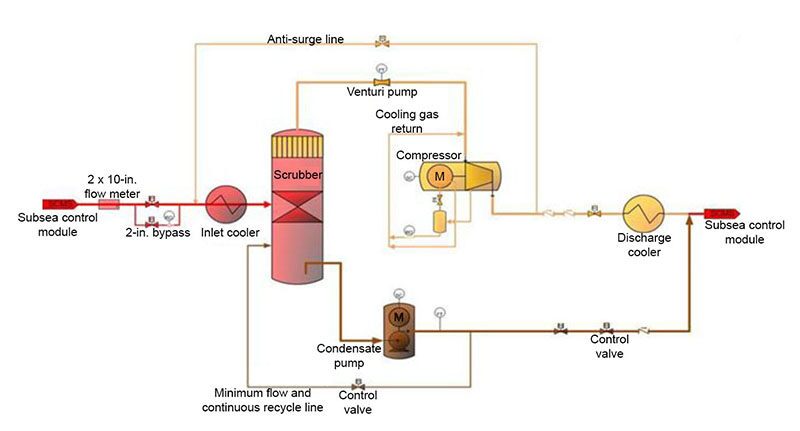
Simplified process flow schematic of a dry-gas subsea compression train, similar to the pioneering Åsgard Subsea Compression system. Key components include the inlet cooler, scrubber, centrifugal compressor with motor, condensate pump, discharge cooler, and anti-surge/recirculation lines.
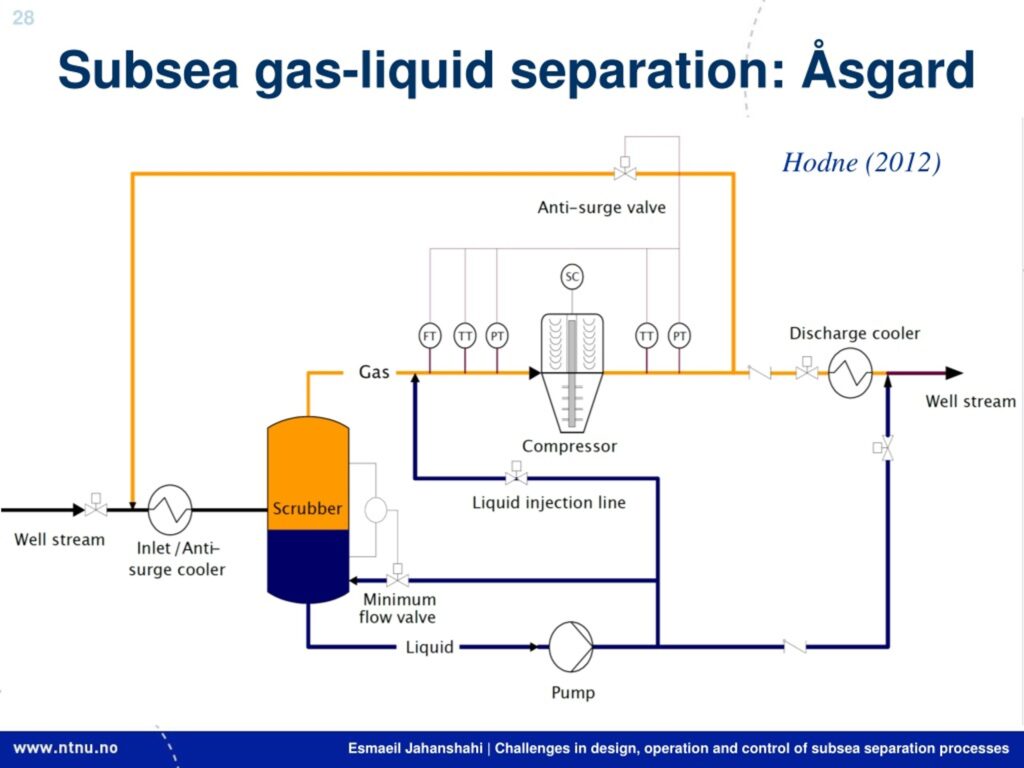
Subsea gas-liquid separation and compression process flow for Åsgard (Hodne, 2012).
Field Diagram of the Pioneering Åsgard Subsea Compression Installation
The Åsgard project (Equinor, Norwegian Continental Shelf) was the world’s first full-scale subsea compression system when it started operation in 2015. It remains the benchmark in 2026.
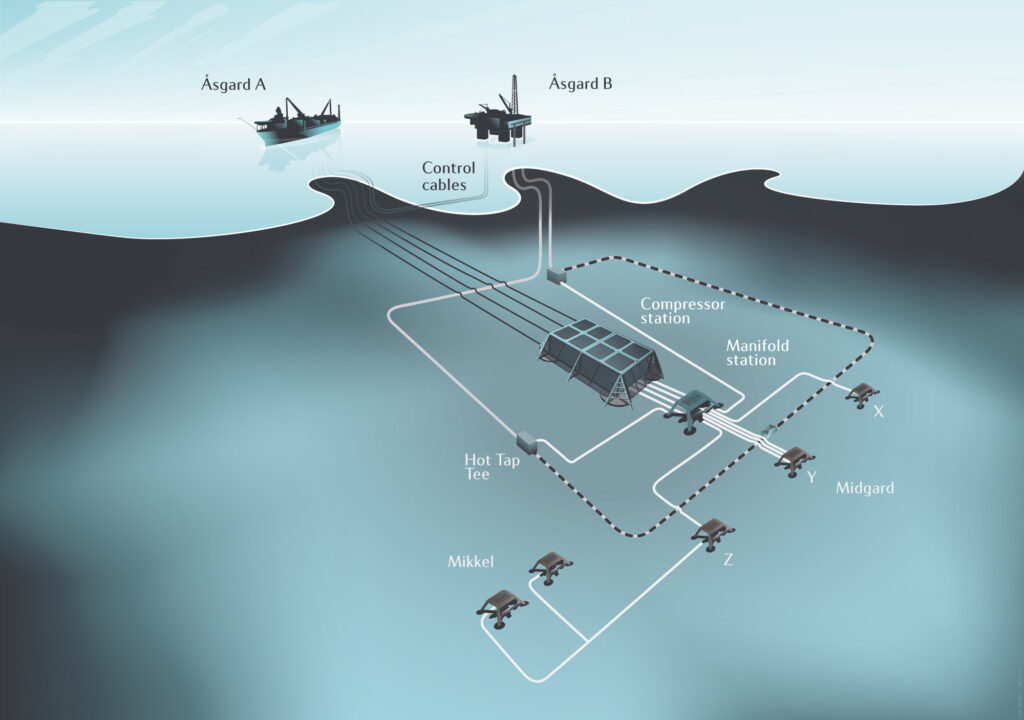
Field layout diagram of the Åsgard Subsea Compression system. The compressor station (center) ties in production from the Midgard and Mikkel satellite fields and boosts gas toward the Åsgard B platform. Control cables and umbilicals connect to the surface facilities.
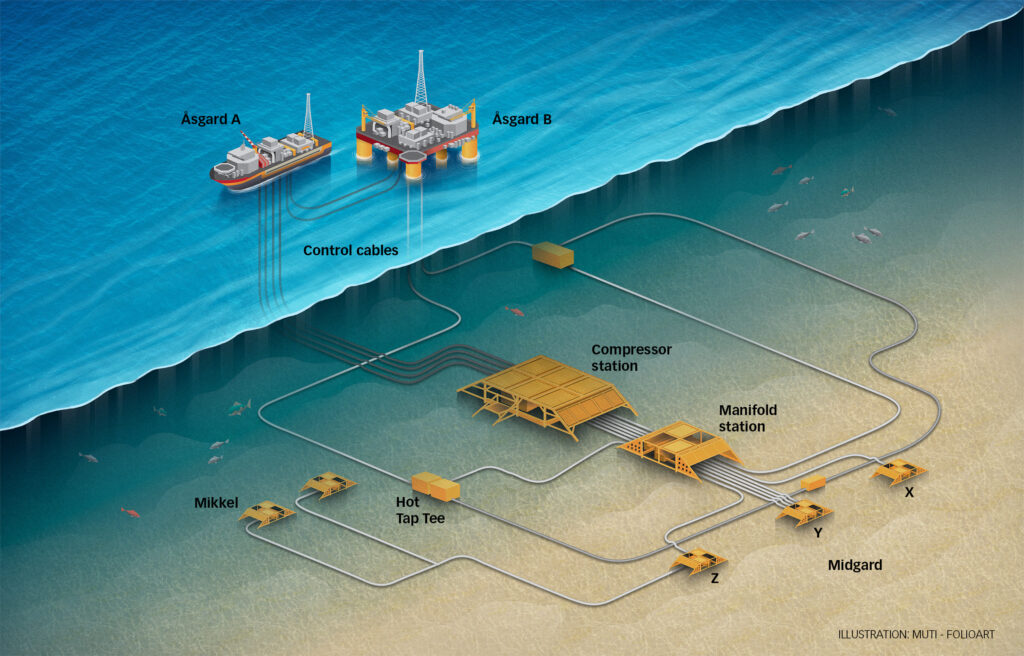
3D field overview of the Åsgard subsea compression installation, showing the compressor station, manifold station, hot-tap tee, and pipeline/flowline connections in approximately 300 m water depth.
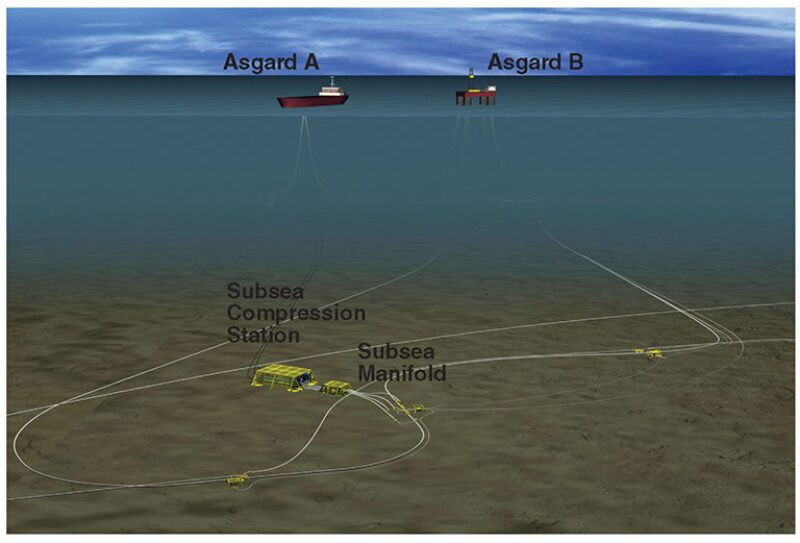
Overall seabed layout of the Åsgard subsea compression station and manifold, with flow lines connecting satellite fields and power/control umbilicals leading to the Åsgard A and B platforms.
Advantages and Challenges in 2026Main benefits:
- Tieback distances extended to 100+ km
- 5–10% higher ultimate recovery
- Smaller or no new topside platforms
- Reduced power consumption and CO₂ emissions
- Improved flow assurance (lower hydrate and liquid hold-up risk)
Key challenges:
- High reliability requirements (modules must run for years with minimal intervention)
- Long-distance power transmission
- Sand/liquid management and ROV-based maintenance
In 2026, subsea compression is no longer experimental it is scaling across the North Sea, Brazil, Australia, and the Gulf of Mexico, with growing interest in wet-gas/multiphase variants for even more compact systems.
Suriname Offshore Developments: A Rising Star in the Guyana-Suriname Basin
Suriname’s offshore sector is accelerating in 2026, creating strong opportunities for subsea compression in future gas developments and long tiebacks.GranMorgu Project (Block 58) – The flagship development led by TotalEnergies (50%) and APA Corporation (50%), with Staatsolie participation.
- $10.5–12.2 billion deepwater project centered on Sapakara and Krabdagu fields
- FPSO with up to 220,000 bbl/day capacity
- First oil targeted for mid-2028
- 32 wells planned, with significant subsea infrastructure (SURF) that will benefit from boosting and compression as reservoir pressure declines
Additional activity includes exploration in Block 58, PETRONAS targeting potential floating LNG from gas discoveries, and cross-border gas discussions with Guyana. Subsea compression could enable longer tiebacks to a central FPSO or future LNG facilities while minimizing topside complexity in this frontier basin.
Pipeline & Subsea Implications
Subsea compression reduces liquid dropout and hydrate risk in long export pipelines, simplifies tieback architecture for satellite fields, and creates synergies with hydrogen and CCS projects. For Suriname, 2026 is a pivotal year of execution that will set the stage for advanced subsea technologies in the coming decade.
Stay tuned to Offshore Pipeline Insight for more on subsea technologies, emerging basins, and practical offshore pipeline solutions.
Oko Immanuel, M.Eng
Founder & Lead Analyst
Offshore Pipeline Insight
https://offshorepipelineinsight.com