By Oko Immanuel, M.Eng – Founder, Offshore Pipeline Insight
March 20, 2026
2026 One of the fastest-rising search trends in the energy industry right now is the “AI-Energy” connection specifically, how natural gas is powering the explosive growth of AI data centers. As hyper scale AI facilities demand massive, uninterrupted 24/7 electricity, intermittent renewables like wind and solar alone cannot meet the reliability requirement. Natural gas delivered via pipelines and LNG is emerging as the dispatch -able backbone fuel that keeps AI running around the clock.This article explores why searches for “natural gas AI data centers,” “gas for 24/7 AI power,” and “LNG powering AI” are surging in 2026, and how offshore/subsea infrastructure is quietly supporting this new demand wave.
1. Why AI Data Centers Need 24/7 Reliable Power
Modern AI training and inference clusters (e.g., NVIDIA DGX, Google TPU, OpenAI clusters) consume enormous power — often hundreds of megawatts per facility, with some campuses projected to reach 1–5 GW in the late 2020s.
Key requirements:
- Constant uptime — AI workloads cannot tolerate interruptions or brownouts.
- High power density — 50–100 MW per building, with rapid ramp-up/down.
- Scalability — New clusters added every few months.
Wind and solar are excellent for decarbonization but intermittent — output drops at night, during calm weather, or cloud cover. Battery storage helps, but at GW scale, it’s still too expensive and land-intensive for full backup. Natural gas-fired combined-cycle plants offer:
- Near-instant ramping (minutes vs. hours for coal/nuclear).
- High efficiency (60%+).
- Lower emissions than coal (50–60% less CO₂).
This makes gas the perfect complement to renewables for 24/7 AI power.
2. Surging Demand from Hyper scalers.
Major tech companies are actively seeking gas-fired power for new data centers:
- Microsoft: Signed long-term gas supply deals and is exploring small modular reactors (SMRs), but gas remains the near-term bridge.
- Google: Targeting 24/7 carbon-free energy by 2030 — gas + CCS is a key interim solution.
- Amazon, Meta, Oracle: All expanding in gas-rich regions (Texas, Virginia, Midwest U.S.).
- U.S. Gulf Coast: Becoming a hotspot — proximity to LNG export terminals, abundant pipeline gas, and existing combined-cycle plants.
Forecasts (Wood Mackenzie, Rystad, IEA) show U.S. data-center power demand growing 15–20% annually through 2030, with natural gas capturing 40–60% of incremental supply in many scenarios.
3. Offshore & Subsea Infrastructure Supporting the AI-Gas Link
The gas powering AI data centers comes from offshore fields via subsea pipelines and LNG terminals.
- U.S. Gulf of Mexico : Deepwater HPHT fields (Anchor, Shenandoah, Kaskida) feed onshore gas processing and pipeline networks to data-center hubs in Texas/Louisiana.
- Qatar North Field : NFE expansion (32–33 MTPA new LNG by 2026) supplies Asian data-center markets via LNG shipping.
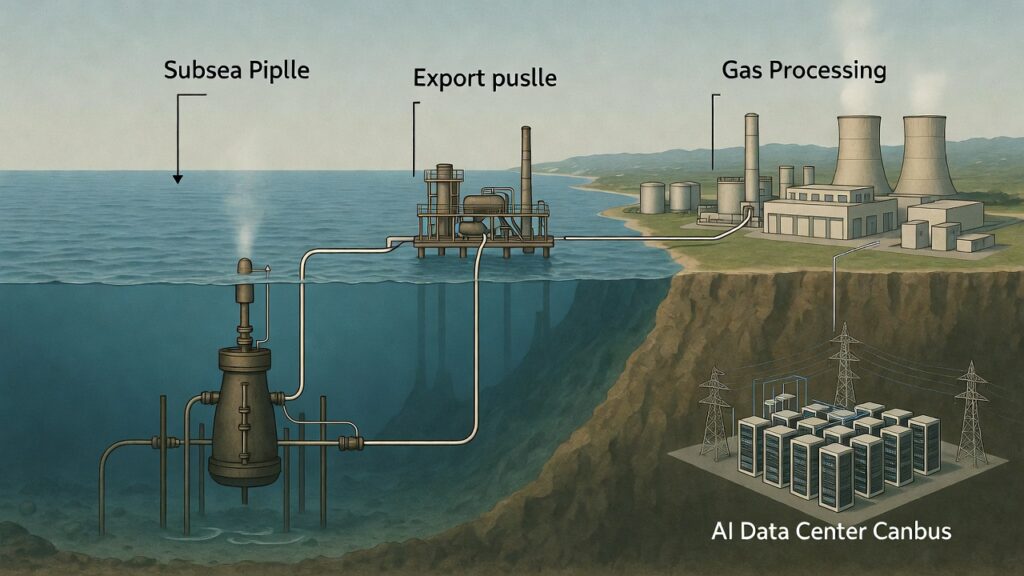
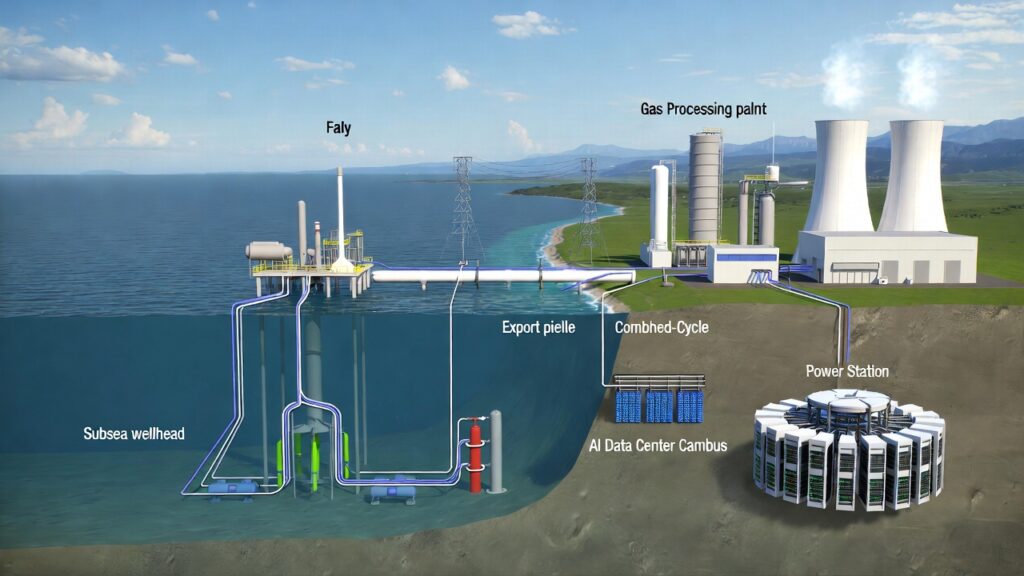
- Subsea role : HPHT subsea trees, flow lines, manifolds, and export trunk lines ensure reliable gas delivery from ultra-deep reservoirs to shore.
Figure 1: AI Data Center Power Demand & Natural Gas Supply Chain
( image: Flow diagram showing offshore HPHT wells → subsea pipelines → onshore processing → gas-fired power plants → AI data centers. Highlight U.S. GoM, Qatar, and Asian/European demand centers.)
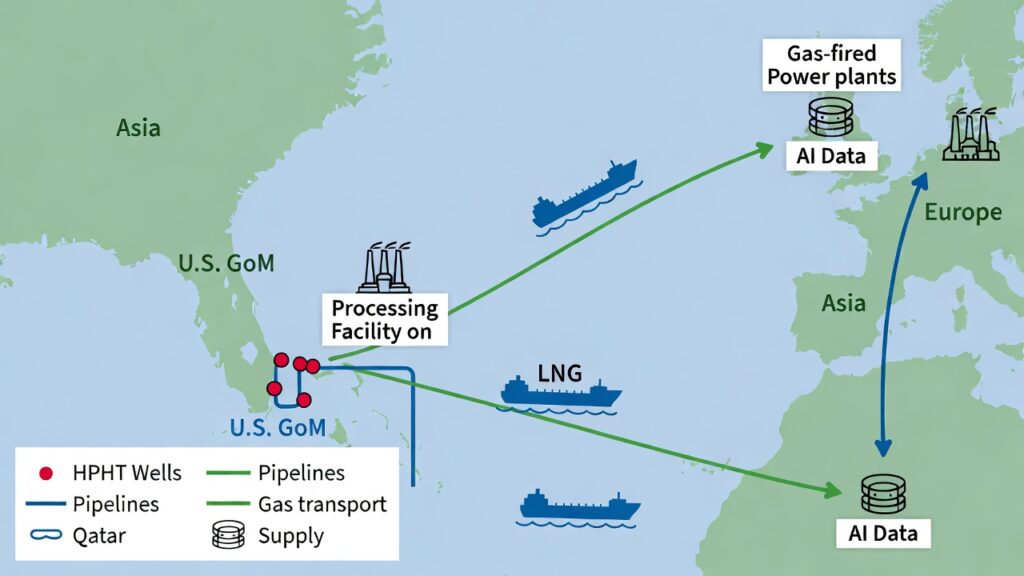
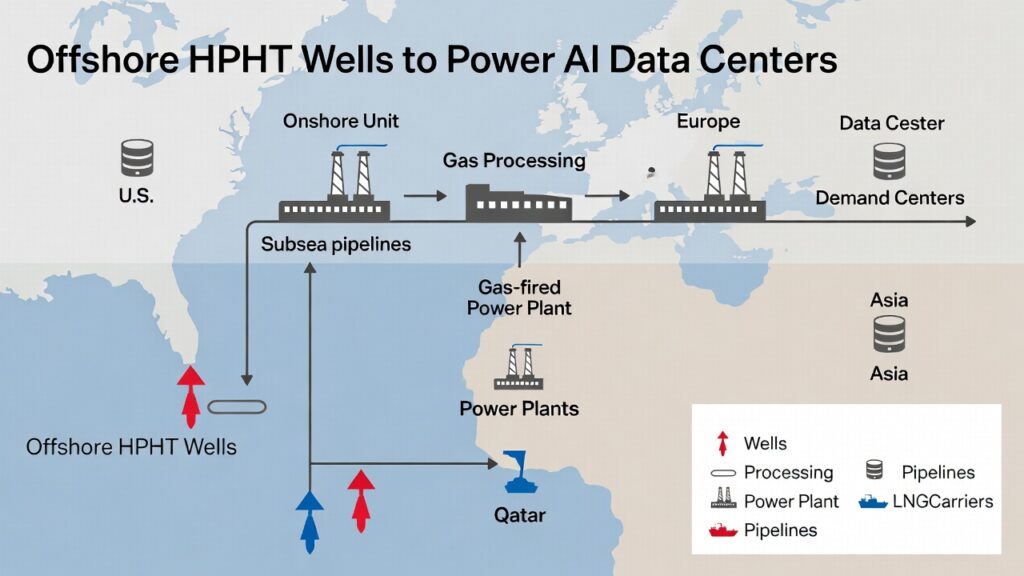
Figure 2: Offshore Gas to AI – Simplified Schematic
( image: Conceptual overview showing subsea wellhead, flow lines, risers to platform, export pipeline to shore, gas plant, combined-cycle power station, and AI data center campus with power lines.)
4. The Broader Implications for 2026
- Energy security : Gas provides reliable base load for AI while renewables scale.
- Offshore investment : High-margin deepwater gas projects fund CCS and transition tech.
- Subsea opportunity : Demand for HPHT subsea systems, pipelines, and integrity monitoring rises with gas production.
- Decarbonization path : Gas + CCS (e.g., Qatar NFE model) offers a lower-carbon bridge to full renewables.
The Bottom Line
Searches for “natural gas AI data centers” and “gas for 24/7 AI power” are surging because AI needs reliable, scalable electricity and natural gas is the fuel that delivers it today. Offshore HPHT gas fields, subsea pipelines, and LNG infrastructure are quietly powering the AI revolution.Engineers and energy pros: How is the AI demand wave affecting your offshore or subsea work more pipeline capacity, CCS tie-ins, or electrification?
Share your thoughts in the comments or on LinkedIn.
Stay sharp out there, brothers. AI is driving energy demand and gas is answering the call.
Oko Immanuel
Subsea Engineering Specialist | Offshore Pipeline Insight