Oko Immanuel
Petroleum / Subsea Engineer
Founder, Offshore Pipeline Insight
Texas A&M Alumnus.
March 09, 2026
High-Pressure High-Temperature (HPHT) wells : defined as >15,000 psi bottomhole pressure and/or >350°F (177°C) bottomhole temperature represent some of the most technically demanding drilling operations in 2026. The combination of extreme pressures, corrosive fluids (H₂S, CO₂), thermal cycling, and narrow operating windows requires specialized wellhead systems, blowout preventer (BOP) stacks qualified to 20,000 psi, and advanced well control techniques such as Managed Pressure Drilling (MPD).
This technical article covers the key engineering considerations for HPHT wellhead design, BOP qualification requirements for 20,000 psi service, MPD integration for pressure control, and real-world safety lessons from recent operations.
1. HPHT Wellhead System Design Requirements
HPHT wellheads must withstand not only static burst/collapse loads but also cyclic thermal and pressure stresses, H₂S embrittlement, and fatigue from drilling/completion operations.
Core design elements in 2026:
- Pressure rating: API 6A PR2 or higher; working pressure 15,000–20,000 psi (common in Gulf of Mexico Lower Tertiary, Brazil pre-salt, and emerging HPHT plays).
- Temperature rating: API 6A Class Y (350°F / 177°C) or Class Z (450°F / 232°C) for ultra-HPHT.
- Material selection: High-strength low-alloy (HSLA) steels (4130, 8630) with controlled hardness (≤22 HRC for H₂S service per NACE MR0175/ISO 15156); corrosion-resistant alloys (Inconel 625/718) for wetted components.
- Sealing philosophy: Metal-to-metal seals (no elastomers in critical paths); dual independent barriers; fire-resistant design (API 6FA/6FB).
- Connector design: High-integrity clamp or bolted flange connections with fatigue-resistant bolting (Inconel 718 or MP35N).
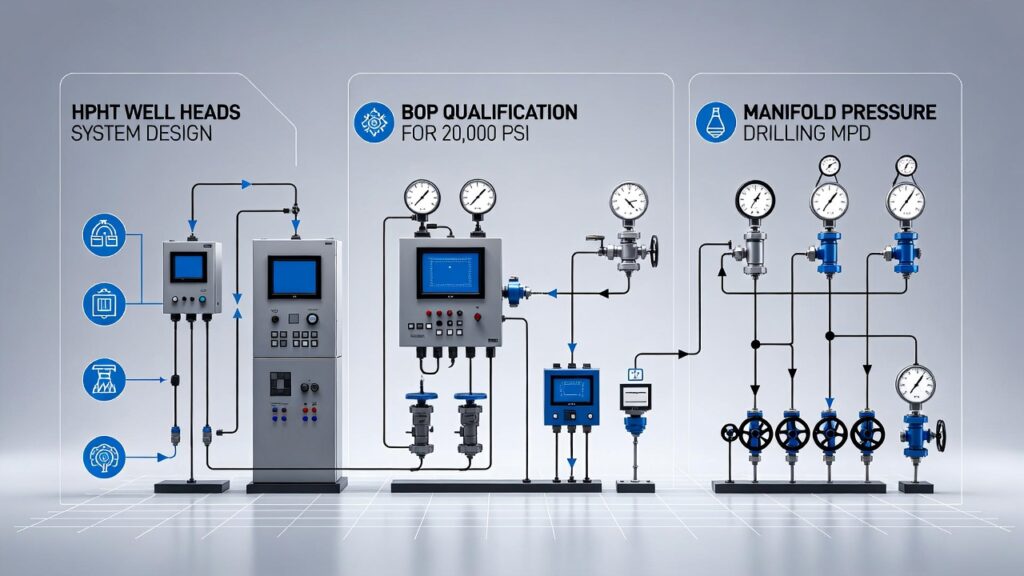
This diagram shows a typical 20,000 psi HPHT wellhead system configuration (Christmas tree, tubing head, casing head, and tie-in to BOP):
2. BOP Qualification for 20,000 psi ServiceQualifying a BOP stack for 20,000 psi is one of the most rigorous processes in drilling engineering. In 2026, the industry standard follows API 16A (5th Edition, 2021 + addenda) and API 16C for choke/kill systems.
Key qualification requirements:
- Design validation: PR2 performance verification (200 cycles at rated pressure/temperature, plus extreme low/high temperature testing).
- Shear testing: Blind/shear rams must cut 6-5/8″ 25.2 lb/ft S-135 drill pipe at 20,000 psi with zero leakage.
- Sealing endurance: Annular elements must seal at rated pressure after repeated operations.
- Connector fatigue: Wellhead-connector interface must withstand 200+ pressure/temperature cycles without fatigue crack initiation.
- Material hardness: All wetted components ≤22 HRC (NACE MR0175/ISO 15156 compliance).
2026 trends:
- Dual-shear ram stacks (two independent shear rams) now standard for 20k systems.
- Rapid-response acoustic backup systems for subsea BOPs.
- Real-time BOP condition monitoring (pressure, temperature, position sensors).
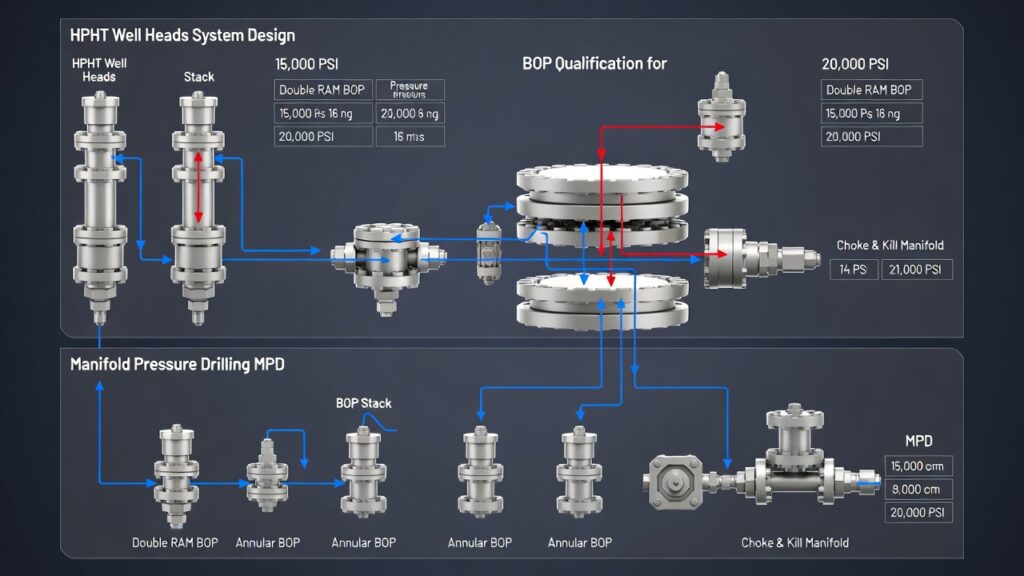
This schematic illustrates a typical 20,000 psi subsea BOP stack configuration (dual annular + 4–6 ram configuration, choke/kill lines, multiplex control pods)
3. Manifold Pressure Drilling (MPD) in HPHT Wells
Managed Pressure Drilling (MPD) is now the preferred technique for HPHT wells with narrow mud windows (often <0.5 ppg). MPD maintains constant bottomhole pressure (BHP) by adjusting surface backpressure via an automated choke manifold.
Key MPD components in 2026 HPHT operations:
- Rotating control device (RCD) rated to 20,000 psi (dynamic seal on drill pipe).
- Automated choke manifold with real-time pressure control (±25 psi accuracy).
- Coriolis flow meters for early kick detection (influx/outflux monitoring).
- Integrated BHP model (hydraulic + thermal effects) for set-point calculation.
Benefits:
- Reduces kick/loss cycles improved wellbore stability.
- Allows narrower mud windows → lower equivalent circulating density (ECD) fluctuations.
- Enables drilling through depleted zones without excessive mud weight.
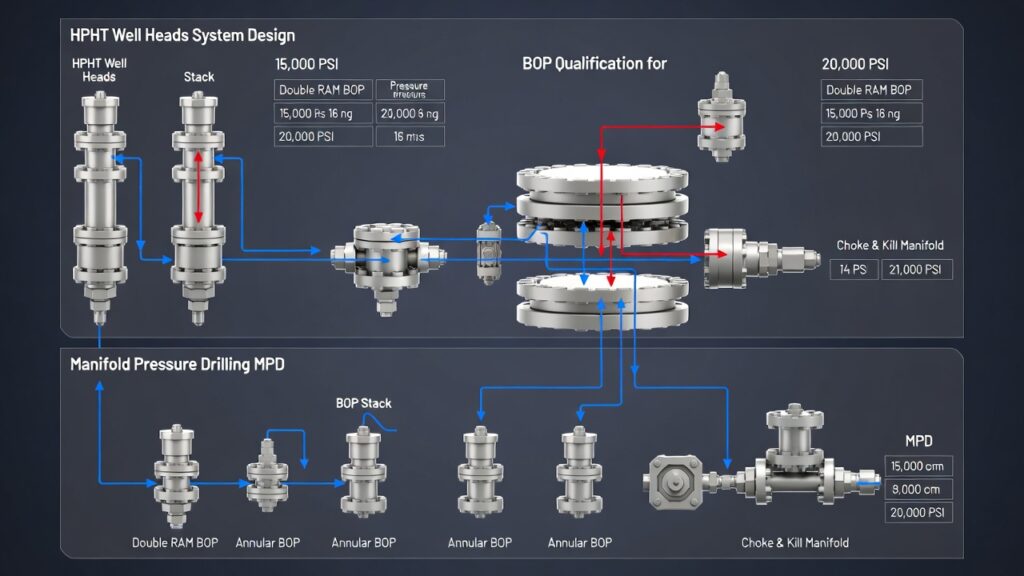
This schematic shows the MPD system integration with a 20,000 psi BOP stack and choke/kill manifold
4. Safety & Integrity Lessons from 2026 HPHT Operations
- Thermal cycling fatigue : Temperature swings (ambient to 200°C+) cause differential expansion micro-annuli and SCP. Use flexible/expansive cements and thermal-stress-rated casing.
- H₂S/CO₂ corrosion : Strict CRA selection and hardness control (≤22 HRC) are non-negotiable.
- BOP shear reliability : 20k psi shear tests on high-strength pipe remain challenging : dual shear rams & redundant controls are standard.
- MPD reliability : Automated choke response time <2 seconds is critical to avoid influx escalation.
Closing Thoughts
HPHT well control in 2026 demands integrated 20,000 psi-rated wellheads, fully qualified BOP stacks, and MPD to manage narrow pressure windows safely. The engineering focus has shifted from static pressure rating to dynamic fatigue, thermal cycling, and real-time pressure control.
For drilling and subsea engineers, these systems represent the cutting edge of well control technology with direct parallels to subsea pipeline integrity (fatigue monitoring, corrosion resistance, high-pressure sealing).
What HPHT well control or MPD challenges are you facing in 2026?
Share in the comments let’s exchange practical insights!
Oko Immanuel
Petroleum / Subsea Engineer
Founder, Offshore Pipeline Insight
Texas A&M Alumnus.
March 09, 2026