By Oko Immanuel
Founder & Owner, Offshore Pipeline Insight
M.Eng in Subsea Engineering | Former Roughneck | Texas A&M Alumnus
March 04, 2026
Subsea technology is the backbone of modern offshore oil and gas production, enabling safe and efficient extraction of hydrocarbons from reservoirs beneath the seabed often in deep or ultra deep waters where surface platforms are uneconomical or impossible. While traditional developments place wellheads and processing topside, subsea systems install critical components directly on the seafloor, tying production back to hosts like FPSOs, platforms, or onshore facilities via pipelines, risers, and umbilicals.
This minimizes surface exposure, cuts costs in remote/harsh environments, and unlocks reserves in HPHT, deepwater, or marginal fields.
What Does “Subsea” Mean? Subsea encompasses all submerged equipment, operations, and infrastructure on or below the seabed for exploration, drilling, completion, production, processing, and fluid transport. Key drivers include deepwater (>500m), ultradeep (>1500–3000m+), satellite tie-backs, and energy transition integrations (e.g., CCUS).
Key Components of a Subsea Production SystemSubsea systems integrate wells, control, transport, and processing. Here’s a detailed breakdown:
- Subsea Wells and Wellheads
The entry point: wellheads provide structural anchoring, pressure containment, and support for casing/tubing hangers. - Subsea Christmas Trees (Production Trees)
Valve assemblies (“wet trees”) on wellheads control flow, injection, and emergency shutdowns. Designs handle HPHT; vertical or horizontal. - Subsea Structures (Underwater Foundations & Protection)
These are the critical underwater structures installed on the seabed to support, protect, and organize equipment:- Templates: Large steel frames holding multiple well slots (e.g., 4–12 wells) for clustered developments. They provide alignment, protection from dropped objects, and foundation stability on uneven seabeds.
- Manifold Structures/Protection Frames: House manifolds with protective covers or full enclosures to shield valves, piping, and jumpers from fishing gear, anchors, or debris. Often include mud mats for soft soils.
- Suction Caissons/Anchors: Cylindrical foundations “sucked” into the seabed for anchoring structures, manifolds, or PLETs in deep/soft soils.
- Protection Structures: Dedicated covers or cages over trees, manifolds, or jumpers for impact protection in high-traffic areas.
- Suction Piles or Gravity Bases: For heavier loads or permanent installations.
These structures ensure long-term stability against currents, soil settlement, fatigue, and external hazards essential for integrity in deepwater.
Detailed Subsea Field Layout with Trees, Manifolds, PLETs, Jumpers (excellent for clustered architecture and underwater structures)
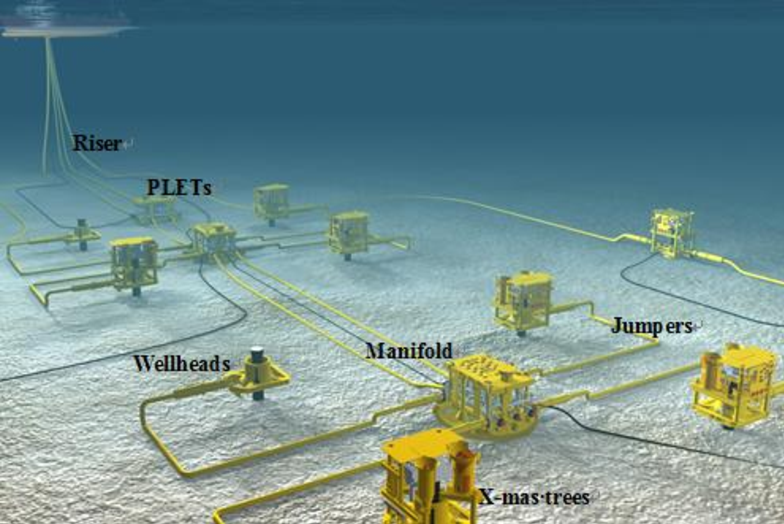
Source: Semantic Scholar – Subsea X-mas tree and system schematic.
4.Manifolds
Collect production from multiple wells or distribute injection fluids into a single header/flowline.
Jumpers and Tie-Ins
Short rigid/flexible pipes connecting trees → manifolds → flowlines/PLETs.
Flowlines, Pipelines, and Risers
Seabed transport lines and dynamic risers to surface hosts.
Umbilicals
Bundled power, hydraulics, chemicals, and communications lines.
Control Systems
Electro-hydraulic MUX or emerging all-electric; Subsea Control Modules (SCMs) manage operations remotely.
Subsea Processing
Boosting pumps, separators, compressors on the seabed for enhanced recovery.
H2 .Comprehensive Offshore Capabilities Diagram (shows subsea templates, manifolds, trees, processing, risers, and more in context)
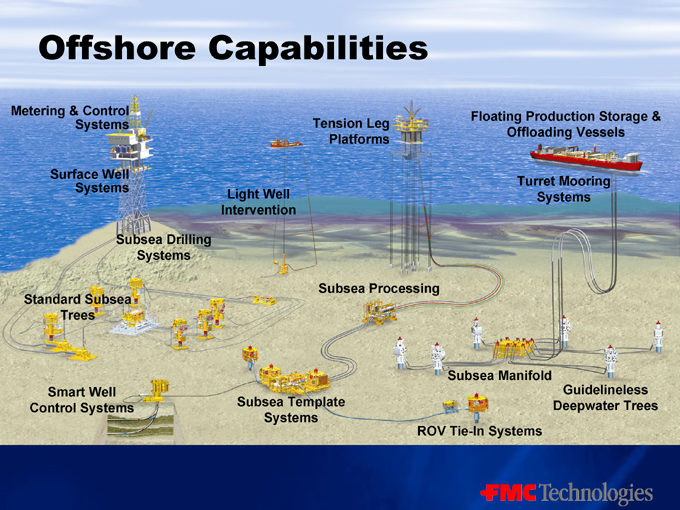
Source: Our World of Energy / FMC Technologies – Offshore Capabilities vignette.
Typical Architectures
- Clustered: Wells on template → manifold structure → flowlines → host.
- Satellite: Single well → direct tie-back.
- Full subsea-to-shore (e.g., some Norwegian fields).
Advantages vs. ChallengesAdvantages: Lower CAPEX in deepwater, faster tie-backs, better recovery via processing, reduced weather risks.
Challenges: High intervention costs (ROV/drillship), flow assurance (hydrates/wax), extreme HPHT/corrosion, and structural integrity demands.
2026 TrendsAs of March 04, 2026, focus is on standardization, modular structures for faster installs, digital twins for monitoring underwater structures, all-electric controls, greater subsea processing, and repurposing for CCUS/hydrogen in maturing basins (Gulf of Mexico, North Sea, Brazil Pre-Salt, West Africa).
Subsea especially robust underwater structures continues enabling global offshore success by combining engineering precision with field-proven durability.
For more on HPHT design, integrity of subsea structures, tie-backs, or career paths in subsea engineering, dive deeper at Offshore Pipeline Insight.